
Sunlight from a window may help regulate blood sugar in type 2 diabetes

Researchers noted a "significant" change when participants spend time in naturally-lit areas.
Canadians spend approximately 90 per cent of their days indoors, which leaves little time for exposure to natural daylight.
But soaking up some sun by sitting near a window could have big health benefits, especially for people with type 2 diabetes, according to a new joint study by European researchers.
Scientists exposed thirteen volunteers, who were over the age of 65 and had type 2 diabetes, to natural light and found it resulted in more stable blood glucose levels and an overall improvement in their metabolic profiles. The authors say their paper, which appears in the journal Cell Metabolism, provides the first evidence that natural light benefits people with this condition.
"It has been known for several years that the disruption of circadian rhythms plays a major role in the development of metabolic disorders that affect an increasing proportion of the Western population," study co-author Charna Dibner, an associate professor at the University of Geneva, says in a statement.
"We largely spend our days under artificial lighting, which has a lower light intensity and a narrower wavelength spectrum than natural light. Natural light is also more effective in synchronizing the biological clock with the environment. Could the lack of natural light be to blame for metabolic diseases such as type 2 diabetes?" adds Joris Hoeks, a corresponding author in the study and an associate professor at Maastricht University.
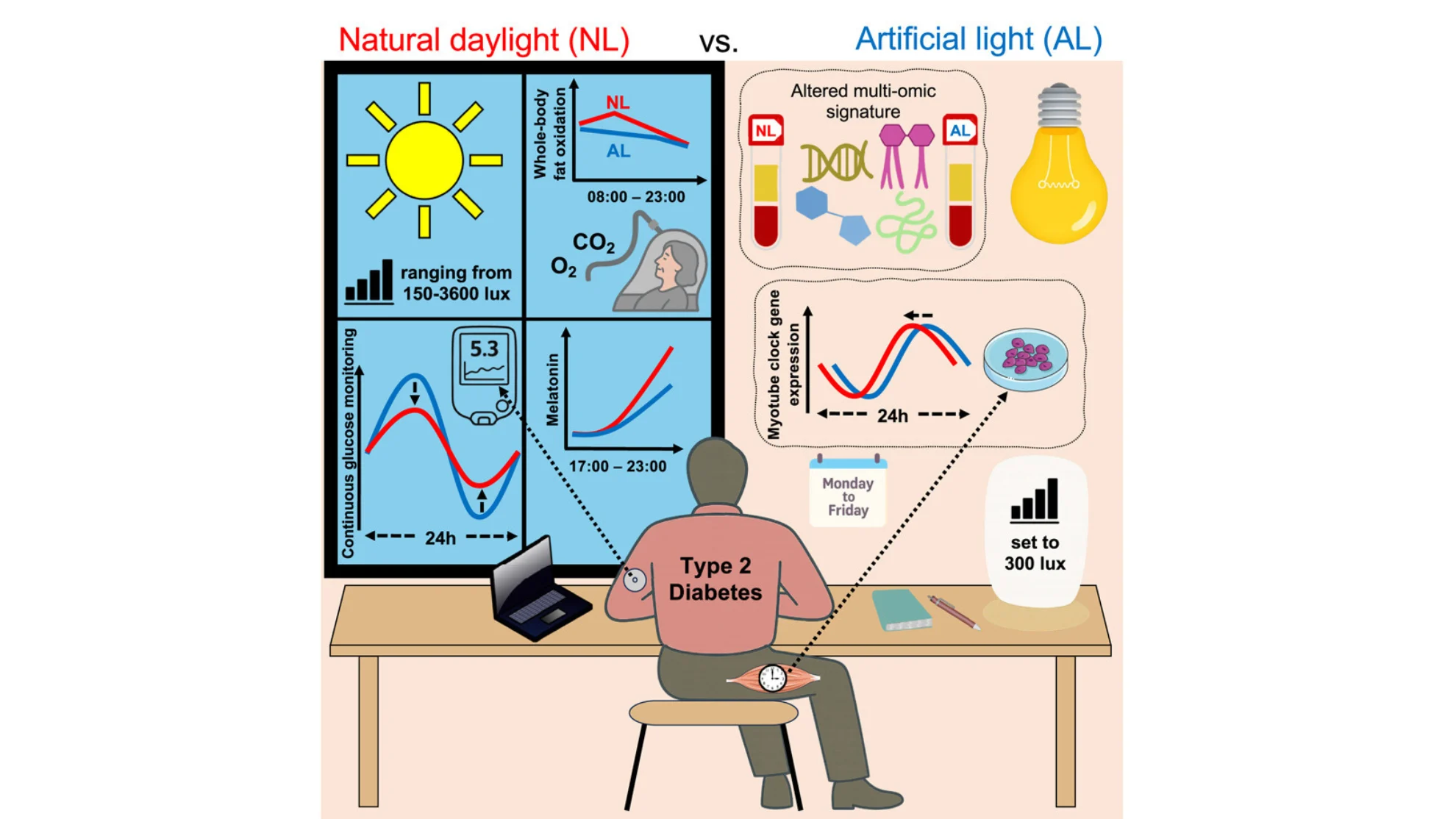
Researchers found blood glucose levels were in the normal range for more hours per day when particpants spent time in naturally-lit areas,(Harmsen, Jan-Frieder et al./Cell Metabolism, Volume 38, Issue 1, 65 - 81.e10)
The volunteers spent 4.5 days in specially-designed living spaces at Maastricht University. Some volunteers spent their time in an artificially-lit area, while others were assigned to a space that was naturally lit by large windows.
Participants then had a two-week break before returning and switching rooms.
"This experimental model allows us to examine the same people under both conditions, which limits the individual variability in our results," Hoeks says.
"Apart from the light source, all the other lifestyle parameters - meals, sleep, physical activity, screen time, etc. - were kept strictly identical."
Big changes in a short time
Despite the experiment being short, it was enough time for researchers to log a “significant” change. They found blood glucose levels were in the normal range for more hours per day when people spent time in naturally-lit areas, leading to less variability. They also noted their melatonin levels were higher and fat oxidative metabolism improved.
"We analysed the regulation of molecular clocks in cultured skeletal muscle cells together with lipids, metabolites, and gene transcripts in the blood,” Dibner says.
“Together, the results clearly show that the internal clock and metabolism are influenced by natural light. This could be the reason for the improved blood sugar regulation and the improved coordination between the central clock in the brain and the clocks in the organs."
Researchers say the next step is to confirm the findings in real-life conditions.
Header image: File photo via Canva Pro.