
Artemis 2 may launch Wednesday. Will the weather hold for this historic flight?

The launch window for the Artemis 2 mission opens Wednesday evening. Could the weather delay the liftoff?
The first people to journey to the Moon and back in over 50 years are about to blast off. Will the weather conditions along Florida's Space Coast cooperate?
At 6:24 p.m. EDT, on Wednesday, April 1, 2026, a two-hour window will open for the Artemis 2 mission to lift off from Kennedy Space Center in Florida. On board, four astronauts — Commander Reid Wiseman, Pilot Victor Glover, Mission Specialist Christina Koch, and Mission Specialist Jeremy Hansen — will be strapped in on the Orion capsule, no-doubt eagerly awaiting the start of their flight into space.
Artemis 2 is a test flight, following up on the uncrewed Artemis 1 mission that flew around the Moon and back in late 2022. Taking the same basic route, the Orion spacecraft will carry Wiseman, Glover, Koch, and Hansen on a roughly 10-day journey through space. They will first orbit Earth to test out some of the Orion systems, then fly out to the Moon, pass around the far side, and return to Earth.
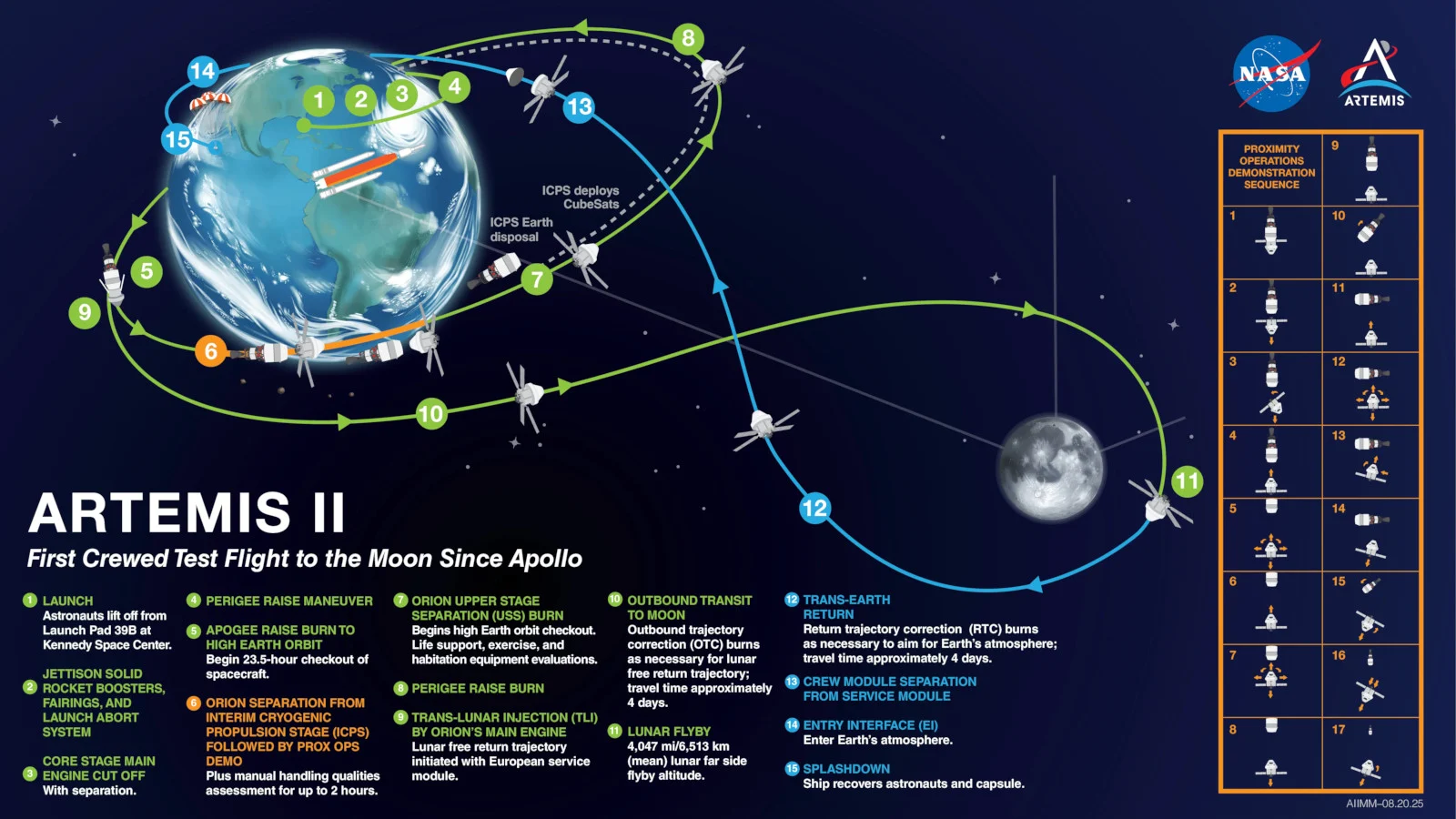
The Artemis 2 flight plan. (NASA)
On the trip, the four will not only be evaluating the performance of their spacecraft, they will also be demonstrating their own capabilities as they test crew response to radiation exposure, on-board fires, capsule depressurization, and medical emergencies.
Additionally, they will conduct medical and science experiments, and take detailed observations of the lunar surface during their flyby.

CSA astronauts Jeremy Hansen (left) and Jenni Gibbons (right) learn about the geology of impact craters from Professor Gordon Ozinski (centre), at the Kamestastin Lake Impact Structure in Labrador. (Canadian Space Agency)
Before they can do all of that, though, they must first contend with Florida's weather.
DON'T MISS: A Great Comet may shine along with meteor showers and bright planets this spring
Weather vs Rockets
Before any rocket blasts off from Kennedy Space Center, the mission control team must consult a list of Lightning Launch Commit Criteria. These are a set of atmospheric conditions near or above the launch site, which could result in lightning striking the rocket as it lifts off from the pad.
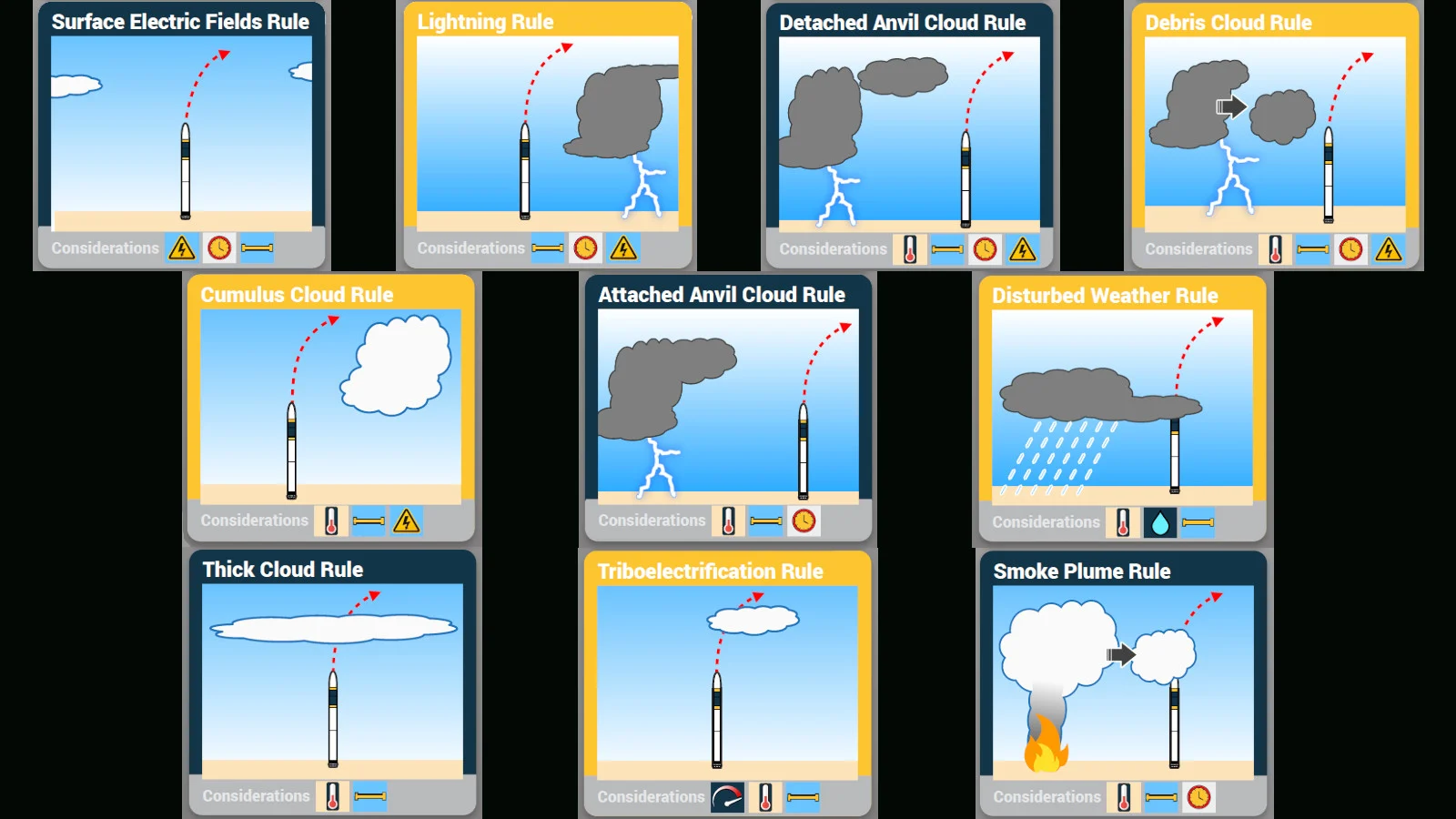
These graphics cover the lightning launch commit criteria used by NASA before any rocket launch. (NASA)
The most obvious is if there are any actual lightning or thunderstorms in the area. However, these rules go far beyond that, delving into anything that could cause the rocket itself to touch off a bolt of lightning — clouds or rainfall nearby, smoke plumes, and even heightened electric fields in the region.
If conditions in the area violate any of these criteria, the ground crew will halt the countdown clock. This could result in just a short delay, but if the conditions persist for too long, the launch will be scrubbed and rescheduled for a later date.

The Artemis 2 LLCC are listed here, atop a picture of the rocket and Orion spacecraft captured in front of the rising Full Moon on February 1, 2026. (NASA)
NASA has documented two lightning strikes during rocket launches — the Apollo 12 mission on November 14, 1969, and the Atlas/Centaur AC-67 satellite launch on March 26, 1987.
During Apollo 12's ascent, it was hit by two bolts of lightning, roughly 15 seconds apart. The skies around the launch site were overcast, with no thunderstorms indicated. However, the massive rocket passing through the clouds still generated enough static charge to trigger both lightning strikes.
These lightning bolts cause problems with the Apollo command modules instruments and readouts. It was only quick thinking on the part of a member of the ground crew, who had witnessed a similar situation during test procedures, that salvaged the mission and allowed the astronauts to continue their journey to the Moon.
READ MORE: What happened when two bolts of lightning struck Apollo 12
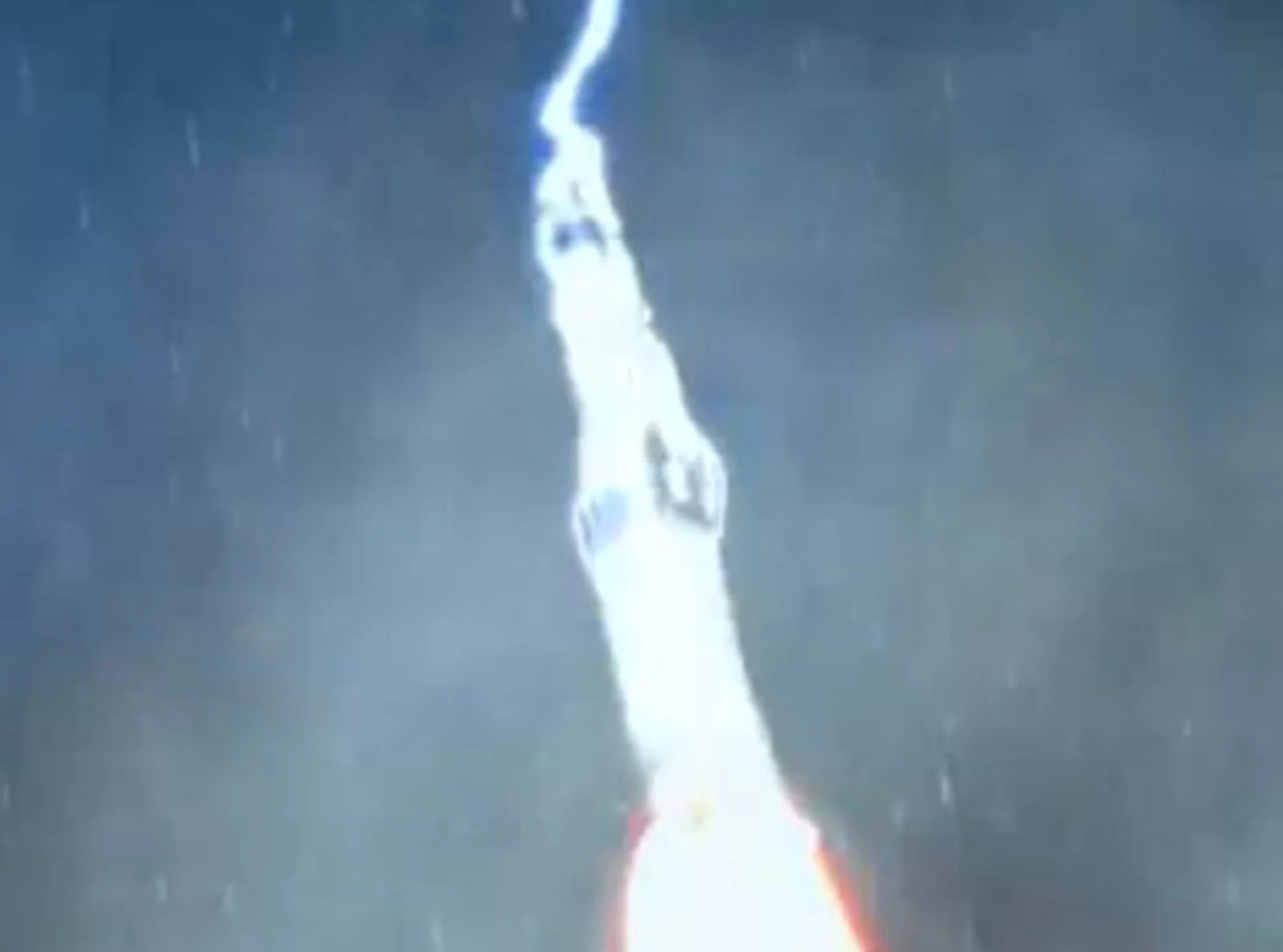
Cameras captured the Saturn V rocket, carrying the Apollo 12 mission into space, being struck by lightning just moments after liftoff on November 14, 1969. (NASA)
In the case of AC-67, though, the electrical current from the lightning strike disrupted the booster rocket's computer, resulting in a Guidance, Navigation, and Control failure that caused the rocket to break apart. Both the rocket and the communication satellite it was carrying were destroyed.
Rules were in place before Apollo 12 to avoid launching through cumulonimbus clouds. These rules were expanded afterwards, and became even more clear and concise after the AC-67 accident, with launch weather teams encouraged and required to speak up regarding any criteria that may not be met.
In addition to these lightning launch commit criteria, NASA also has rules based on if the air the rocket is flying through is too hot or too cold, if the winds at launch time are too strong, and even if space weather conditions (solar flares, solar radiation storms, or geomagnetic storms) will put spacecraft electronics at risk or interfere with communications between the spacecraft and ground control.
RELATED: With so many bright fireball meteors lately, what's going on?
Will the weather cooperate?
In their latest official assessment, the US Space Force's 45th Weather Squadron determined that there is an 80 per cent chance of favourable conditions for Wednesday's Artemis 2 liftoff.
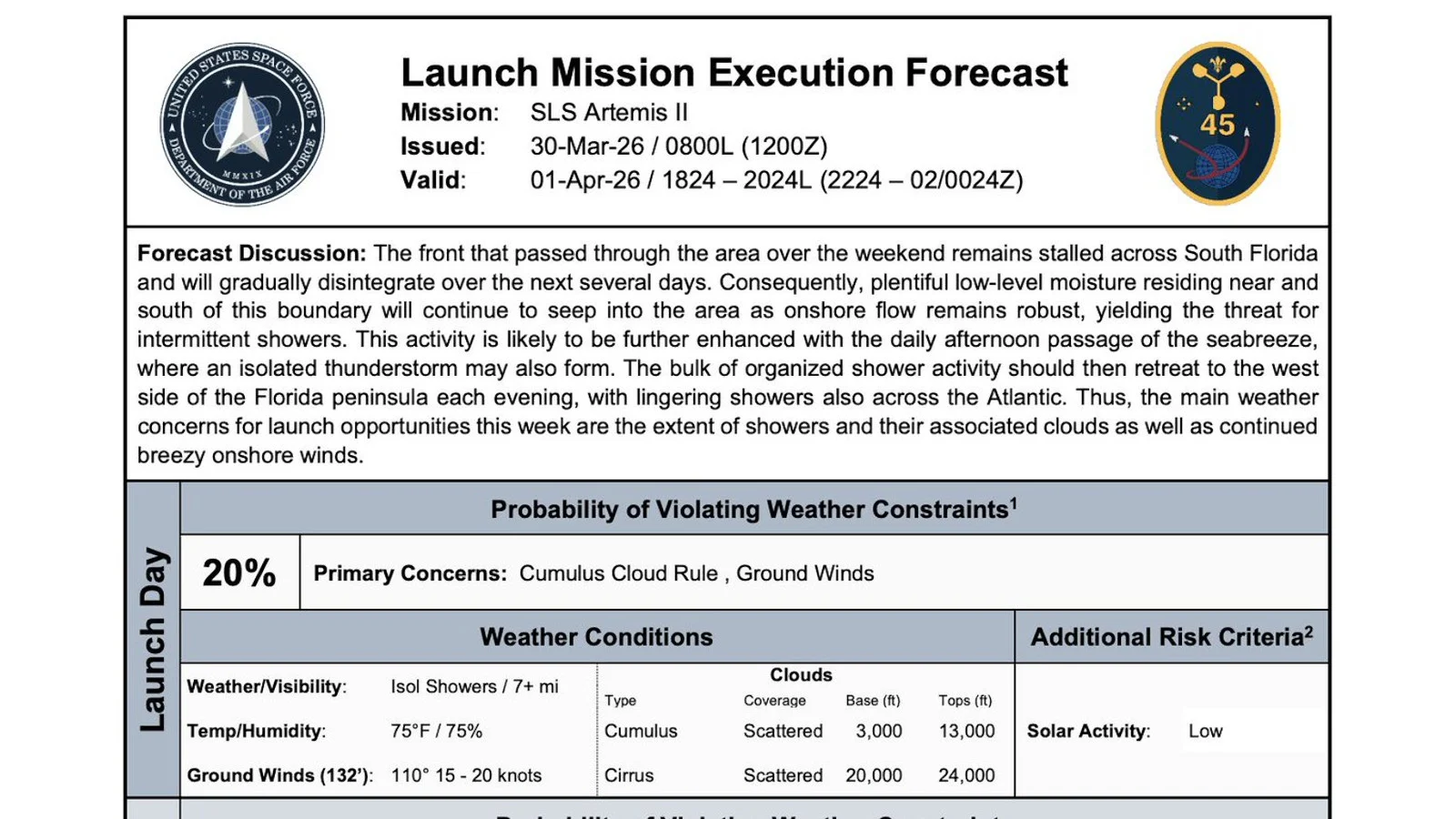
The Artemis 2 launch forecast, as of March 30, 2026. (US Space Force)
According to the forecasters, with a weather front stalled across southern Florida, there is some concern that intermittent showers will develop in the area, potentially becoming isolated thunderstorms due to enhancement by the afternoon passage of the sea breeze.
This makes possibly strong ground winds and nearby cumulus clouds the primary concerns. However, this is a very favourable forecast for the launch.
(Thumbnail image depicts the Moon rising the Artemis 2 Space Launch System rocket and Orion spacecraft, as they stand at Launch Complex 39B at NASA’s Kennedy Space Center in Florida on Sunday, Feb. 1,. 2026, as captured by NASA photographer Ben Smegelsky)