
Artemis 2 captures spectacular new Earthset from their trip around the Moon

The new images being posted from the Artemis 2 mission are spectacular!
The Artemis 2 crew just sent back a new image from space that will join Apollo 8's Earthrise as one of the most iconic pictures from human space exploration.
On Christmas Eve, 1968, during a live broadcast from the first crewed mission to the Moon, Apollo 8, Frank Borman, Jim Lovell, and William Anders showed the world pictures they took of the Moon and Earth.
Among those images was this one, which they snapped just after emerging from around the far side of the Moon.
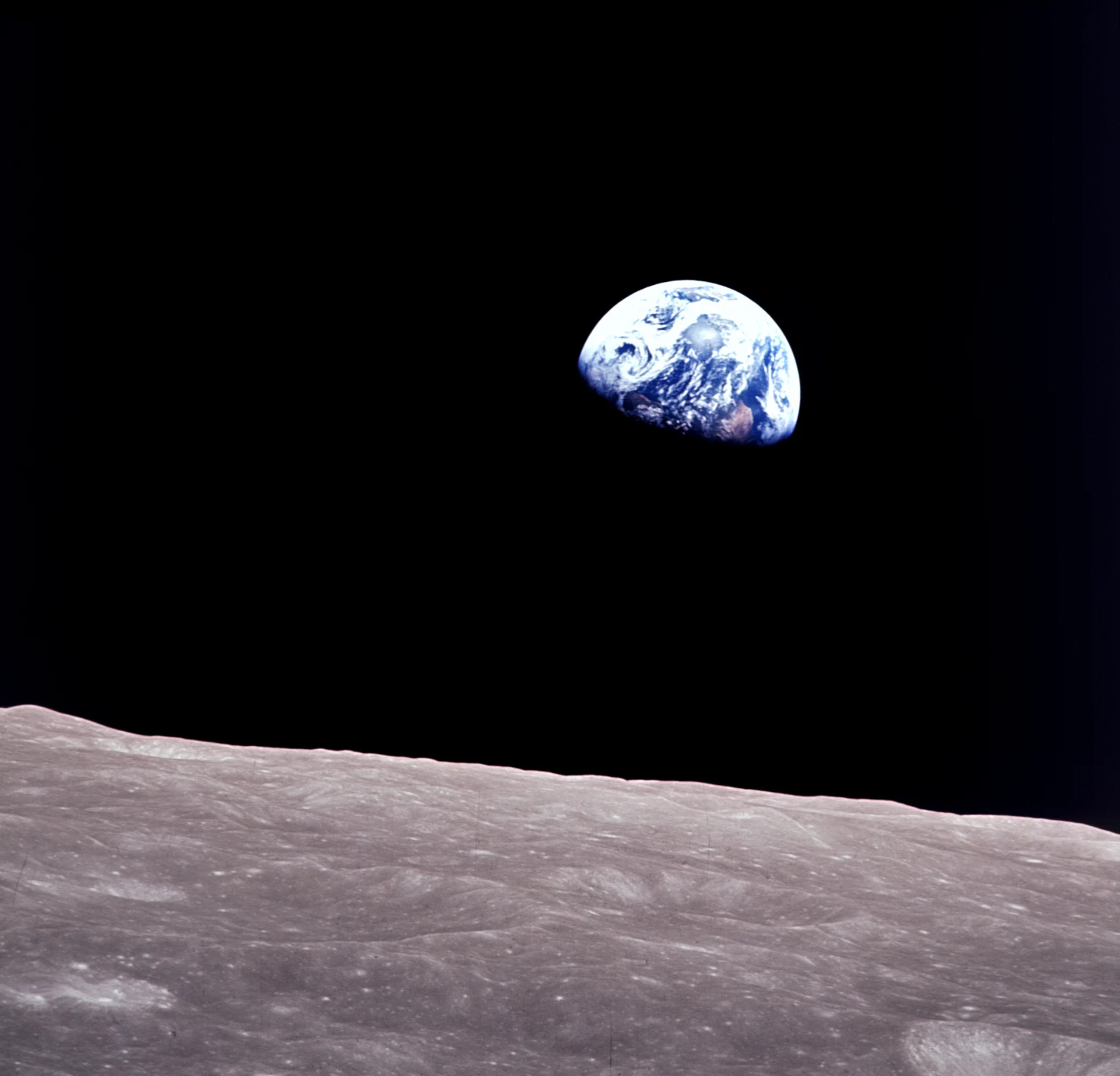
Earthrise, from December 1968. (NASA)
It went on to be named Earthrise.
Now, nearly 58 years later, the Artemis 2 crew captured something to rival that iconic spaceflight image.
This is Earthset.

(NASA)
READ MORE: Four astronauts made history as they flew around the Moon on Monday!
Taken at 6:41 p.m. EDT, April 6, 2026, this picture shows the Earth just above the limb of the Moon. However, it was caught just before the Earth set, as the spacecraft was about to swing around the far side of the Moon and enter communications blackout for roughly 45 minutes.
During the Apollo 8 mission, the Earth was in a 'waxing gibbous' phase when viewed from the Moon, with a little more half of its right side illuminated by the Sun. This time, just days after a Full Moon, with the Moon in its gibbous phase, the Earth appears as a thin crescent. This is because at any specific time the Earth and Moon always have opposite phases, when viewed from the other object.
When the crew emerged from their comms blackout, they also snapped a picture of their new, Artemis-era Earthrise.

Artemis Era Earthrise. Both Earth and the Moon are oriented with their north poles to the left and south poles to the right. (NASA)
DON'T MISS: 'He gave her the Moon': Artemis 2 crew names crater after commander's late wife
While the Earthset image featured roughly matching crescents of the Moon and Earth, from their perspective, this new Earthrise is very different.
"The planet's soft blue hue and scattered white cloud systems stand out against the blackness of space, while the lower portion fades into night," NASA wrote. "Taken with a 400 mm lens, the image, Earthrise, reveals a striking alignment of Earth and Moon, with the Moon in the top foreground and the Earth below."