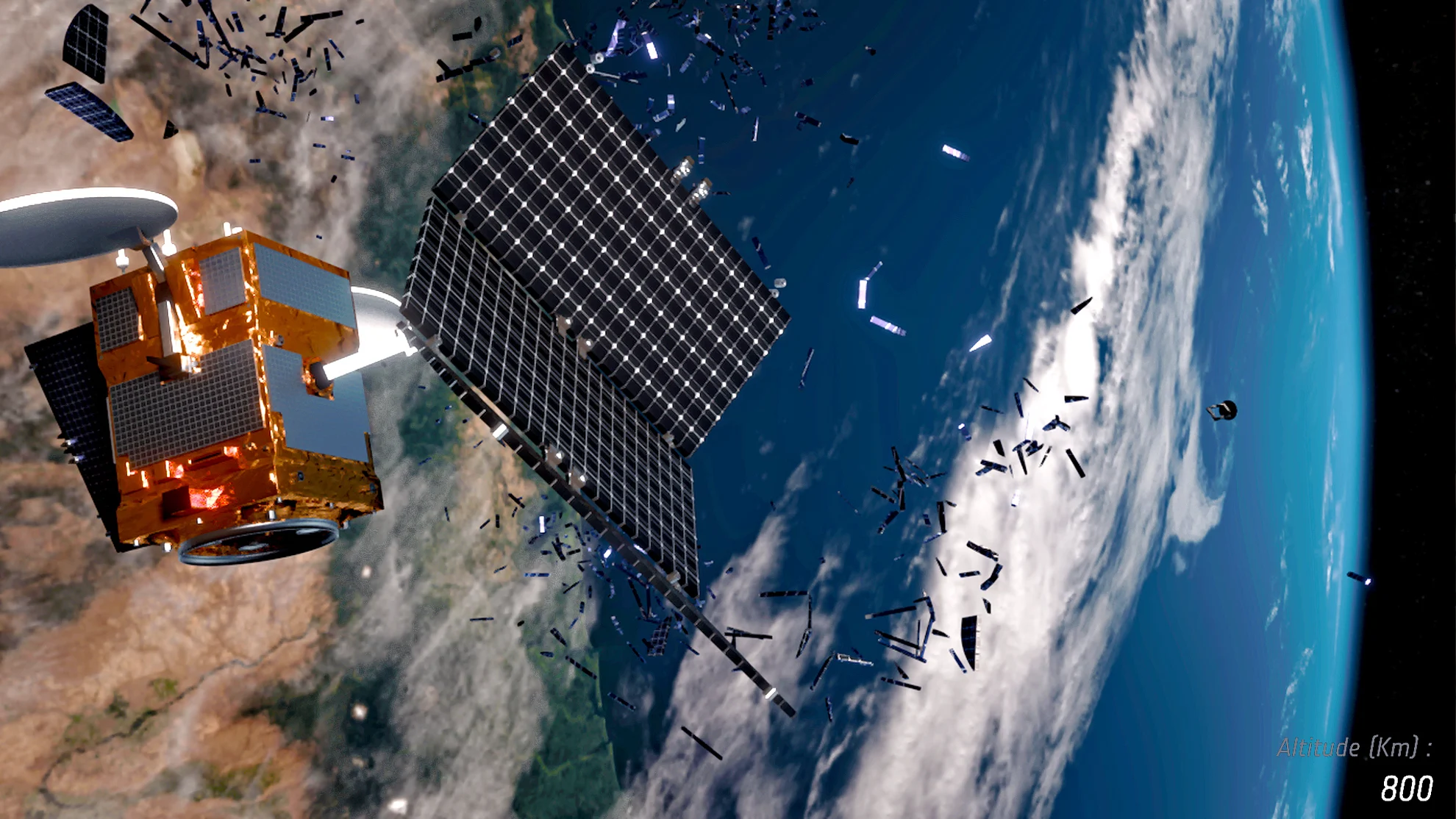
CRASH Clock: A satellite collision in low-Earth orbit could be just days away

Extreme solar activity or even a software glitch could put us just days away from a satellite collision in low-Earth orbit.
As low-Earth orbit becomes more crowded, the risk of orbital collisions is on the rise, especially when those satellites lose the ability to avoid each other, or manoeuvre out of the path of space junk. The CRASH Clock, a new tracker developed by Canadian researchers, shows that we are fast approaching the 'danger zone' for these types of collisions in space.
In the 2013 film, Gravity, Dr. Ryan Stone, played by Sandra Bullock, sometimes literally claws her way through a nightmare scenario in space: an anti-satellite missile test produces an expanding cloud of debris sweeping around the planet, impacting more satellites, resulting in even more high-velocity debris, in a runaway chain reaction of cascading collisions. The end result of this is the complete collapse of low-Earth orbit, apparently claiming all satellites, spacecraft, and space stations in less than a day.
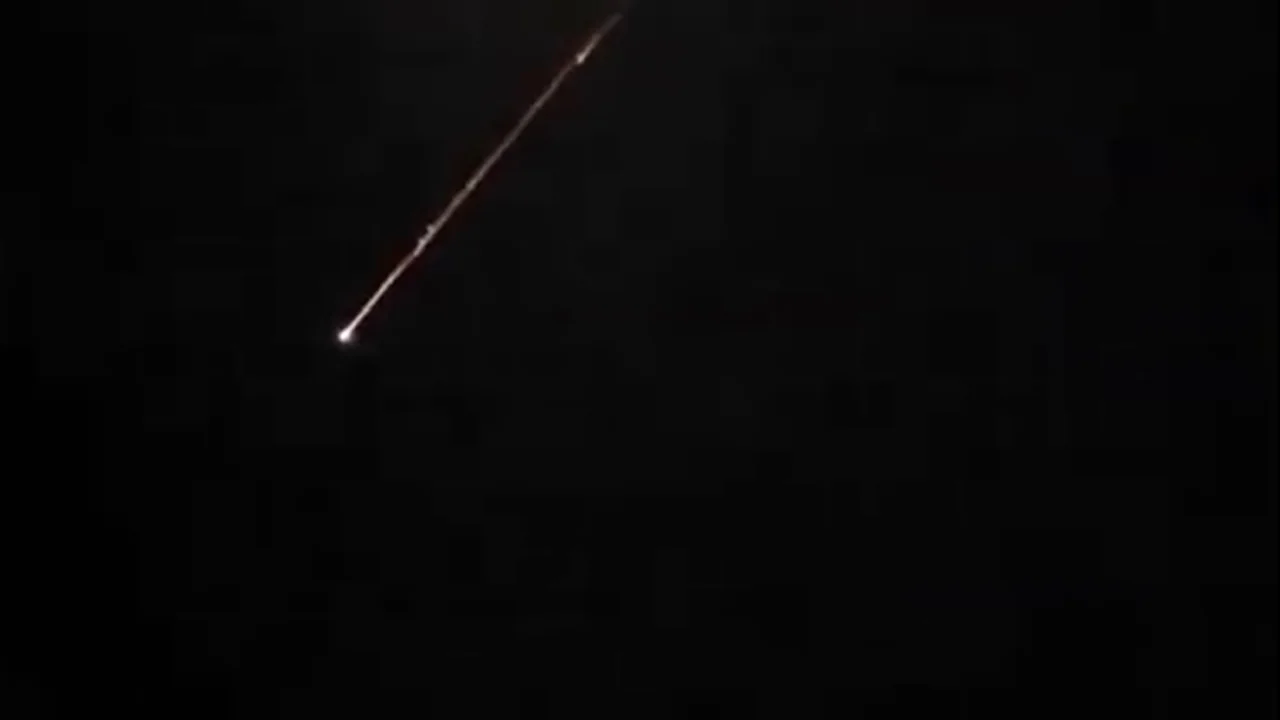
The Russian Kosmos 2551 satellite burns up during reentry over Michigan on October 29, 2021. (Brian Stalsonburg/AMS)
The movie was a work of fiction, of course, which ramped up the events to an extreme for the sake of drama. Even so, the scenario it depicts is one that real-world scientists have already studied.
Kessler syndrome was first described in 1978, as the point where low-Earth orbit (LEO) becomes so crowded that any significant collision would cause a cascade effect. Collision after collision would result in space debris growing exponentially.
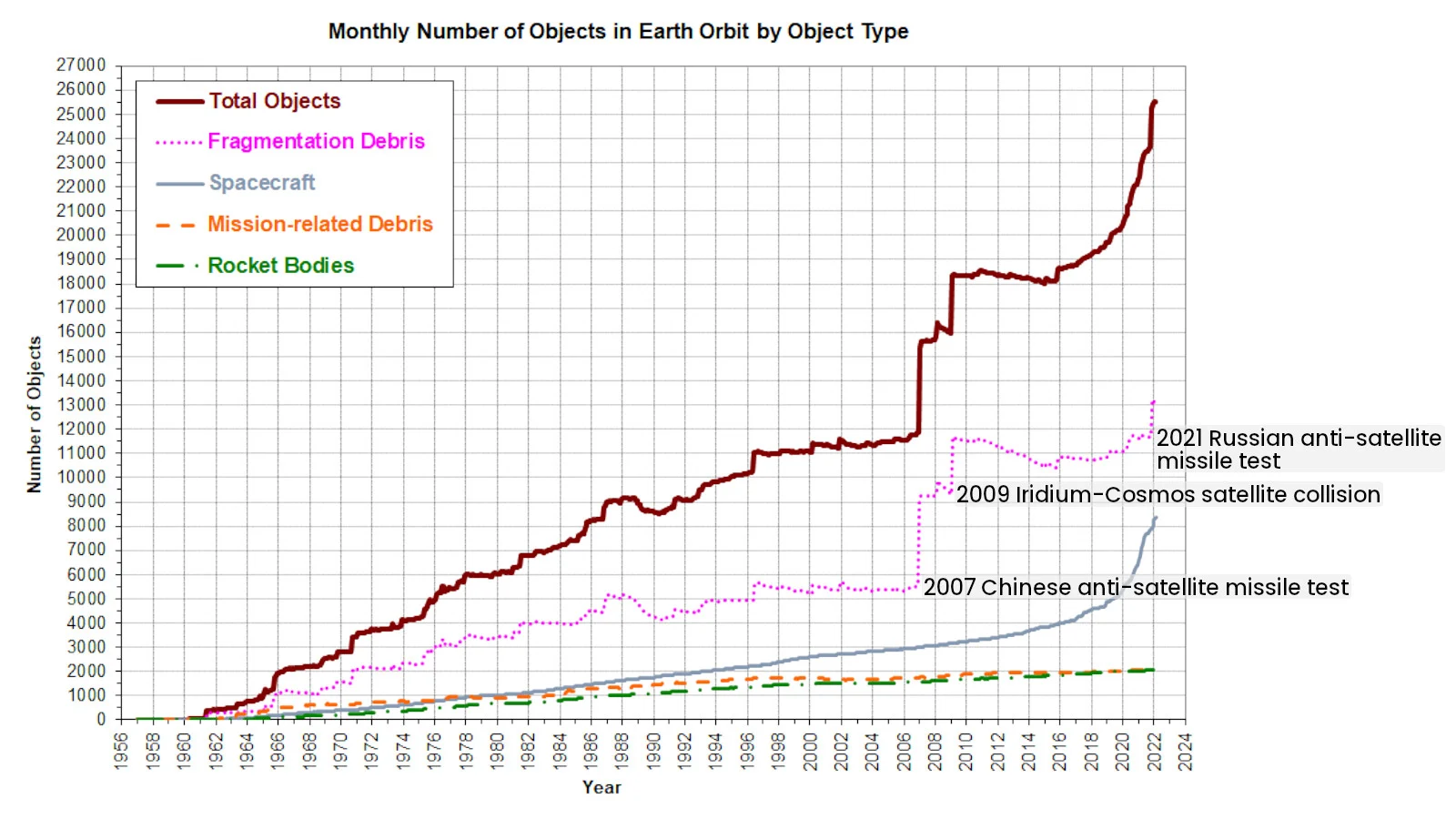
A graph of objects in orbit over time shows the steady increase of rocket bodies and spacecraft, while debris has remained the greatest population of objects, especially due to China's 2007 anti-satellite test, the 2009 Iridium-Cosmos collision, and Russia's 2021 anti-satellite test. (NASA Orbital Debris Program Office)
Although it would take a lot longer than it did in the plot of Gravity, the final impacts in the real world would be very similar. Beyond the loss of many, if not all, satellites and spacecraft in LEO, entire regions of Earth orbit could become so choked with debris that they would be unusable for future space missions. It's even possible that the amount of debris could physically prevent us from safely launching any further satellites or spacecraft, for years or even decades to come.
We are still quite a ways off from this scenario. This is largely due to the ongoing efforts of ground controllers, as they identify potential close encounters and program in collision avoidance manoeuvres to keep spacecraft safe.
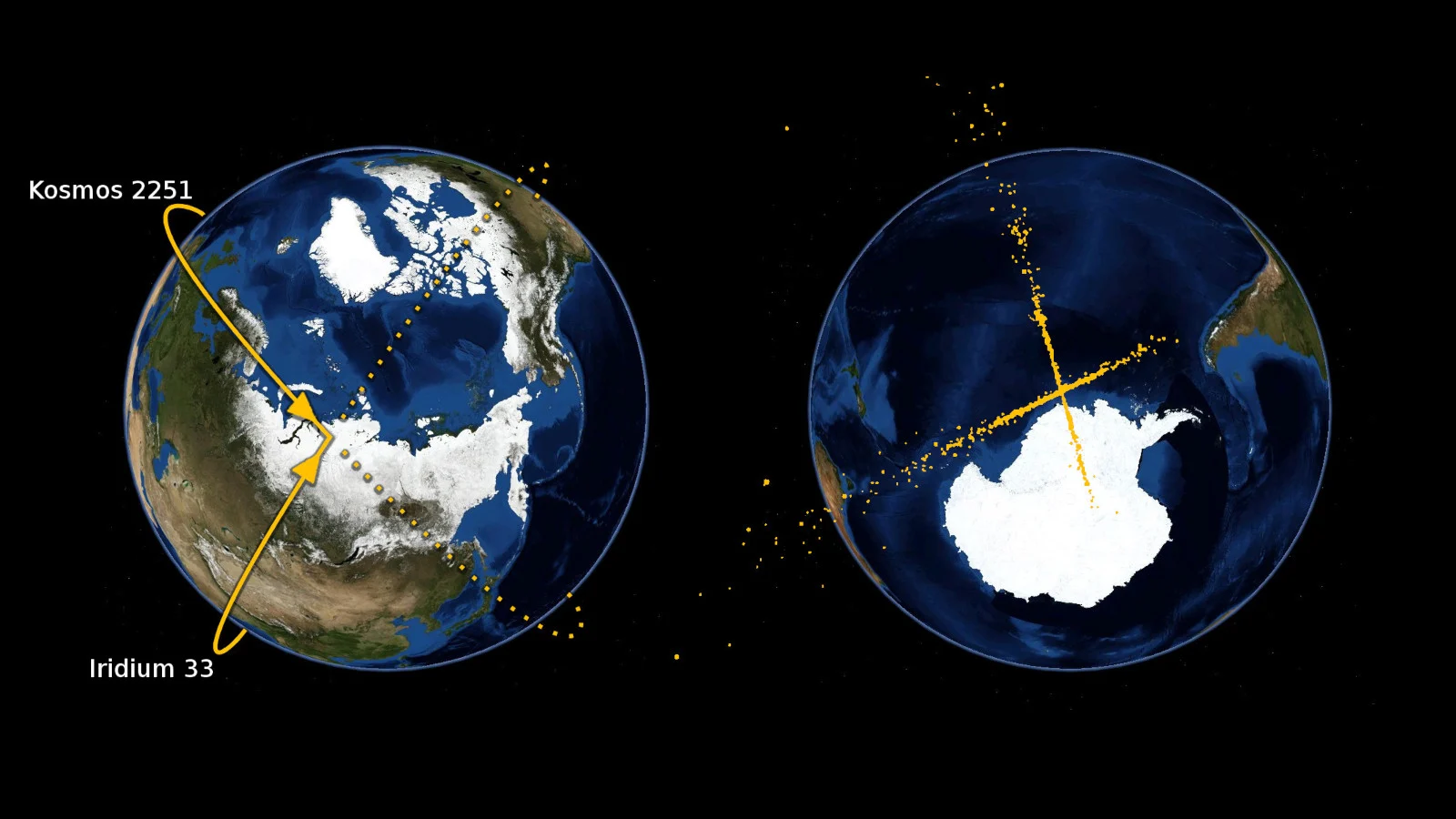
The collision of the Iridium 33 and Kosmos 2251 satellites, on February 10, 2009, is depicted in these two images, with the trajectory of each prior to collision (left), and a simulation of the resulting debris less than an hour later (right). It is a perfect example of the damage that can occur without collision avoidance manoeuvres. (Rlandmann/Wikimedia Commons (CC BY-SA 3.0))
Related: Eyes to the sky in February to spot a new Six Planet Parade
According to the United Nations Office for Outer Space Affairs and the European Space Agency, each of the ESA's orbiting spacecraft must perform three or four avoidance manoeuvres every year to avoid debris or other satellites.
Since its launch in 1998, the International Space Station has performed 40 of these manoeuvres. The most recent was on April 30, 2025, when it avoided a Long March rocket fragment that was launched by China in 2005. According to NASA, without the manoeuvre, the object would have come to within 650 metres of the station. While that would not have resulted in a direct impact, there may have been any number of smaller objects, too small to detect from the ground, travelling with the rocket fragment. Any of those could have struck the orbiting lab, damaging components and potentially endangering the crew.
What would happen, though, if collision avoidance manoeuvres became more difficult, or even impossible? How long would it take before two objects collided?
These were the exact questions asked by four researchers — Sarah Thiele from Princeton University, Skye Heiland and Dr. Aaron Boley from the University of British Columbia, and Dr. Samantha Lawler from Campion College at the University of Regina.
Their new study, titled An Orbital House of Cards: Frequent Megaconstellation Close Conjunctions, currently up on the pre-print server arXiv, is an attempt to answer this question.
To begin, the team examined the catalogue of all known 'resident space objects' (RSOs). This includes both active and derelict satellites, rocket bodies that continue to orbit up to years after delivering their payloads, and all other known pieces of debris.
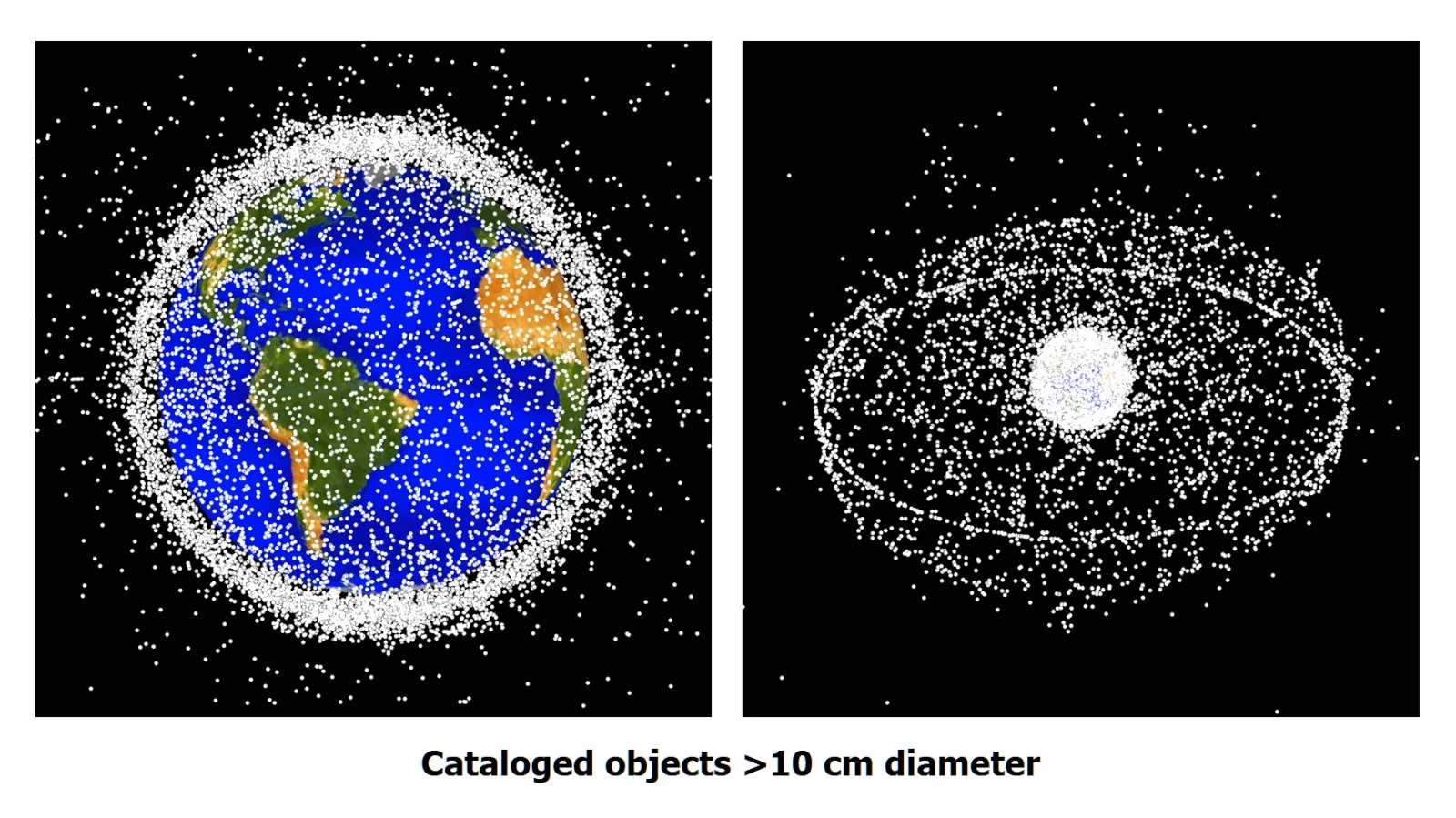
The known catalogue of space debris as of 2019, for low-Earth orbit (left) and out to geostationary orbit (right). The white dots are not shown to scale, but still demonstrate that Earth orbit is extremely crowded. (NASA)
Taking into account all the different altitudes (or 'shells') of orbiting objects, as well as their relative sizes (or 'collision cross section'), they then calculated the odds of two objects crashing into one another for each shell. Adding up all the rates for all the shells across low-Earth orbit gave them a total estimated time to impact, should we lose all ability to coordinate satellite avoidance manoeuvres.
This final value, measured in days, became the Collision Realization And Significant Harm Clock, aka the CRASH Clock, which can be found on the website of the Outer Space Institute.
According to the paper, based on the population of RSOs as of January 1, 2018, the CRASH Clock value would have been 164 days. In contrast, the Clock value as of June 25, 2025 was down to just 5.5 days, and the latest update, on January 26, 2026, now has it set at only 3.8 days.
Therefore, if we were to experience any kind of outage that prevented operators from relaying instructions to orbiting satellites, we would have less than four days to recover before the first collision would likely occur.
DON'T MISS: Asteroid impact with Moon would produce visible flash, followed by meteor storms
Outages can happen due to a variety of reasons. A software glitch could knock out a satellite's ability to manoeuvre, or an entire constellation could suffer the same problem if it were due to a scheduled update from the ground. Powerful X-class solar flares cause radio blackouts that last up to several hours at a time. Solar radiation storms have the potential to completely disable satellites and spacecraft, due to high-energy protons damaging their electrical systems or computer components. Strong geomagnetic storms can also impact satellite communications, and can last for much longer than the effects of a solar flare.
It doesn't even need to be an outage. One of the 'side effects' of a geomagnetic storm is that they heat the upper atmosphere, causing the outer layers to puff up. When this occurs, satellites in low-Earth orbit experience increased drag, which slows them down and causes them to lose altitude.

Auroras visible from Collingwood, ON, on the night of May 10, 2024, were the result of an intense geomagnetic storm. (UGC/Angie Gibson)
This introduces a level of uncertainty into satellite positions in space, with the amount of uncertainty growing with the strength of the solar storm.
"During a Carrington-level solar storm, the uncertainties in your satellite positions become so large that predicting collision risks, and thus doing collision avoidance manoeuvres, become extremely difficult," Thiele, the lead author of the study, said in an email to The Weather Network.
In that situation, intervening to order an orbital correction manoeuvre could be more disastrous than just leaving the satellite alone.
The Carrington Event is an infamous 1859 solar storm that caused nearly worldwide auroras, as well as severe electrical disturbances along the limited telegraph networks in operation at the time. If a similar solar storm were to happen now, the effects on the world's power grids, as well as satellites and spacecraft in orbit, could be catastrophic.
"A Carrington-level event will happen again, it is just a question of when and how prepared we are for it when it comes," Thiele explained.
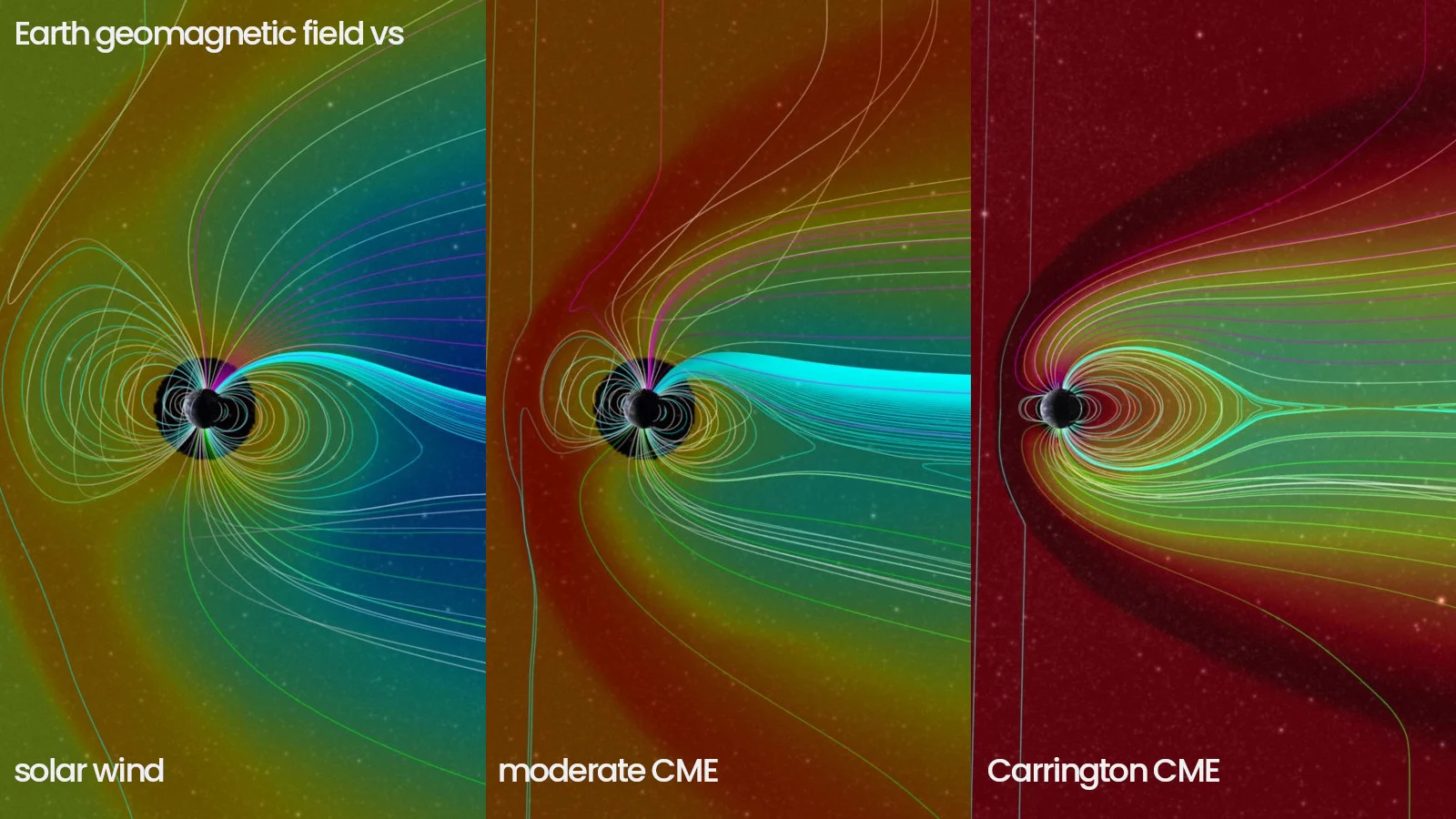
A simulated comparison between the normal solar wind (left), a common solar storm (centre), and a Carrington-level solar storm (right), show the relative impacts on Earth's geomagnetic field. (NASA's Scientific Visualization Studio)
"In general, the likelihood of the mass loss of control of satellites is very unlikely," Thiele assured. "The CRASH Clock is intended to be used as an indicator for how reliant we are on operations in orbit being executed without error, and how much stress we are placing on the orbital environment."
However, with more satellites being launched every year, and especially giant satellite constellations like Starlink, it may not take much more to push the CRASH Clock into the Danger Zone.
The Danger Zone of the CRASH Clock is defined as a value less than 1.4 days. That is when there would be a roughly 50 per cent chance of a collision in the first 24 hours after orbital manoeuvres cease. At that point, it becomes much more likely that the effects of a power blackout or extreme geomagnetic storm could linger long enough to make collision avoidance impossible.
"We aren't able to give an exact point at which the CRASH Clock will tip into the Danger Zone," Thiele said. "What we can say is that orbit is evolving rapidly, and the CRASH Clock is going in the less favorable direction."
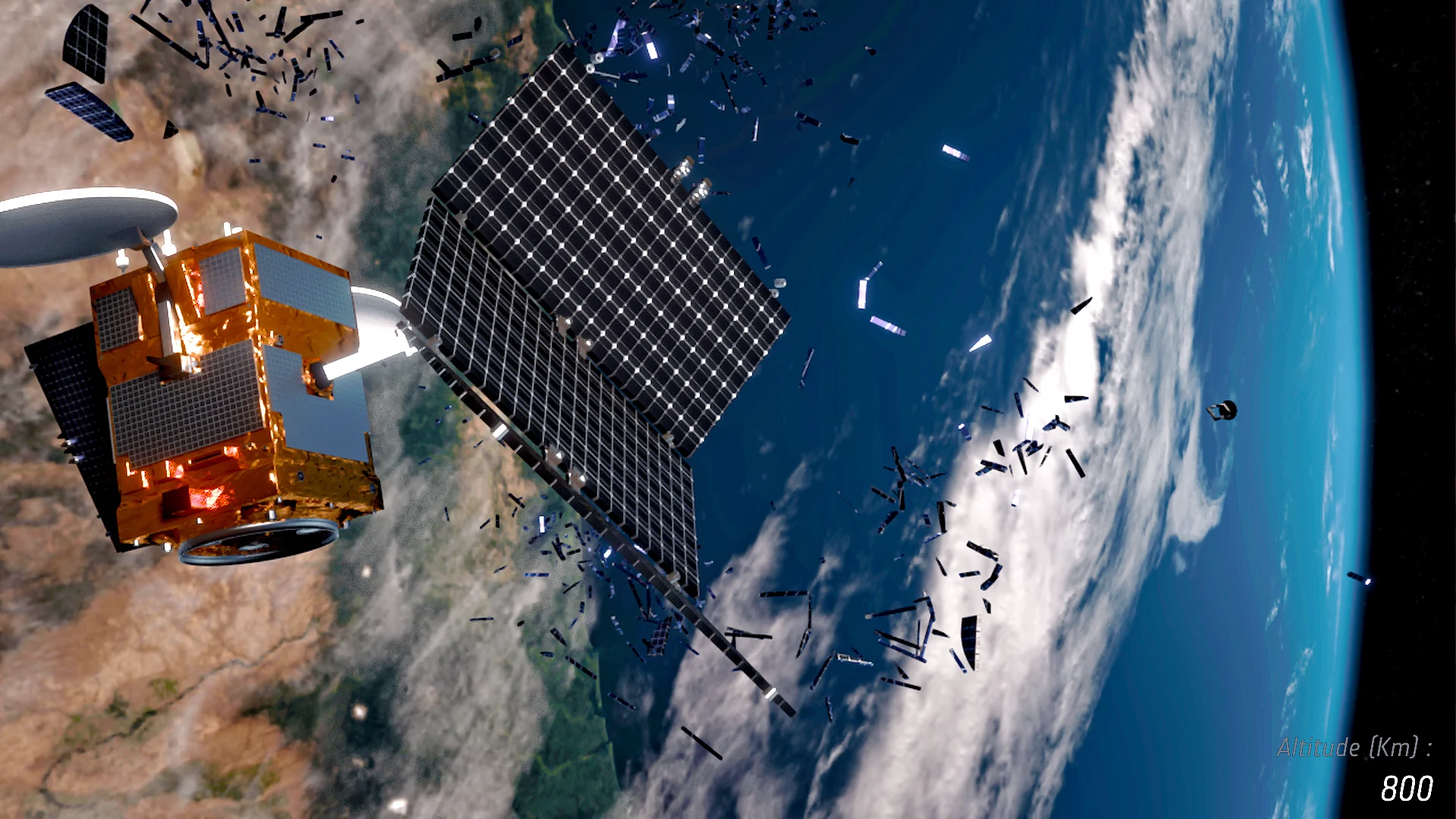
An illustration of a debris-forming satellite collision in low-Earth orbit. (ESA/ID&Sense/ONiRiXEL)
Mark your calendars: The Blood Worm Moon will soon shine across Canada
So what can be done to improve the situation, even as the number of satellites increases in the years to come?
"The main determinants of the CRASH Clock value are the number density of objects on orbit, and the collisional area," Thiele explained. "So to improve it, you can reduce the number of objects you are placing into a given altitude shell, and you can make your objects smaller."
According to Thiele, better coordination between satellite operators can also help, such as the sharing of satellite tracking data and manoeuvre plans. Also, the proper disposal of satellites at the end of their mission (through planned de-orbiting), as well as efforts to minimize the amount of debris generated by mission launches, can go a long way towards putting less stress on the satellite environment.
(Thumbnail image is an illustration depicting the aftermath of a satellite collision in space, courtesy the ESA/ID&Sense/ONiRiXEL (CC BY-SA 3.0 IGO))