
Eyes to the sky in February to spot a new Six Planet Parade

Another six planet parade becomes visible this month. Don't miss out!
With the Full Snow Moon kicking off the month, February's darkening nights will be great for stargazing, and spotting the new 'six planet parade' stretching across the evening sky.
Check your weather forecasts throughout the month, as any clear night will be a great opportunity to get outside and take in the wonders of the universe.
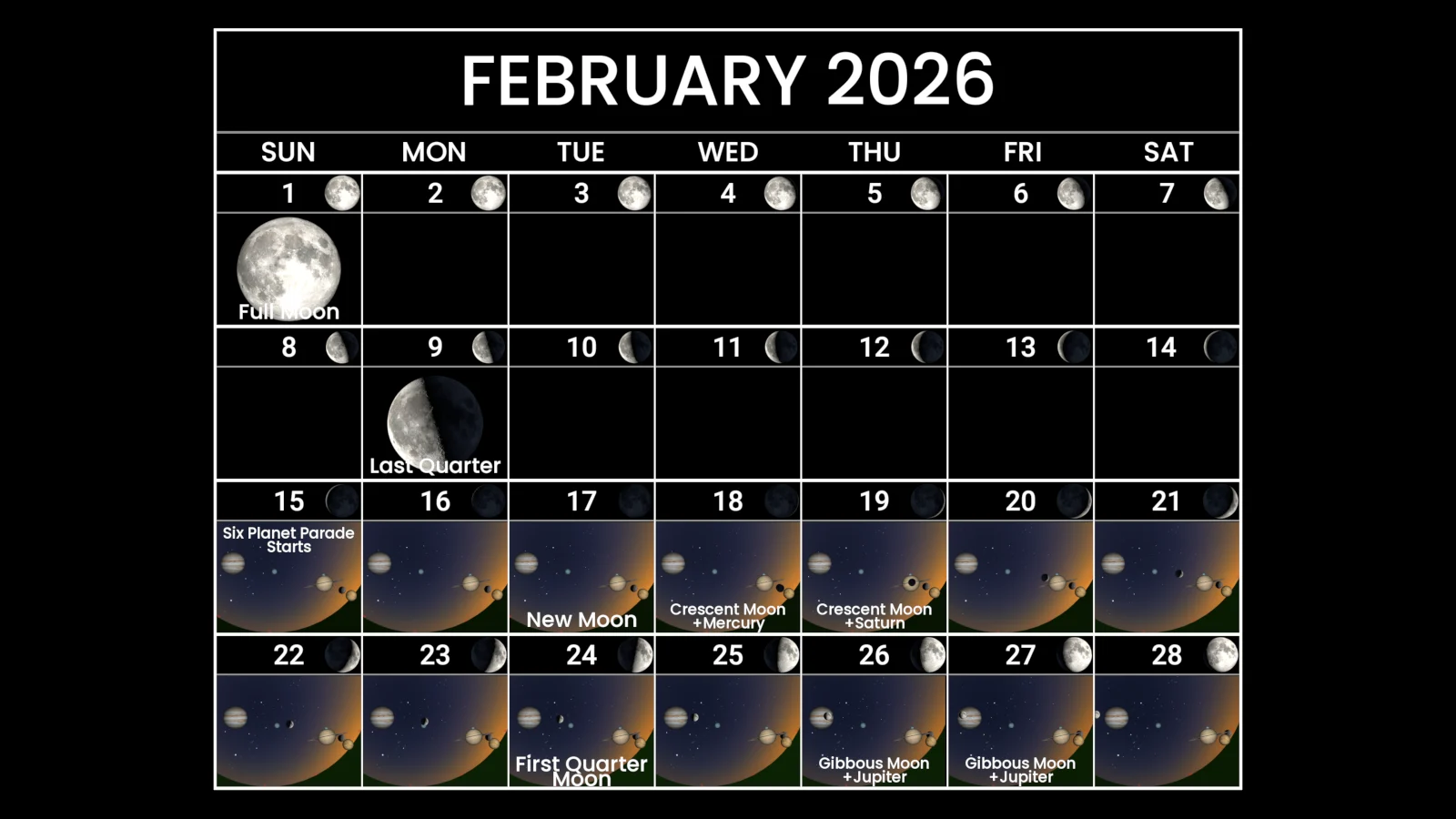
The astronomical events of February 2026, in calendar format. To the top right of each panel of the calendar is the phase of the Moon for that day. Major lunar phases (Full, Last Quarter, New, First Quarter) are shown with a large image of the Moon, except when there is an exceptional event occurring on that date. The positions of the planets in the new "planet parade" are shown for the latter half of the month (the size of the planets in each is exaggerated for display). (Scott Sutherland/NASA SVS/Stellarium)
The Moon
On the very first night, the Full Snow Moon will light up the sky. This is the first 'normal' sized Full Moon, following a string of four supermoons that started in October. That is unlikely to diminish its grandeur, though, especially if we take advantage of the mysterious "Moon Illusion" in the evening or just before dawn.
Following that, from the 2nd to the 8th, the Waning Gibbous Moon will shine, with the Last Quarter Moon on the night of the 9th. A Waning Crescent Moon will be in the sky on the nights after, getting thinner and thinner, and rising closer and closer to dawn, up until the 16th.
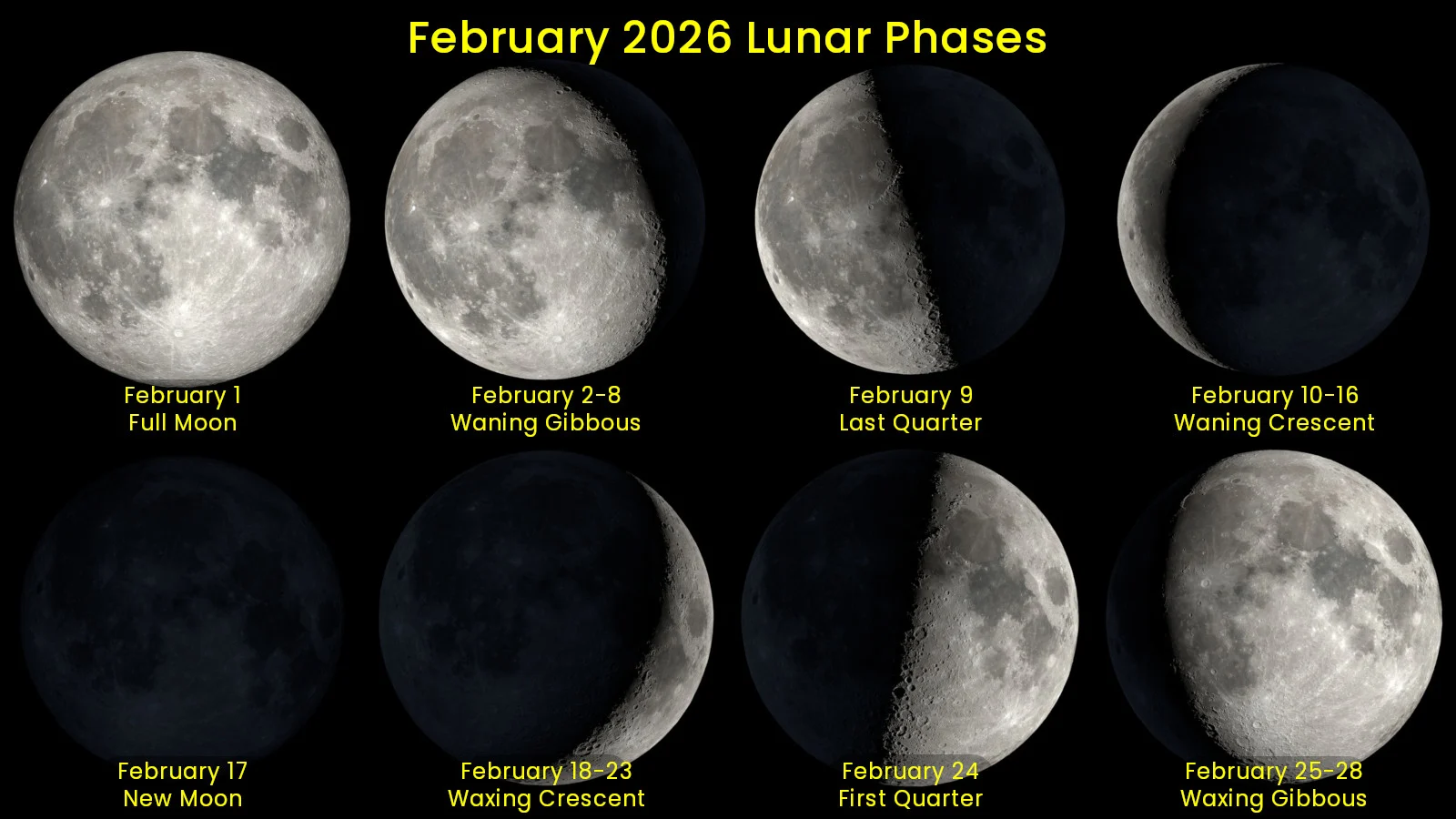
The phases of the Moon for February 2026, with each image produced with data from NASA's Lunar Reconnaissance Orbiter. (NASA's Scientific Visualization Studio/Scott Sutherland)
The New Moon occurs on the 17th, which makes the night around that date the best for stargazing, as they will be the darkest of the month.
Following the New Moon, we will see the Waxing Crescent Moon in our evening skies from the 18th through the 23rd. During that time, the Moon will be very close to the planet Mercury on the night of the 18th, and near Saturn on the 19th.
The First Quarter Moon happens on the 24th, with the Waxing Gibbous Moon in the sky for the last four nights of the month. On these nights, the Moon will be close to Jupiter in the southern sky.
DON'T MISS: Why does the Moon look so big? What is the mysterious Moon Illusion?
Annular Solar Eclipse
On, Feburary 17, the day of the New Moon, the Earth, Moon, and Sun will perfectly align to cast the Moon's shadow across the face of our planet.
Unfortunately, the alignment is not perfect enough, as the majority of us will miss out on directly seeing the Annular "Ring of Fire" Solar Eclipse that results from it.
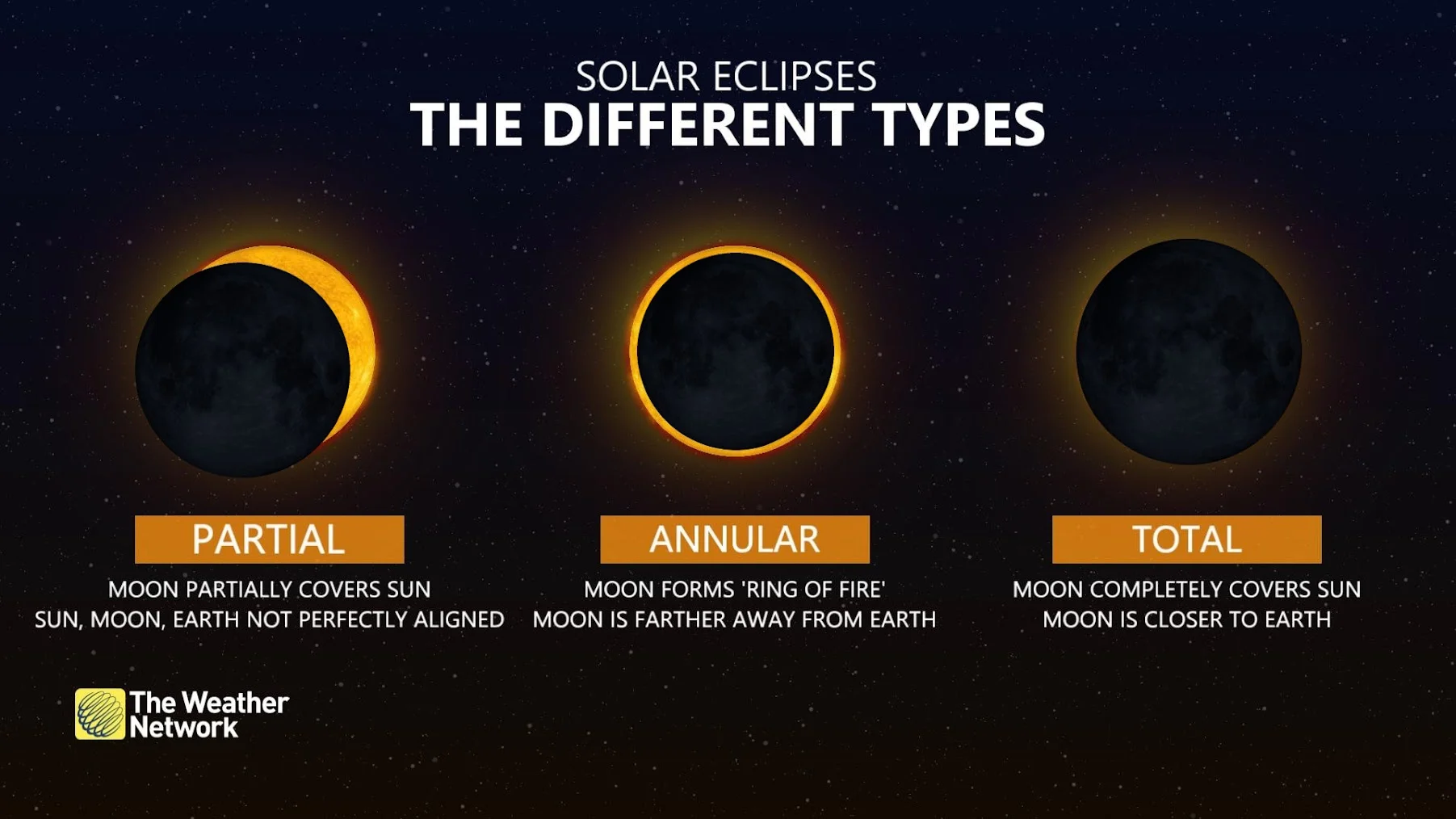
There's only one community on Earth in the direct path of the Moon's shadow on that day — Concordia Station, the joint French-Italian scientific research station located on the Antarctic Plateau.
Given clear weather, those stationed there will see the Moon partly blot out the Sun for a period of nearly two hours — slowly covering more and more for about an hour, then blocking the centre 92.5 per cent of the Sun's disk for just shy of two minutes, followed by another hour of the Moon slowly revealing more of the Sun, until the eclipse ends.
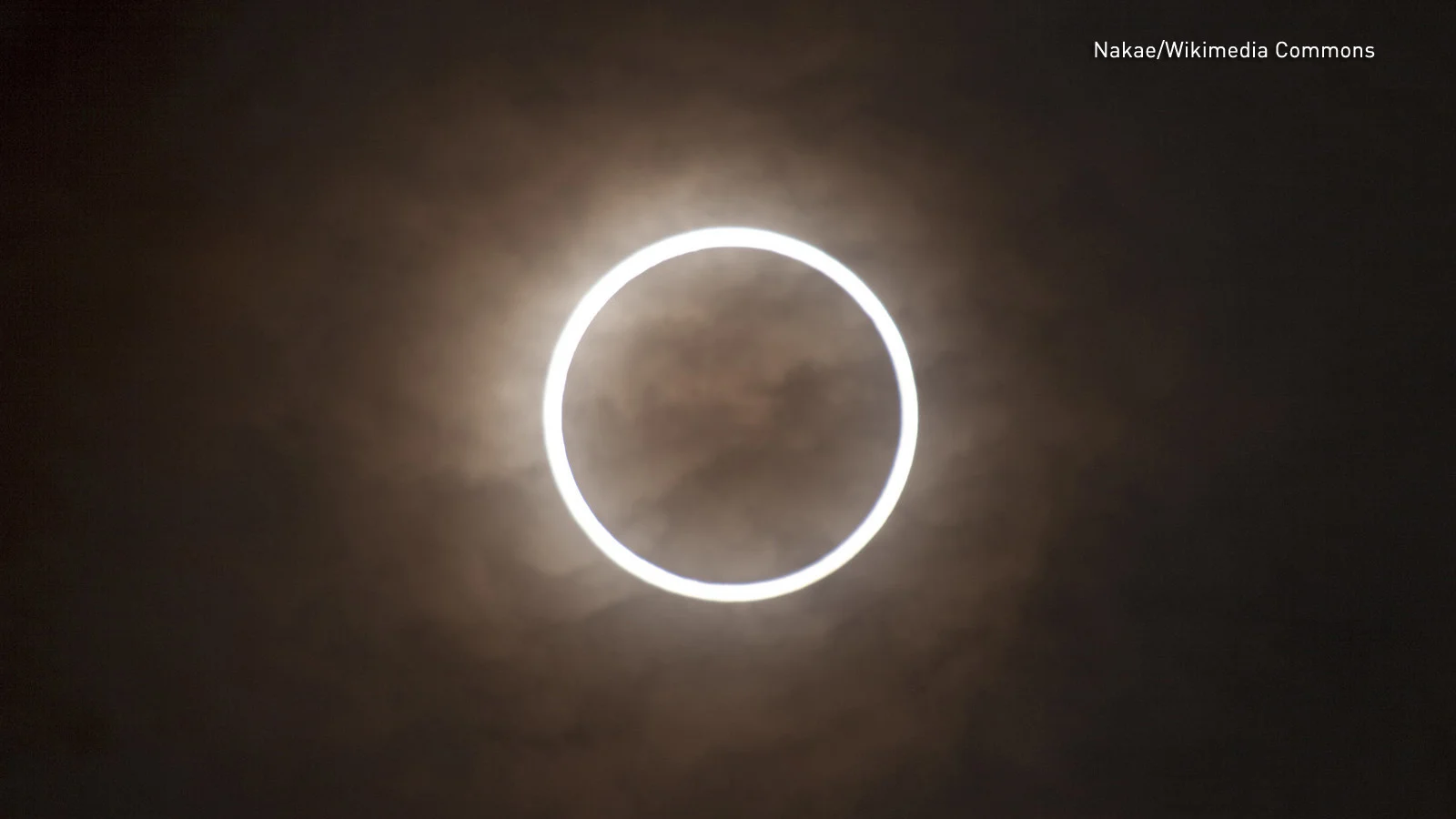
This image of an annular solar eclipse was captured from Tokyo, Japan, on May 21, 2012. (Nakae/Wikimedia Commons (CC BY 2.0))
Given the astronomical research that is conducted at Concordia Station, it is possible that someone there may live stream the eclipse for the rest of us to see. Otherwise, if we want to see a solar eclipse, we will need to wait until the August 12 Total Solar Eclipse, which will pass over the Arctic, with a partial eclipse visible across Canada.
RELATED: Mark your calendars! The Blood Worm Moon will soon shine across Canada
The Planets
Each night, after sunset, it is fairly easy to find the planets Jupiter and Saturn in the sky.

The evening sky on February 1, 2026. (Stellarium/Scott Sutherland)
Jupiter can be seen in the eastern sky, rising near Pollux and Castor, the brightest stars of the constellation Gemini.
Look to the southwest to spot Saturn, as a dim point of light shining steadily amongst the twinkling stars around it. At the beginning of the month, it will be visible for roughly three hours, before it sets in the west. With each successive night, though, it will be a bit closer to the western horizon, until it is setting just before 8 p.m., local time, by the end of the month.
Unseen to the naked eye, Uranus and Neptune are also present in the sky each night. Uranus can be located just south and west of the Pleiades Star Cluster, while Neptune lurks just to the west of Saturn. However, observers will need a telescope to spot either.
This configuration of outer planets will persist, night by night, but eventually two inner planets — Mercury and Venus — will emerge from evening twilight. Exactly when these two become visible will vary from observer to observer. Those with keen eyes may be able to pick them out from the twilit sky earlier in the month. By the 15th, though, they should be visible to all.
Once those last two join the rest, it will form yet another 'Six Planet Parade'.
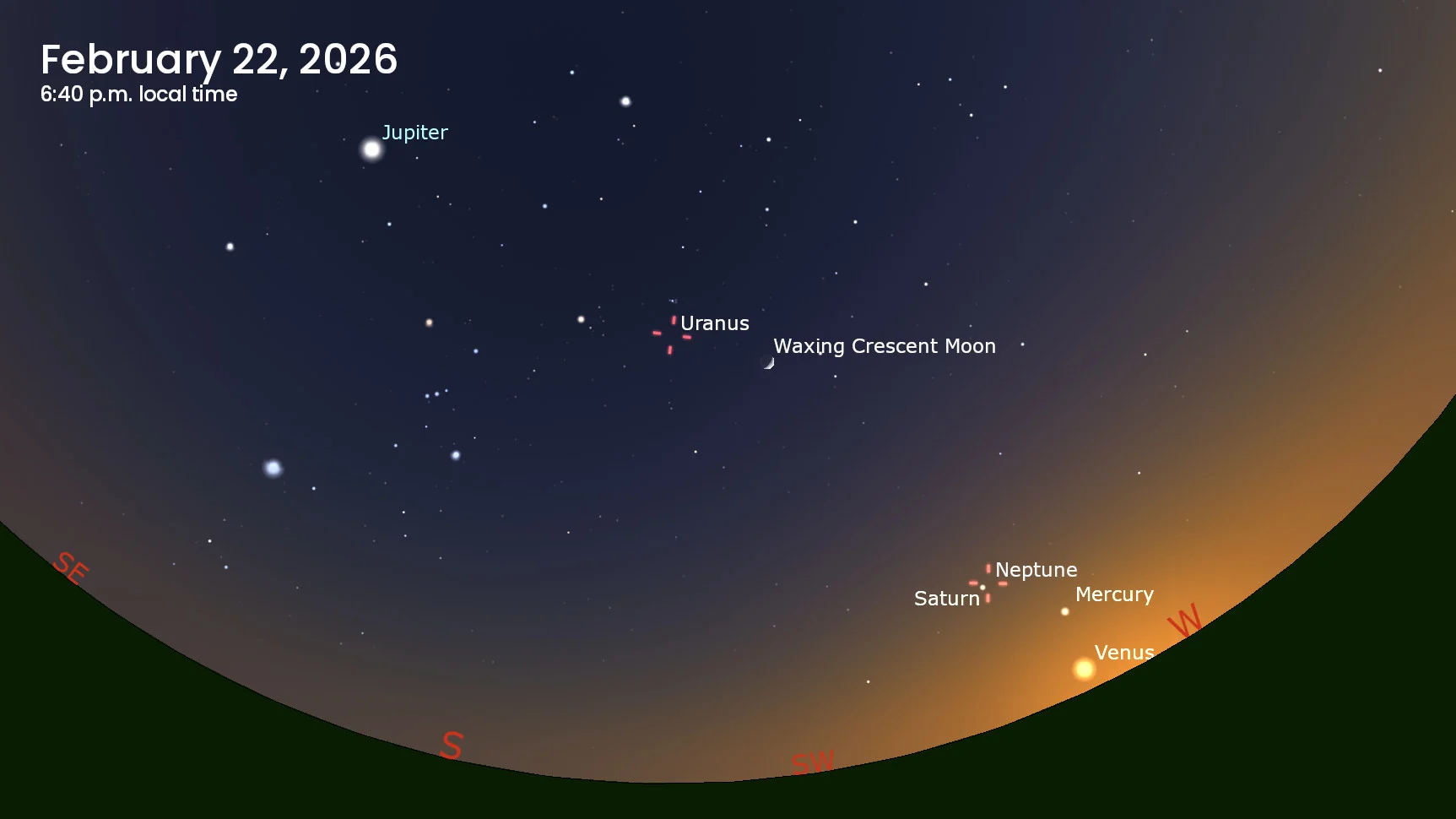
The Six Planet Parade, specifically on Feb. 22, 2026, just after sunset, local time. The Waxing Crescent Moon is also present in the sky on this night, while the locations of Uranus and Neptune are indicated by reticles. (Stellarium/Scott Sutherland)
While Jupiter, Saturn, Uranus, and Neptune will shift closer to the western horizon each night, Mercury and Venus will climb higher, at least to start.
Mercury will reach its highest point above the horizon (it's 'greatest eastern elongation') on the night of the 19th. Afterwards, it will swing back towards the west, appearing closer to the horizon each night for the rest of the month.
Venus, on the other hand, will continue to climb, and will remain as the 'evening star' in our western skies for months to come.
(Thumbnail image is a simulation of the night sky using the free planetarium software Stellarium, which shows the planets of the "Six Planet Parade" with their sizes extremely exaggerated, for illustrative purposes.)