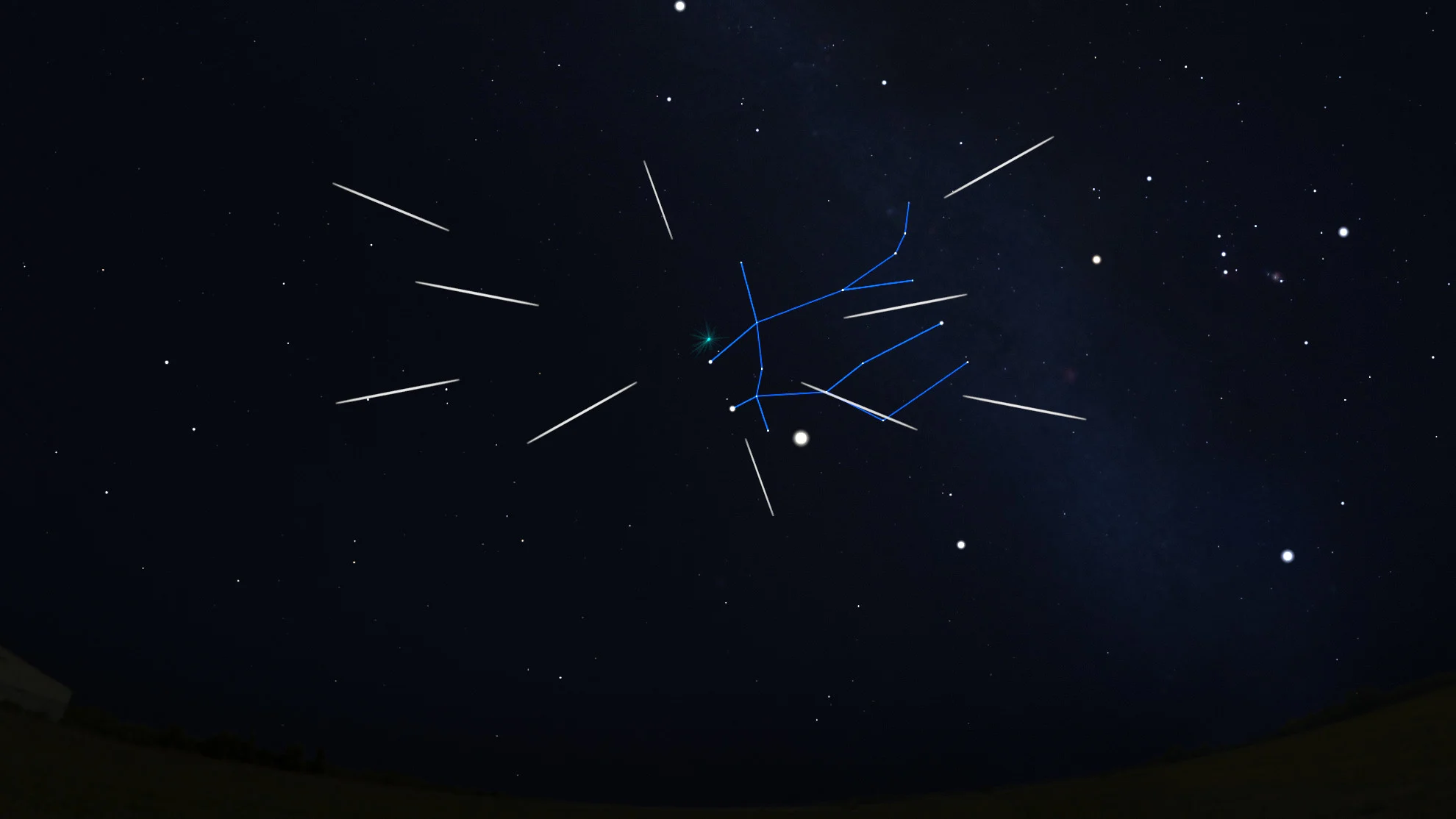
Watch for Geminid 'rock comet' meteors to flash through the sky in December

The brilliant Geminid meteor shower is the main feature of the night sky this month.
Keep your eyes on the forecast for clear weather throughout the month of December, as there's plenty to see in the night sky.
The last Supermoon of the year, Jupiter growing brighter throughout the month, and two meteor showers, one of which is arguably the best of the entire year — there is plenty to look forward to for stargazers and skywatchers this month.
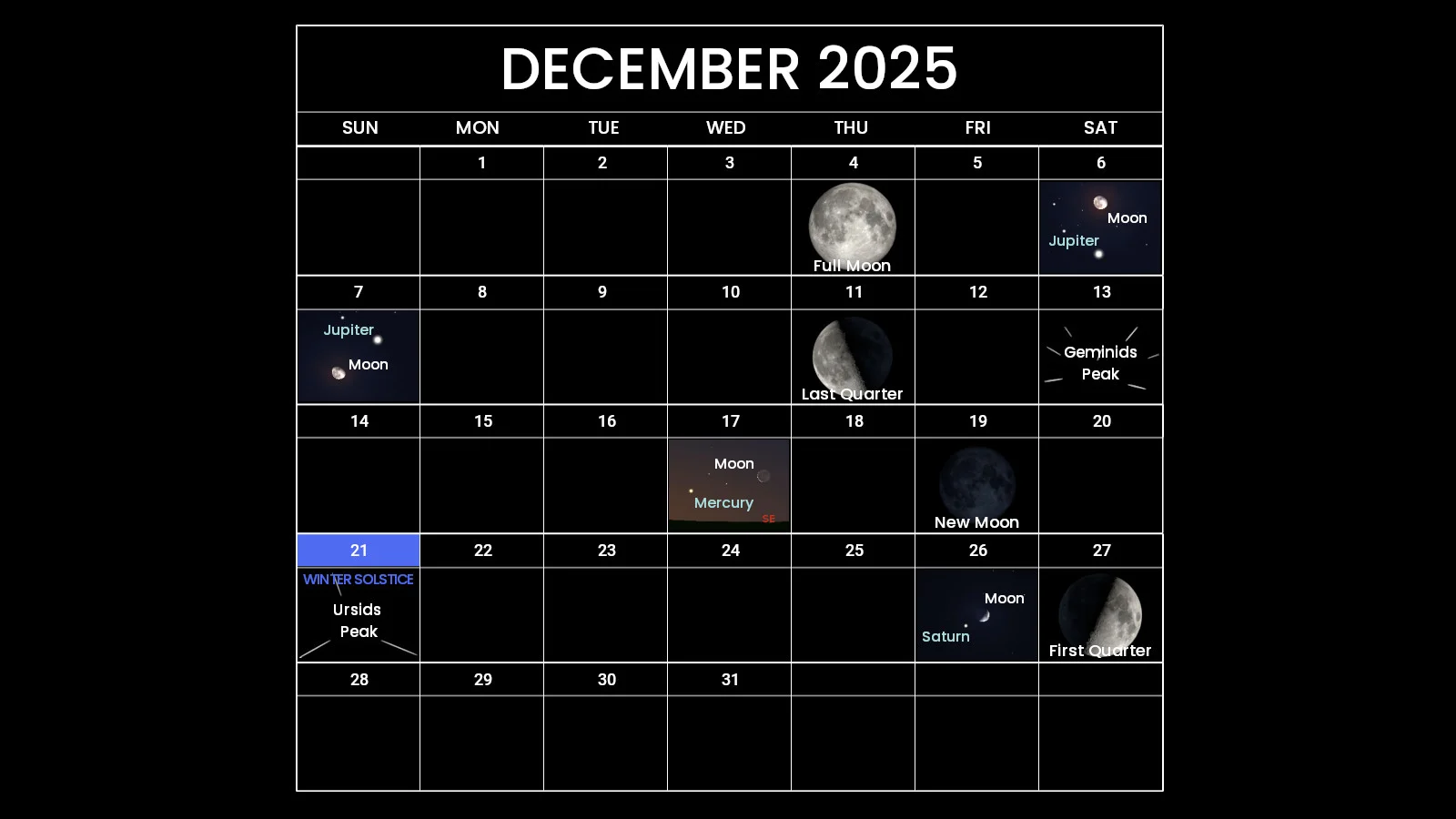
The calendar of astronomical events for December 2025, including the major phases of the Moon, when the Moon can be seen near bright planets, along with meteor shower peaks and the Winter Solstice. (Scott Sutherland/NASA SVS/Stellarium)
READ MORE: Eyes to the winter sky for meteor showers, a supermoon and a total lunar eclipse
The Moon and the Planets
Right at the start of December, from the 1st to the 3rd, we will see a Waxing Gibbous Moon in the sky each night, followed by the final Full Moon of the year on the 4th, December's Cold Moon.
This is the third of four Supermoons in a row, which began with the October Hunter's Moon, continued with November's Perigee Beaver Moon, and will be completed with the Wolf Moon in the first week of January 2026.
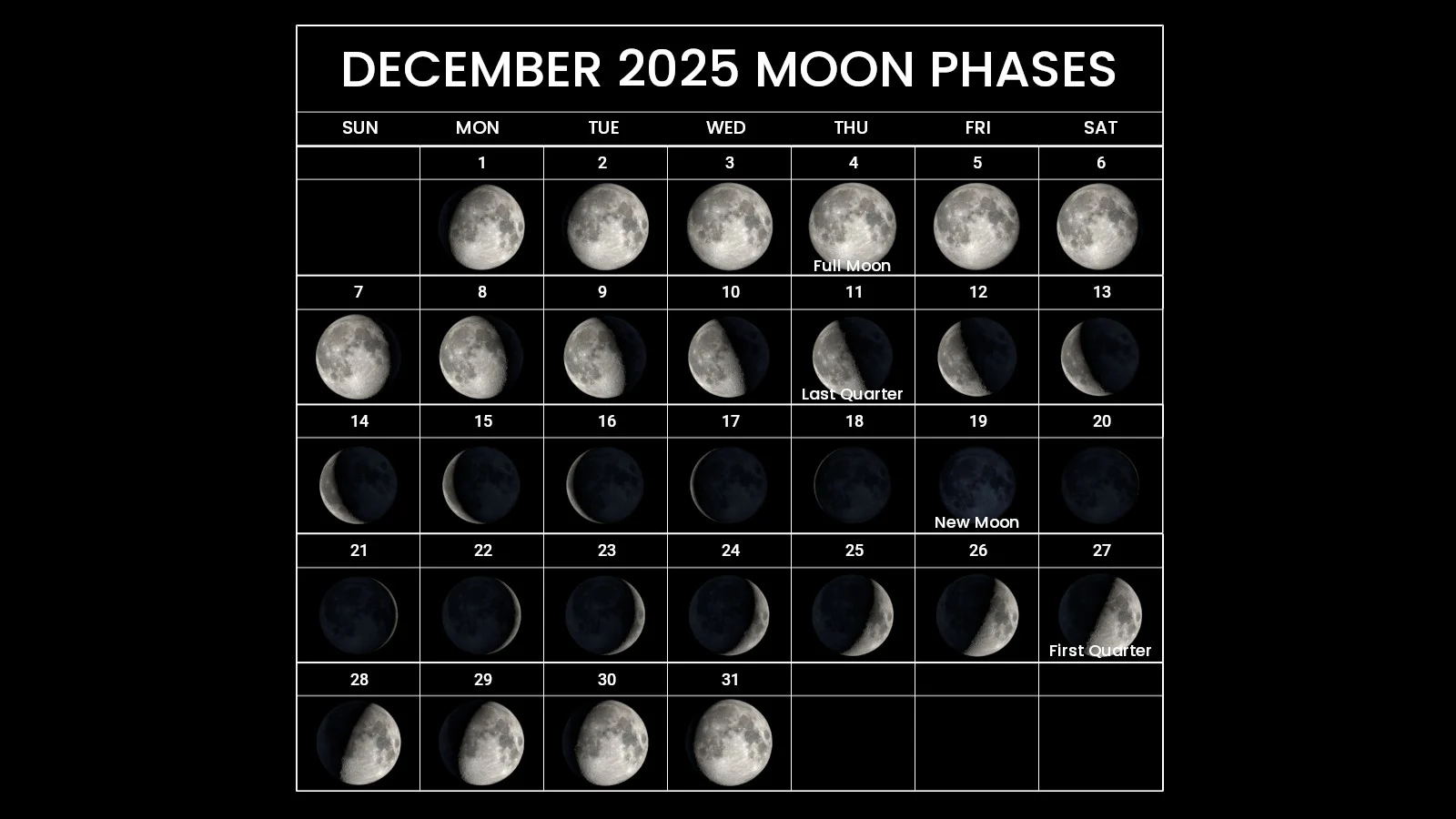
The calendar of lunar phases for December 2025. (Scott Sutherland/NASA SVS)
From the 5th through the 10th, the Waning Gibbous Moon will rise later, with more of its easterly side in shadow, each night.
Look for it near the planet Jupiter on the nights of December 6-7 and 7-8.
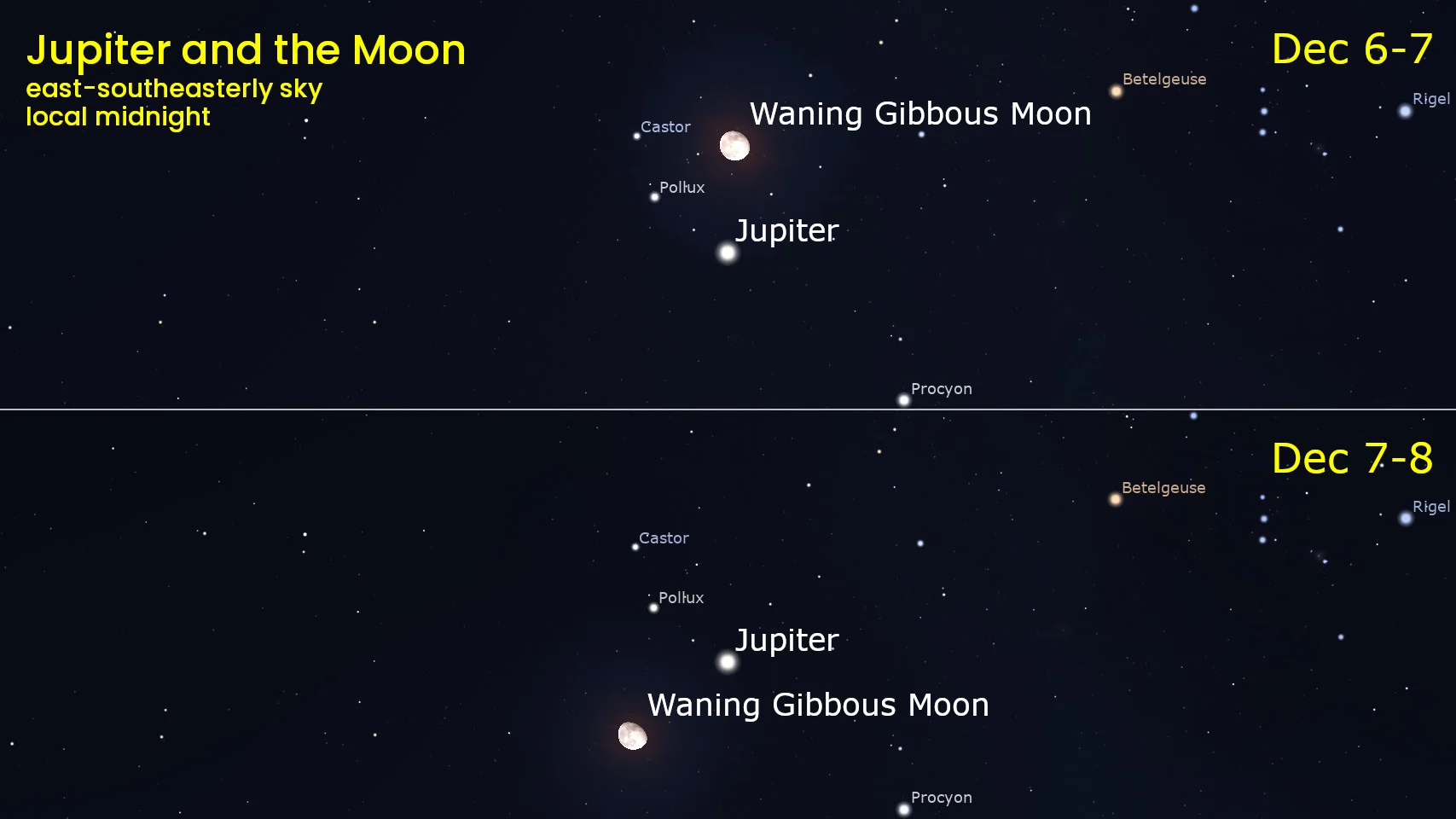
Find Jupiter near the Waning Gibbous Moon on the nights of December 6-7 and 7-8. Both nights, the pair will rise in the evening, along with the constellation Gemini, and will be in the southern sky in the hours after midnight. (Scott Sutherland/Stellarium)
The Last Quarter Moon occurs on December 11, when we will see it rise around midnight.
This will be followed up by the Waning Crescent Moon appearing in the sky after midnight, getting thinner and thinner and rising closer and closer to dawn, from the 12th through the 18th.
Look for the planet Mercury near the thin Crescent Moon in the predawn sky on the mornings of December 16 and 17.
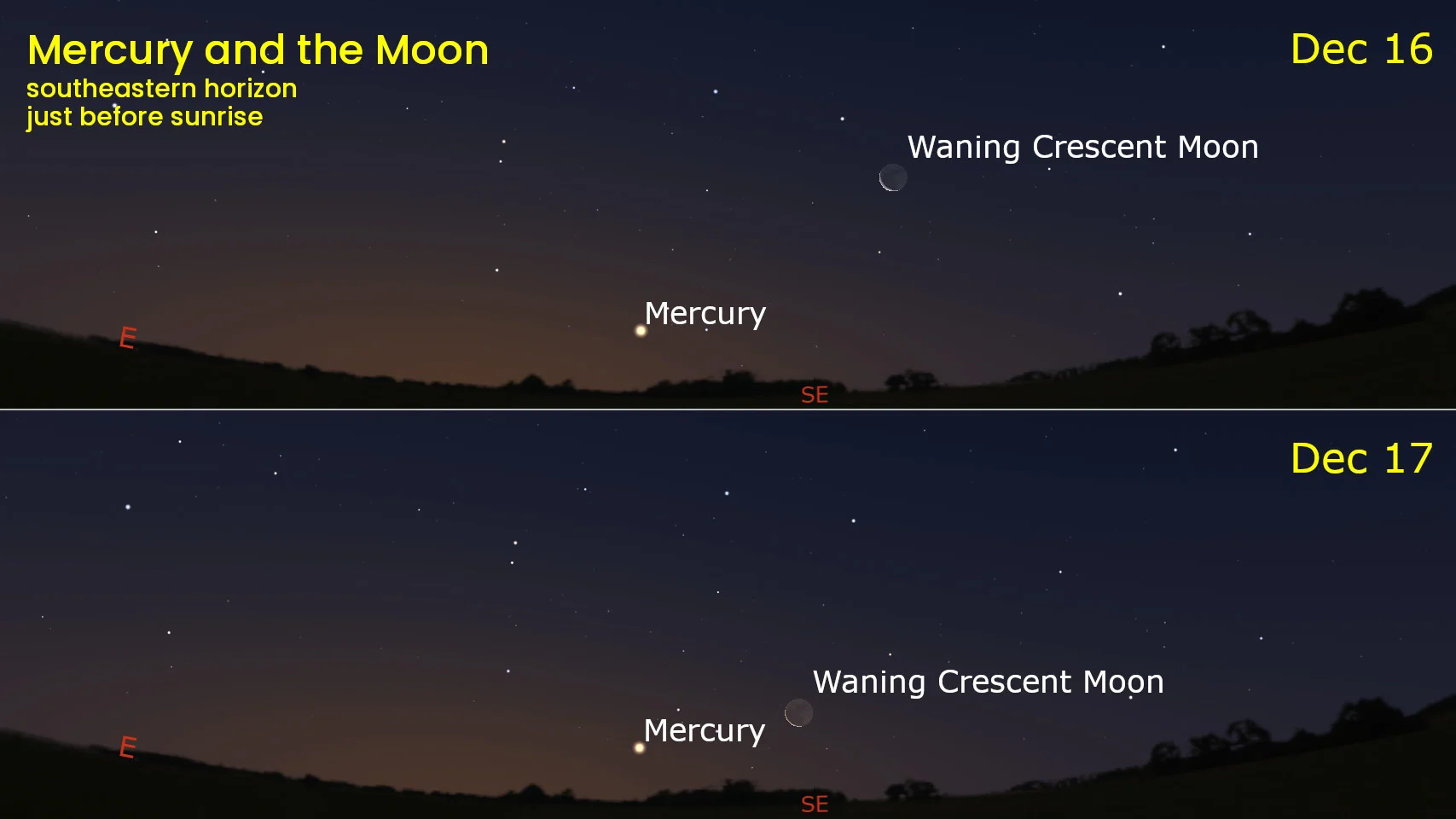
Mercury and a very thin Waning Crescent Moon are visible together in the eastern sky just before morning twilight on the 16th (top) and 17th (bottom). (Scott Sutherland/Stellarium)
The Moon will be absent from our skies on December 19, during the New Moon phase, when it passes between the Earth and Sun.
It will return on the 20th as a very thin Waxing Crescent Moon, which will become visible just after sunset, and will rise later and later from the 21st through the 26th.
Find it on the nights of the 25th and 26th, and you can see the planet Saturn nearby.
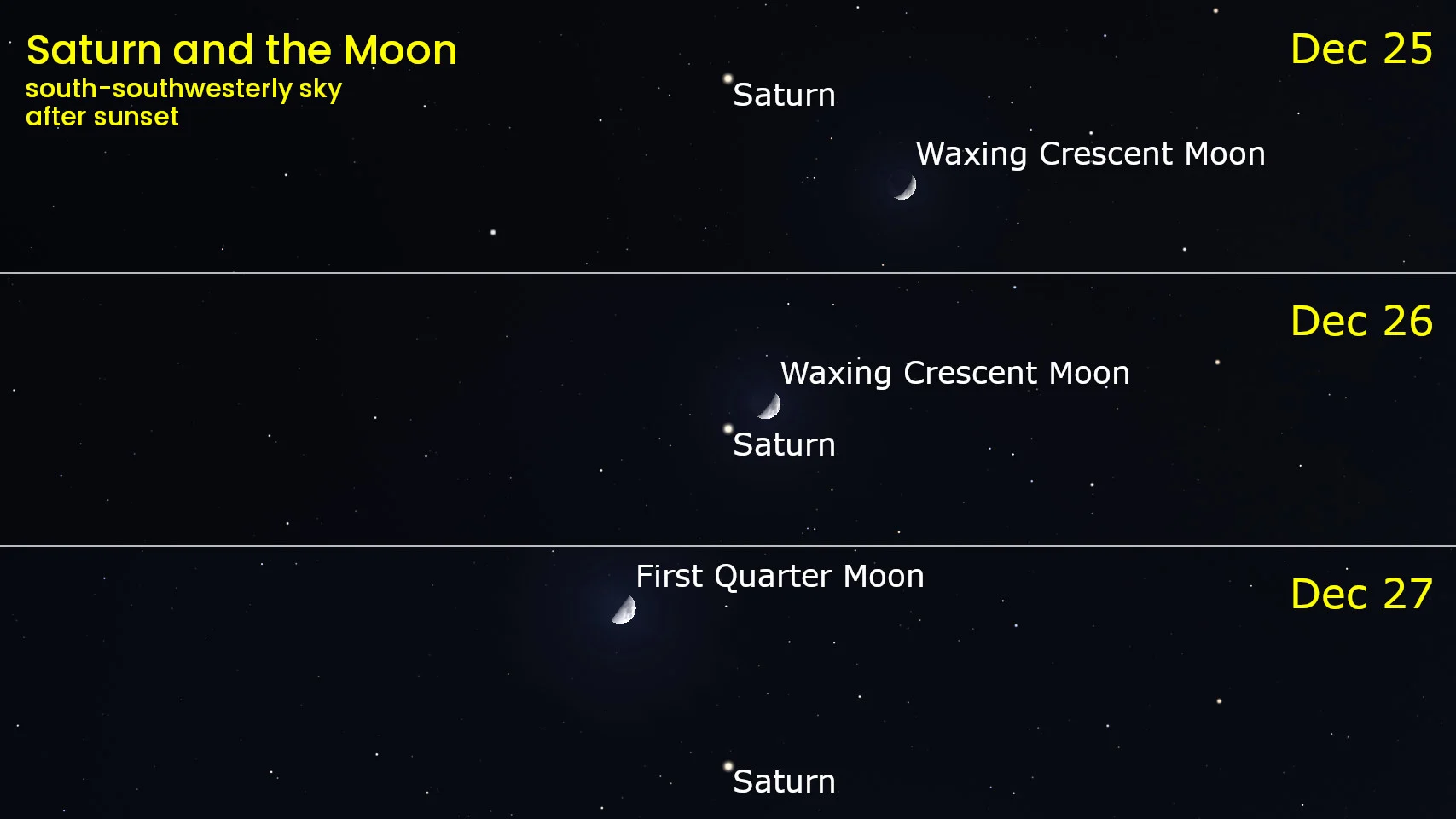
Saturn is near the Waxing Crescent Moon on the 25th (top) and 26th (middle), and then near the First Quarter Moon on the 27th (bottom). (Scott Sutherland/Stellarium)
The First Quarter Moon, on the night of the 27th, is reasonably close to Saturn, as well.
We will then finish off the month with a Waxing Gibbous Moon in the sky from the 28th through the 31st.
DON'T MISS: Solar radiation may impact flight controls, prompting urgent Airbus recall
Two meteor showers
Since the end of September, one meteor shower after another has been sending streaks of light across our night skies. However, in the first half of December, we finally reach what is arguably the best meteor shower of the entire year — the Geminids.
Beginning in the first few days of the month, as Earth slips into the gritty debris stream left behind by 'rock comet' 3200 Phaethon, the Geminid meteor shower lasts until the 17th.
The shower always starts off rather sparse, producing one or two meteors every hour, which appear to originate from the constellation Gemini. It may be difficult to notice any activity during the first week or so, though, due to the Moon's brightness during that time. The light from the Waxing Gibbous Moon, Full Cold Moon on the 4th, and Waning Gibbous Moon will wash out the sky, making it more difficult to spot dimmer meteors.
Fortunately, the Geminids do include the occasional fireball, and the number of meteors we see from this shower will ramp up significantly starting around December 10. By that time, we may see between 5 to 10 meteors every hour.
Each night afterward, the number of meteors will roughly double — up to 20 per hour on the night of the 11th, 40-50 per hour on the 12th, and up to 100 or more during the shower's peak, on the night of December 13-14.
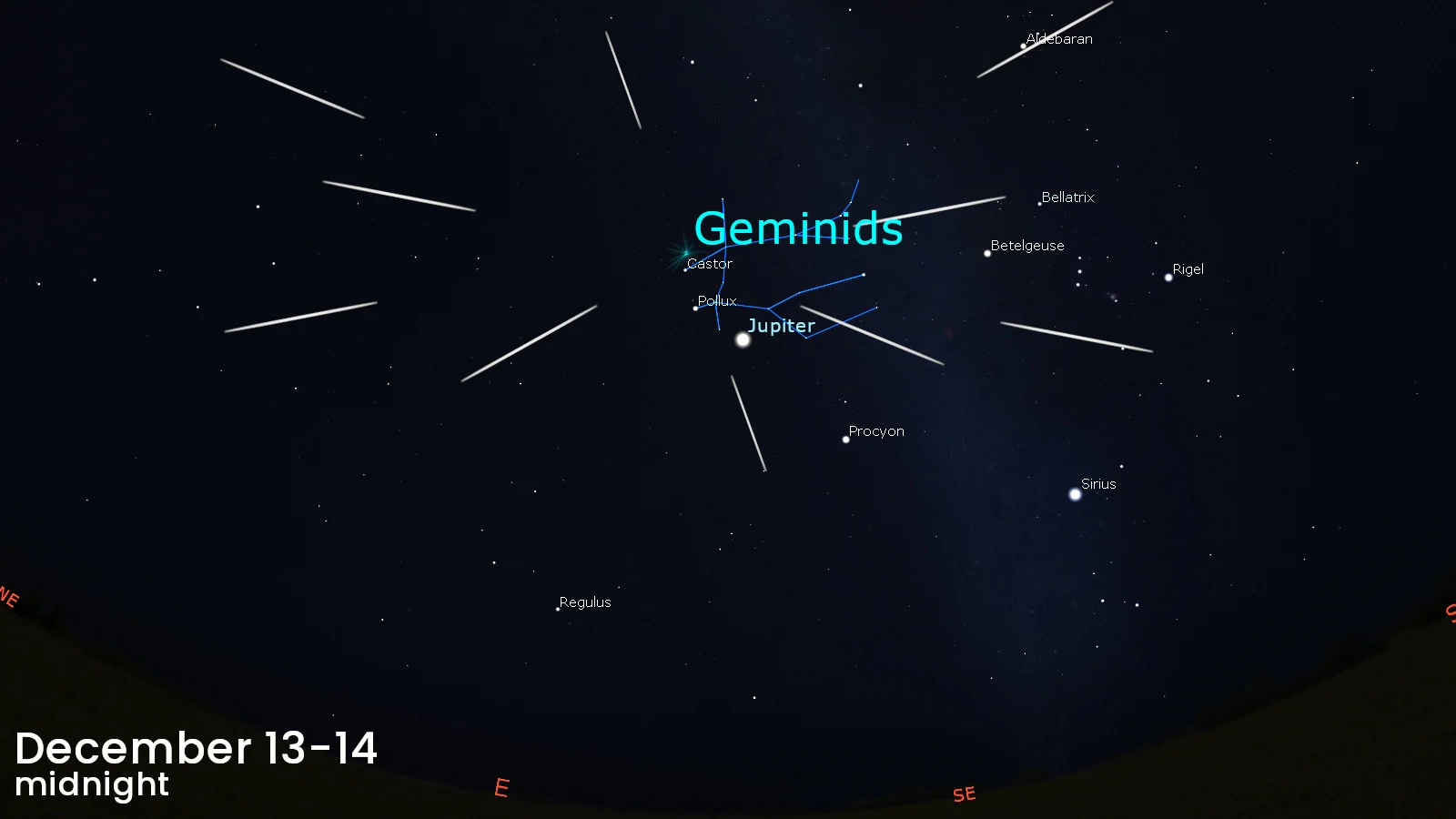
The radiant of the Geminid meteor shower, located in the northeastern sky, on the night of December 13-14, 2025. (Stellarium/Scott Sutherland)
There will only be a Waning Crescent Moon that night, which rises about 1:30 a.m., thus leaving the evening hours and around midnight with a dark, moonless sky.
Fingers crossed for clear skies that night, as these are ideal conditions for observing the Geminids!
Right after the Geminids end on the 17th, Earth plunges into another debris stream, this one from a comet named 8P/Tuttle. Thus, the Ursids meteor shower takes over the sky, with meteors streaming from the constellation Ursa Minor, near the North Star.
The Ursids are a relatively short and weak meteor shower, which reaches its peak on the night of the Winter Solstice, December 21-22.
It typically only producing about 10 meteors per hour at its peak, however, this year, there may be some increased activity in the hours just before sunrise on the 22nd.
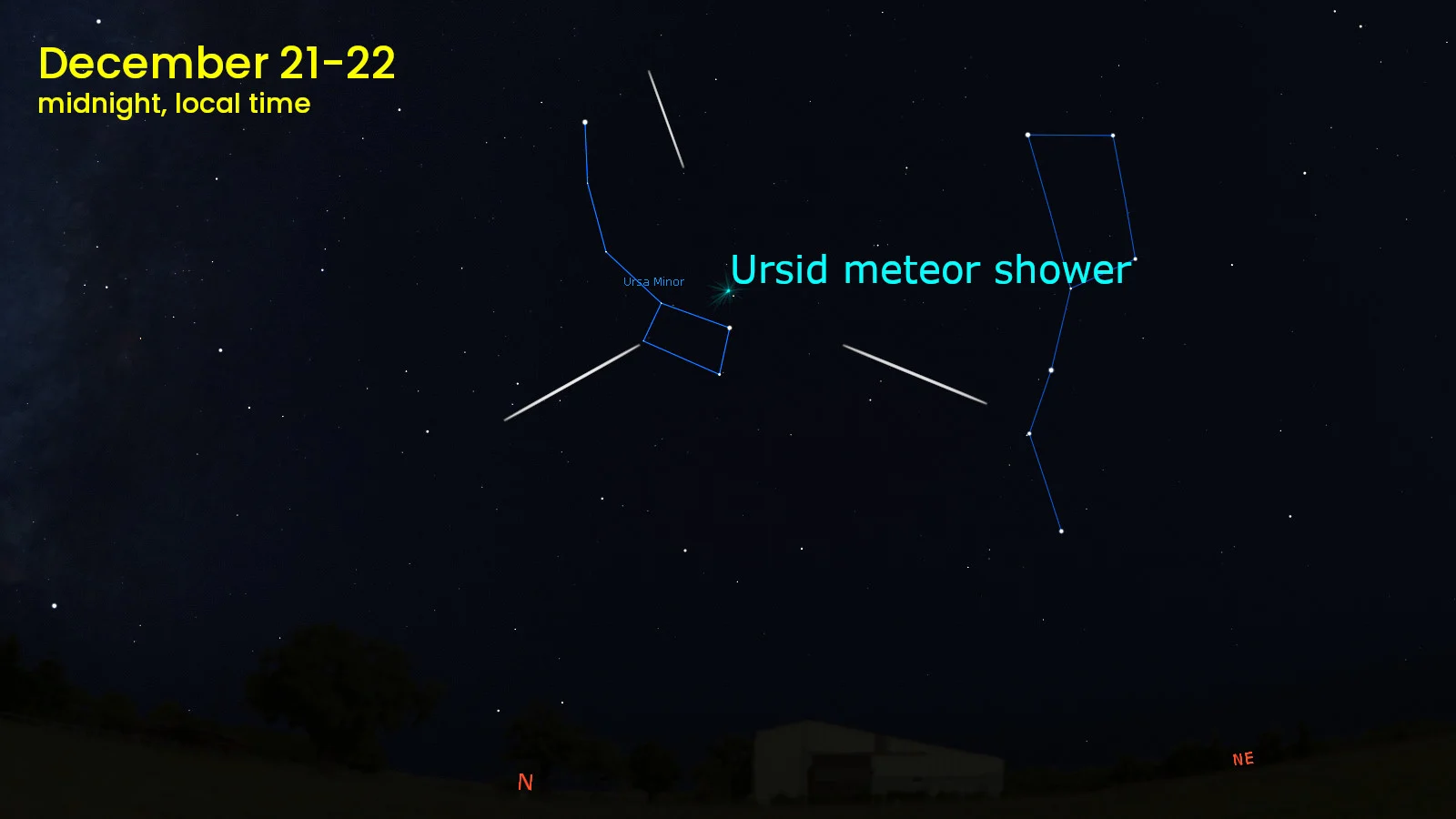
The Ursid meteor shower radiant, located near the Little Dipper in the northern sky, on the night of December 21-22, 2025. (Stellarium/Scott Sutherland)
A very thin Waxing Crescent Moon will be in the sky just after sunset, but will quickly set, leaving the rest of the night moonless.
Given that this is longest night of the year, the timing really couldn't be better for the peak of a meteor shower, even one as typically weak as the Ursids.
RELATED: How to get the most out of auroras, meteor showers, and other night sky events
December Constellations
Night by night, our view of the night sky above changes as Earth travels in its orbit around the Sun. This means that each night, we face a slightly different part of the space around our solar system. The difference is subtle from one night to the next. However, over the course of a month, entire constellations can disappear or reappear in our sky.
In December, the Winter constellations take their place in the celestial sphere.
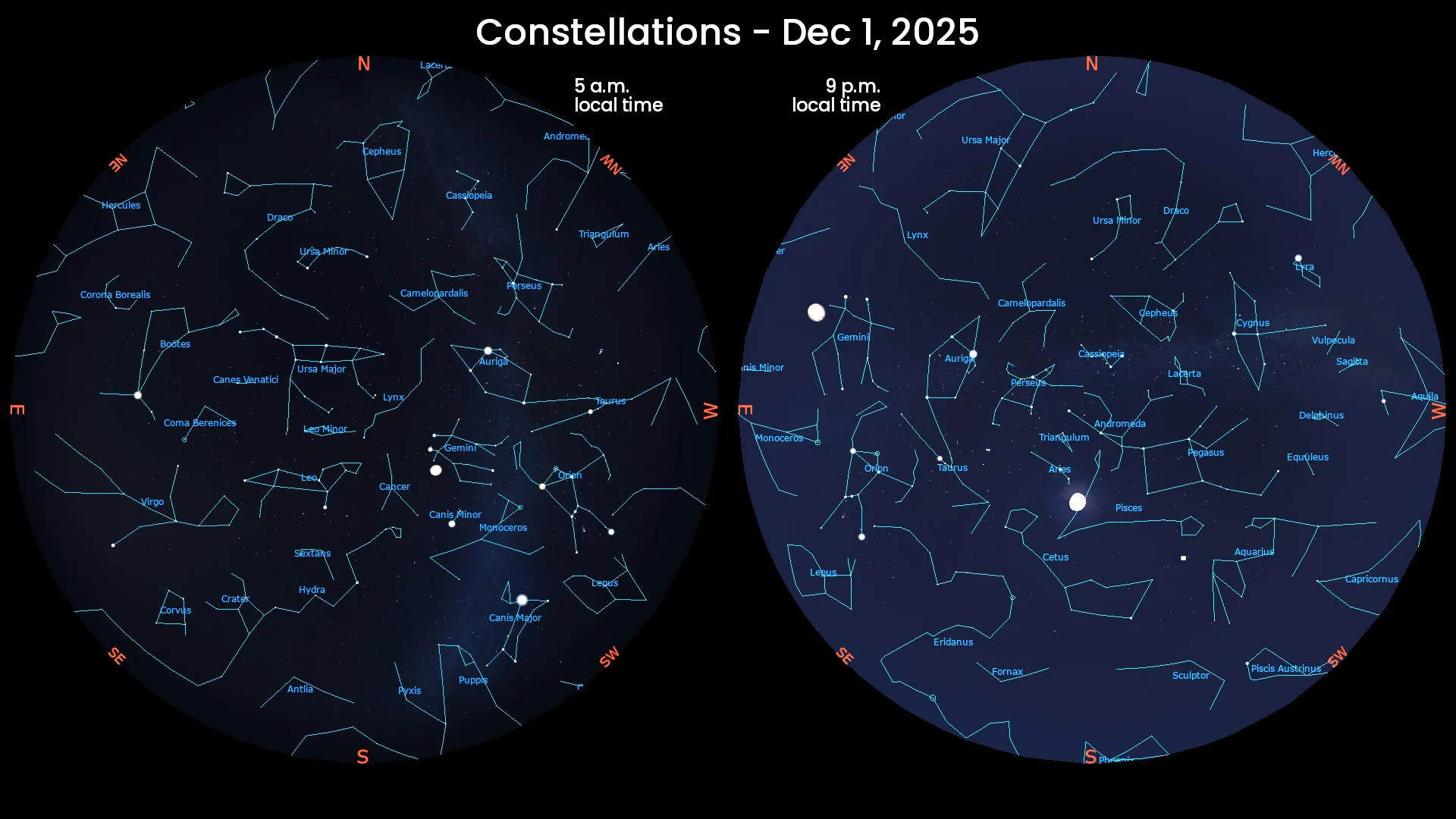
The constellations visible in the morning and evening skies on December 1, 2025. Jupiter can be seen in the constellation Gemini throughout the night, while Saturn hangs out between Pisces and Aquarius. The evening sky is so bright due to the light of the Waxing Gibbous Moon (in the constellations Pisces on that night). (Stellarium/Scott Sutherland)
To start off the month, Virgo, Hydra, Leo, Cancer, Puppis, Canis Major, Canis Minor, Monoceros, Gemini, Orion, Lepus, and Taurus can be seen arrayed across the southern sky from east to west each morning.
High overhead, we will find Boötes, Ursa Major (the Big Dipper), Lynx, Auriga, and Perseus. Meanwhile, in the northern sky, Hercules and Draco will be in the northeast, with Cepheus to the north, Cassiopeia and Andromeda in the northwest, and Ursa Minor (the little dipper) hanging on to the North Star.
In the evening hours, Gemini and Orion will rise in the east, tagging along behind Taurus, Cetus, Eridanus, Pisces, Andromeda and Pegasus, with Aquarius and Capricornus to the southwest, and Aquila in the west.
Higher up, Auriga, Perseus, Cassiopeia, Cepheus, Cygnus, and Lyra will dominate. To the north, Ursa Major will be closer to the horizon, with Draco and Hercules having swung around into the northwest sky.
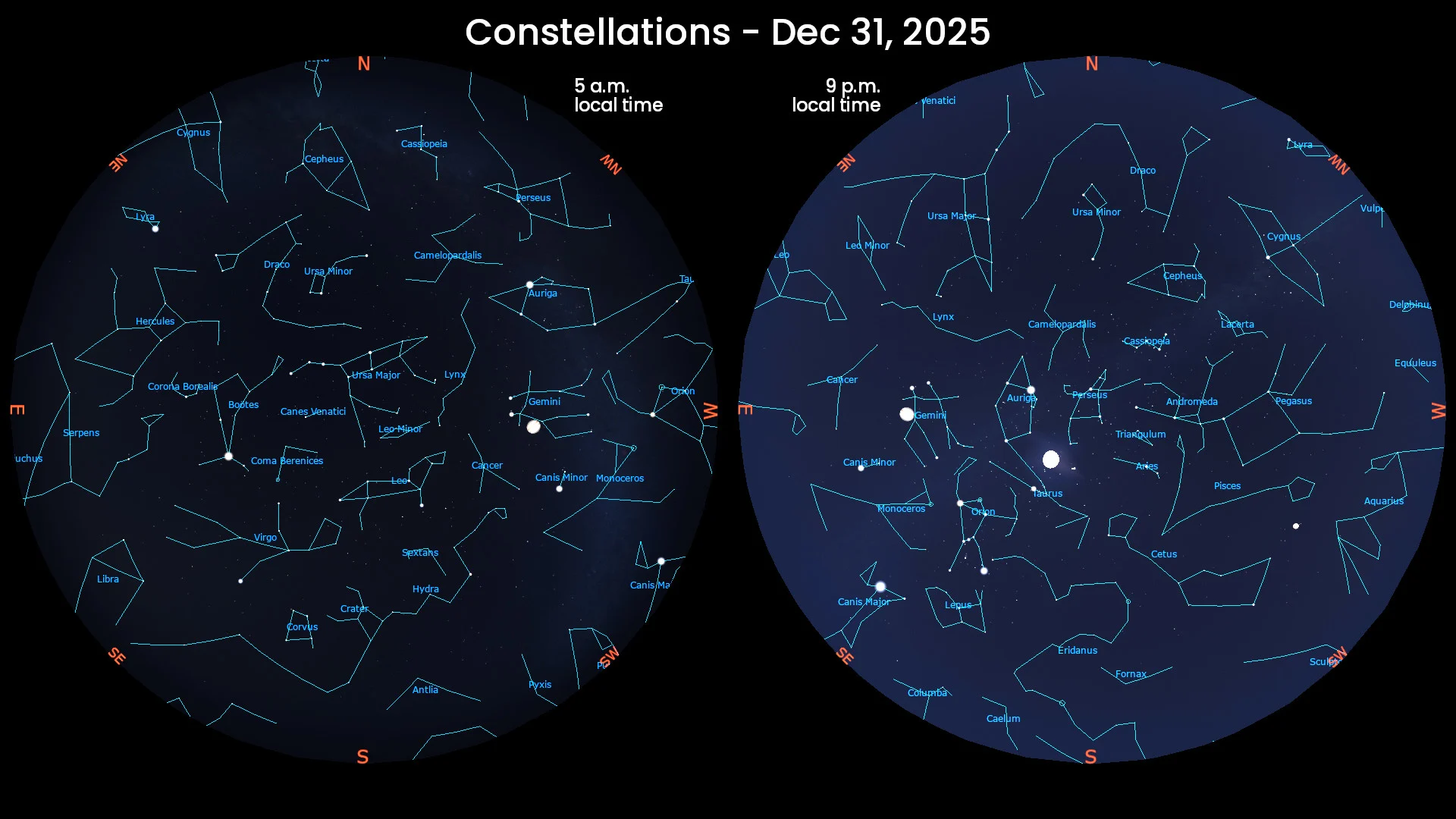
The constellations visible in the morning and evening skies on December 31, 2025. Jupiter and Saturn have shifted their positions ever-so-slightly compared to the beginning of the month. The evening sky is so bright due to the light of the Waxing Gibbous Moon (in the constellation Taurus on that night).(Stellarium/Scott Sutherland)
By the end of December, the arrangement of evening constellations will be roughly the same, except Cancer will be rising in the east after sunset, right after Orion and Gemini, while Aquila and Capricornus will have set in the west.
In the predawn sky, a similar shift towards the west will put Orion right on the western horizon before morning twilight, with Serpens, Ophiuchus and Libra rising in the east prior to sunrise.
(Thumbnail image depicts a simulated view of the night sky, using the free, open-source planetarium software, Stellarium, during the peak of the Geminid meteor shower on the night of December 13, 2025.)