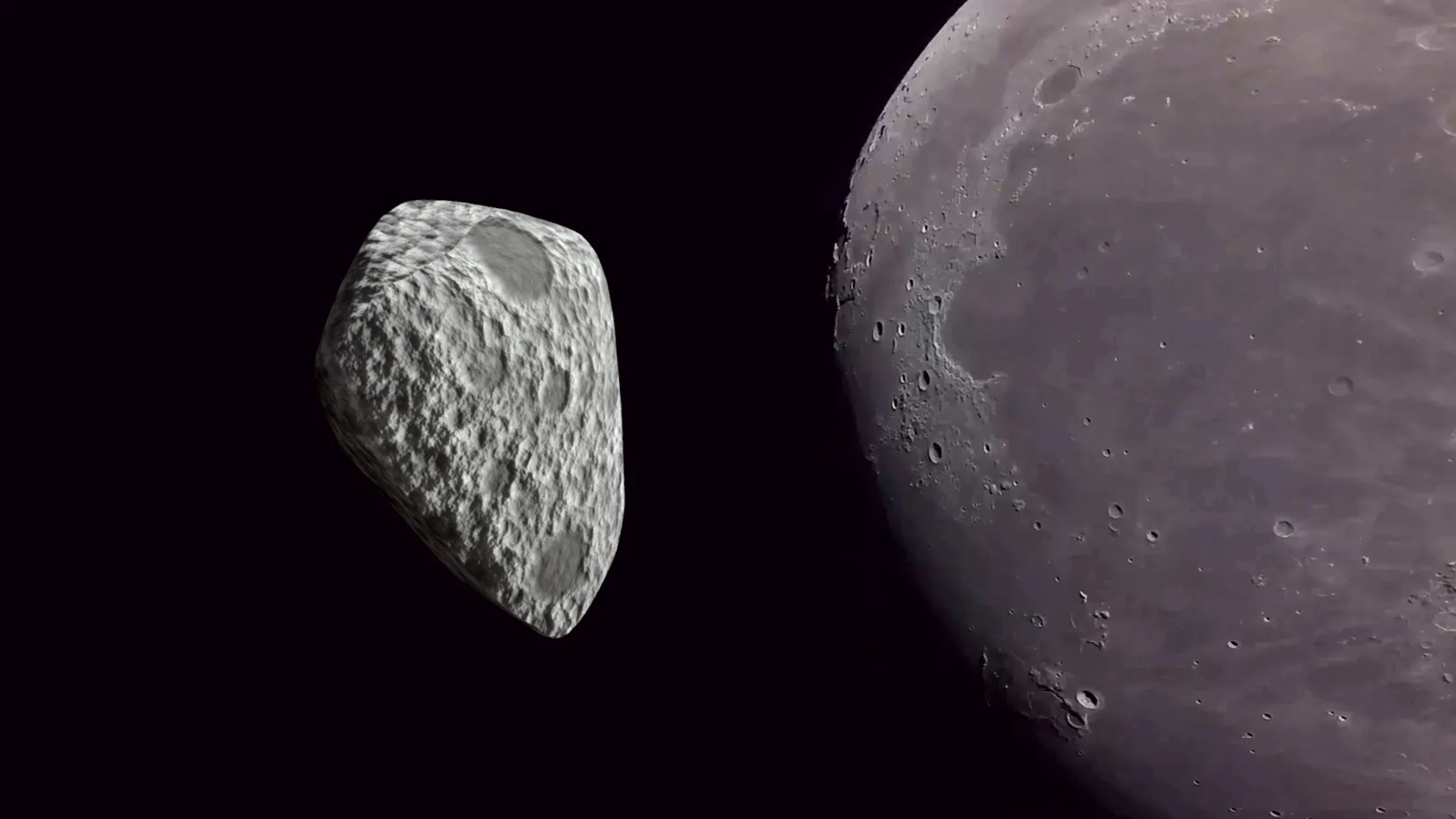
Asteroid impact with Moon would produce visible flash, followed by meteor storms

If 2024 YR4 strikes the Moon in 2032, we could not only witness the event, but also meteor storms like nothing we've ever seen before.
On December 22, 2032, a sixty-metre-wide asteroid may strike the Moon. If this happens, it will not only produce a visible flash, easily spotted from Earth, but will likely be followed by periodic meteor storms streaking across our night skies.
Known as 2024 YR4, this space rock was discovered in late 2024 and initially caused some alarm, as it had a small chance of hitting Earth. Using observations of the object in the months following its discovery, astronomers narrowed down its potential orbital paths. This allowed them to completely rule out the possibility of an Earth impact, which is for the best. At around 60-metres wide, 2024 YR4 is roughly three times the size of the one that exploded over Chelyabinsk, Russia, in February 2014. If it were to hit somewhere populated, the damage would be catastrophic.
However, as safe as we are from that scenario, there remains the possibility that this asteroid could hit the Moon, instead.
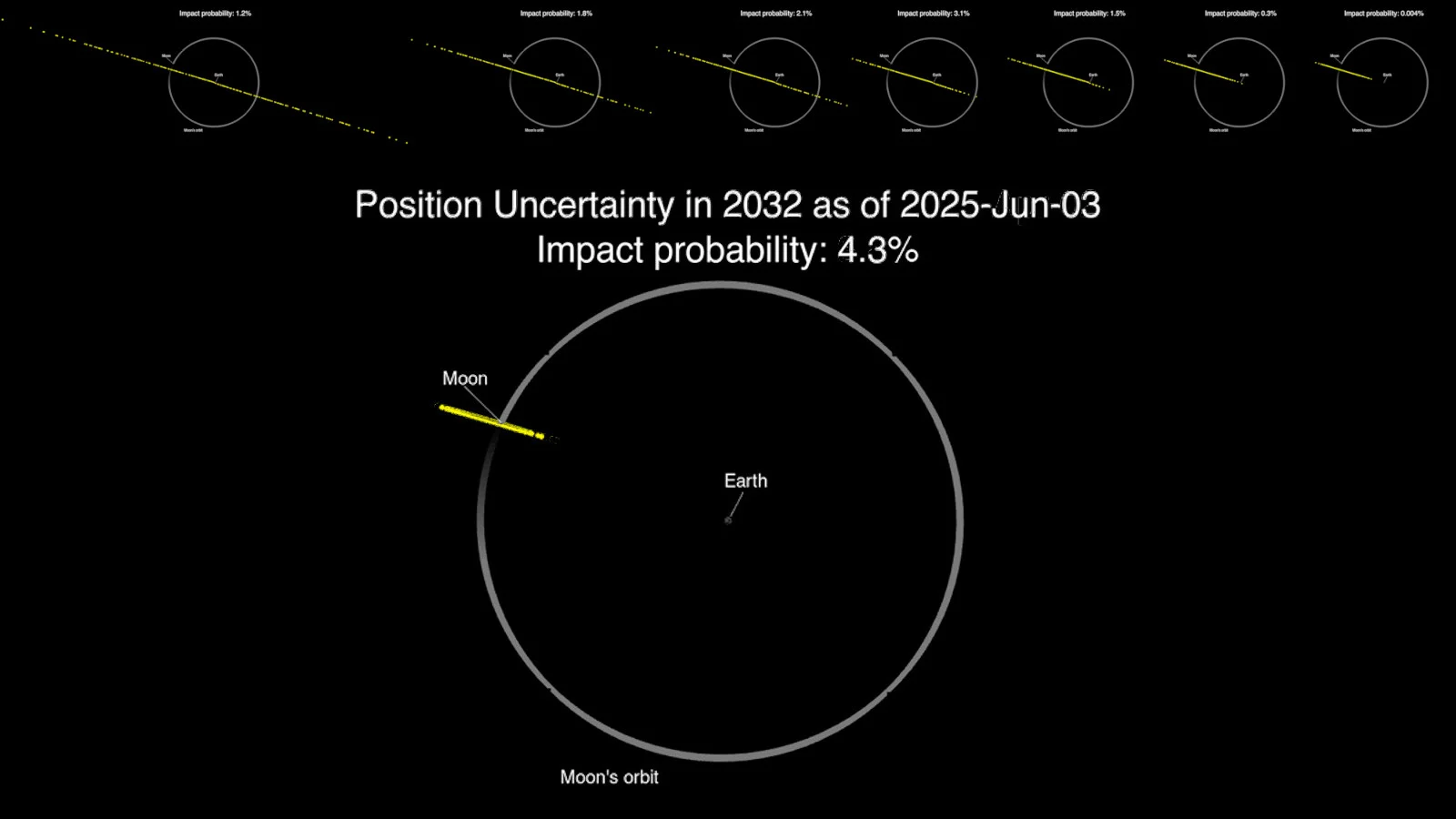
The latest plot for 2024 YR4's trajectories through the Earth-Moon system on December 22, 2032, with a 4.3 per cent chance of striking the Moon on that date. Along the top, past computations show how the plots initially included potential Earth impacts, but refined over time. (NASA)
The probability of that impact is only 4.3 per cent. So, that means there is a 95.7 per cent chance that it will completely miss the Moon, and just continue on, harmlessly, into space.
Even with such low odds, though, the potential effects of such an impact make it worth studying. After all, we're talking about a rock with a mass of around 280,000 metric tons slamming into the lunar surface travelling at a speed of over 46,000 kilometres per hour.
According to a team of Canadian researchers, led by Paul Wiegert from Western University, that impact would release the same energy as detonating 6.5 megatonnes of TNT. Based on that same study, which was published in August 2025, such a blast would carve a new crater into the Moon's surface, roughly 1 kilometre in diameter, while launching an estimated 200,000 metric tons of lunar material into space.
While most of that material would be flung away from Earth, up to 10 per cent (20,000 metric tons) could find its way to Earth. Here, those lunar meteoroids have the potential to damage orbiting satellites and spacecraft. They would also cause a recurring meteor shower, as the particles burn up in our atmosphere.
Now, a new study, posted to the pre-print server, arXiv, has confirmed these estimates, while also giving us an idea of some of the other potential effects of the impact.
The exact results of 2024 YR4 hitting the Moon will depend on precisely where it hits. Even now, there is a wide swath of potential impact points, stretching across the lunar southern hemisphere.
The strongest impact results on the Moon involve those on the 'leading' side of the Moon, as these are the 'head on' impact scenarios, with the Moon and asteroid traveling in roughly opposite directions when they hit. For an impact on the 'trailing' side of the Moon, the Moon would be travelling across the asteroid's path, producing a lower impact velocity.
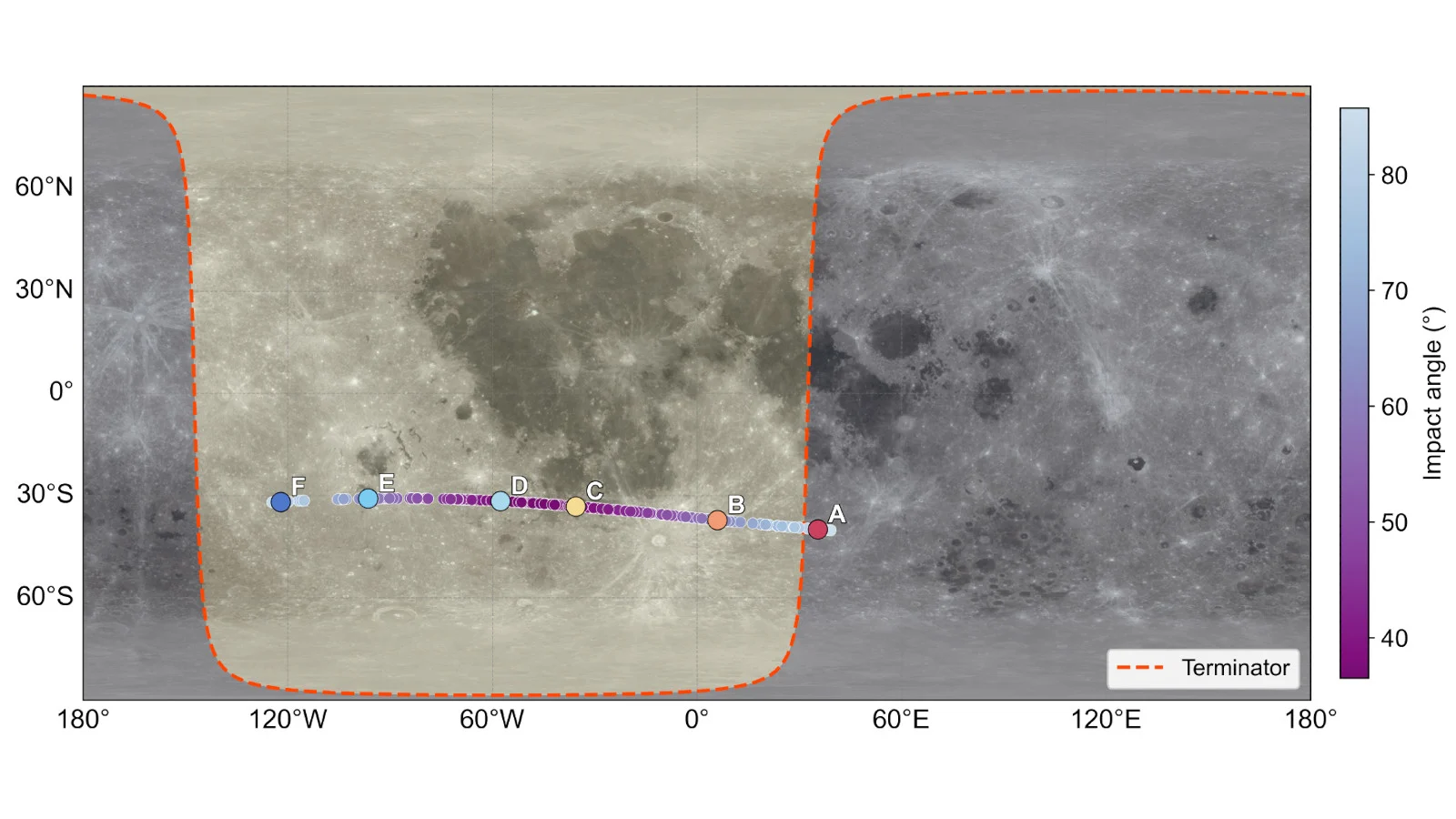
Potential impact points on the lunar surface for asteroid 2024 YR4, on Dec. 22, 2032. The 'leading' side of the moon is to the left, while the 'trailing' side is to the right. (Yifan He, et al. 2026)
This new research, conducted by a team at Tsinghua University, in Beijing, reveals that 2024 YR4 crashing into the Moon would produce a visible flash of light that would reach a magnitude of between -2.5 and -3 for several minutes.
For comparison, the planet Jupiter has been shining in our night skies at a magnitude of between -2.5 and -2.7 over the past few months.
In the aftermath, infrared cameras would still pick up the afterglow of the molten material in the newly-formed crater, which would reach a temperature of around 2,000 degrees Kelvin and take hours to cool. Additionally, the shockwave travelling through the surface would register as the equivalent of a 5.0 magnitude quake to seismometers left there during the Apollo missions.
The most significant effect for those of us here on Earth at the time, would be the meteor storm that would follow the impact.
According to the 2026 paper, a strike on the lunar trailing-side (locations A and B on the above map) would cause roughly 1 per cent of the debris blasted into space to reach Earth between 2 and 8 days after impact.
The result would be a spectacular meteor storm, with between 100,000 and 600,000 meteors flashing through the sky every hour, including 100 to 400 fireballs every hour, as well.
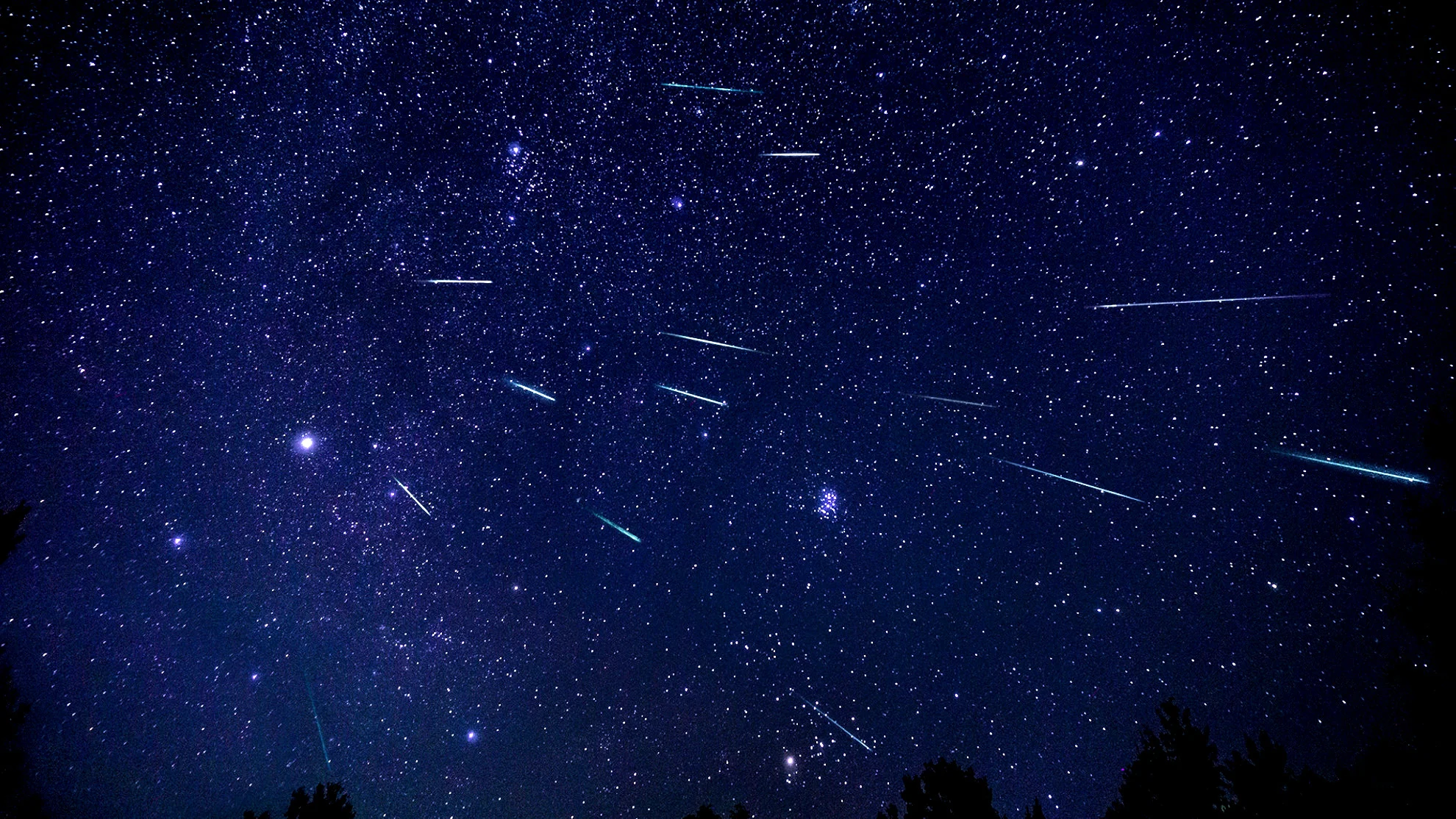
This image of the 2021 Perseid meteor shower represents a time-lapse of the event, with all meteors throughout the night presented at the same time in one image. A meteor storm would produce this and more, all at the same time in the sky. (Brad Perry/UGC)
The only thing that has come close to this, so far, was the 1966 Leonid meteor storm. On November 17 of that year, Earth passed through an exceptionally dense part of the debris stream left behind by comet Tempel–Tuttle. According to eyewitness accounts, meteor rates on that night hit around 40 per second, or 144,000 per hour.
In contrast, an impact on the leading side of the Moon could result in an even more spectacular meteor storm. From the latest orbital calculations for 2024 YR4, this is apparently the more likely scenario. Thus, if the asteroid does strike the Moon, it will probably do so somewhere between impact sites C through F (on the map above). The catch is that we'd have to wait until mid-March 2033 to see the results.
As the researchers explain in both studies, the head-on collision of a leading-side impact would blast the lunar debris away at higher velocities, with plenty launched free of the Earth-Moon system, completely. Meanwhile, the rest would spread out along a much wider and longer trajectory before it reached Earth.
Watch below: A simulation shows how the impact debris from 2024 YR4 could reach Earth
Estimates are that the debris would impact low-Earth orbit, and begin streaming into the atmosphere, starting around 80 days after impact.
While the 2025 study shows that the influx of debris from this stream would probably be negligible, according to the 2026 study, it could produce an event unlike anything humanity has ever seen in our skies. Based on their calculations, visible meteor rates could reach as high as 20 million per hour!
Additionally, both studies show that these meteor storms wouldn't just be one-off events. The lunar debris would settle into specific orbits around the Earth-Moon system, which we would pass through, repeatedly.
Thus, in the trailing-side impact scenario, we'd see another, less intense meteor storm roughly 30 days after the impact, and then again 90 days after impact. For a leading-side impact, the researchers only state that the meteor storm would start around 80 days post-impact, with their results implying that the storm could persist or repeat for days to weeks after.
Overall, it would take up to 100 years for the remaining debris to eventually be swept up by Earth's atmosphere.
(Editor's note: This article was updated shortly after publishing, to clarify various points taken from the two research studies. All major points of the article remain consistent.)