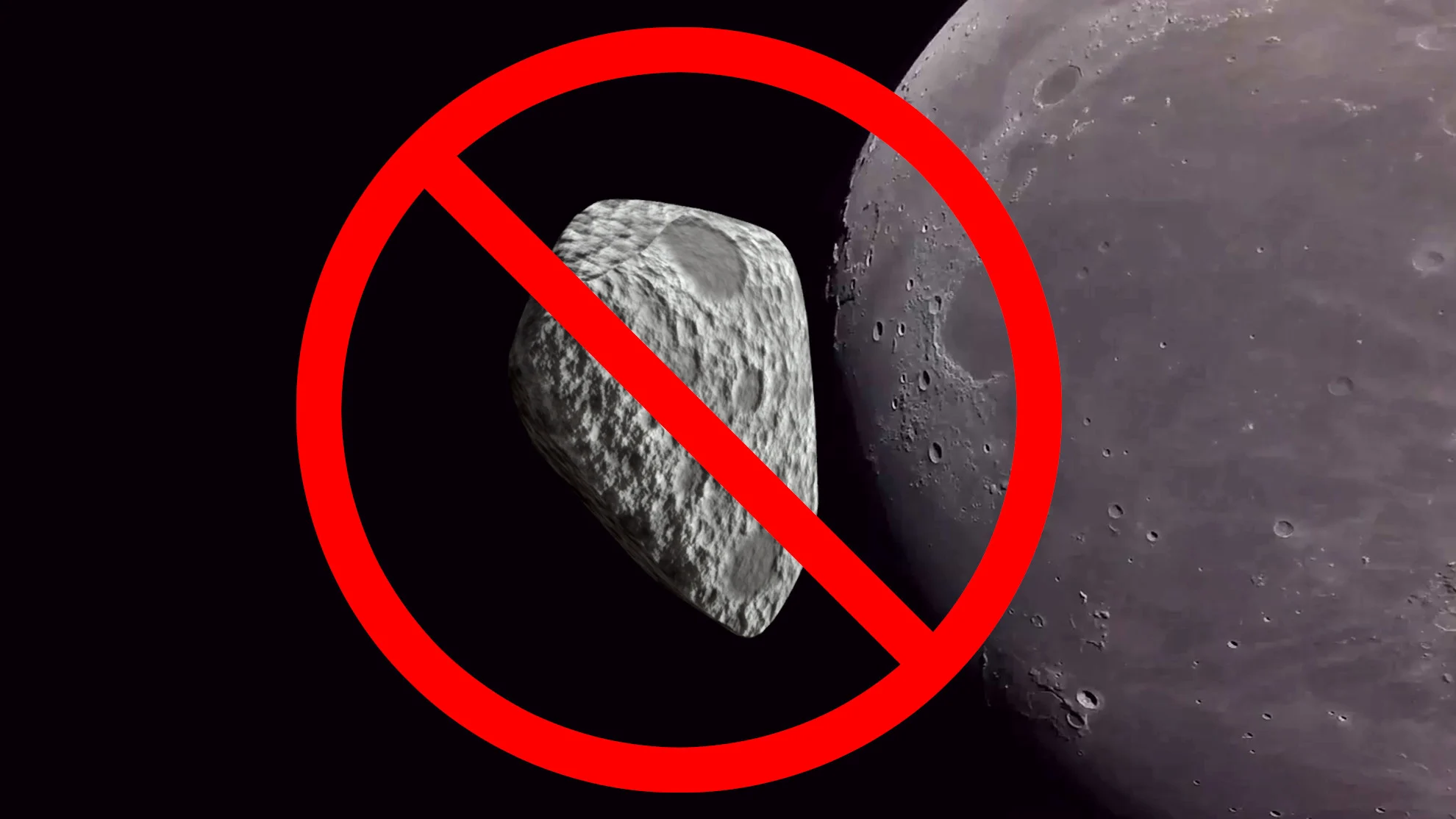
Asteroid 2024 YR4 will not strike either Earth or the Moon in 2032

One of the most complex machines humankind has ever built tracked an almost invisible object many millions of kilometres away, and then accurately predicted its position almost seven years into the future.
Astronomers using the James Webb Space Telescope have now completely ruled out any impact risk from asteroid 2024 YR4, both for Earth and for the Moon.
In late 2024, a 60-metre wide asteroid was discovered that initially had a small but non-zero chance of hitting Earth in December of 2032. This probability was based on the uncertainties of its orbit.
As we track an object through space, it only takes a few observations for us to tell where it will be within the next few days or weeks, with at least reasonable accuracy. However, looking farther into the future, that becomes harder and harder. All of the possible trajectories the object can follow gather into a 'cone of uncertainty', which gets wider the farther forward in time we look.
This is very similar to the cone of uncertainty for hurricane forecasts.
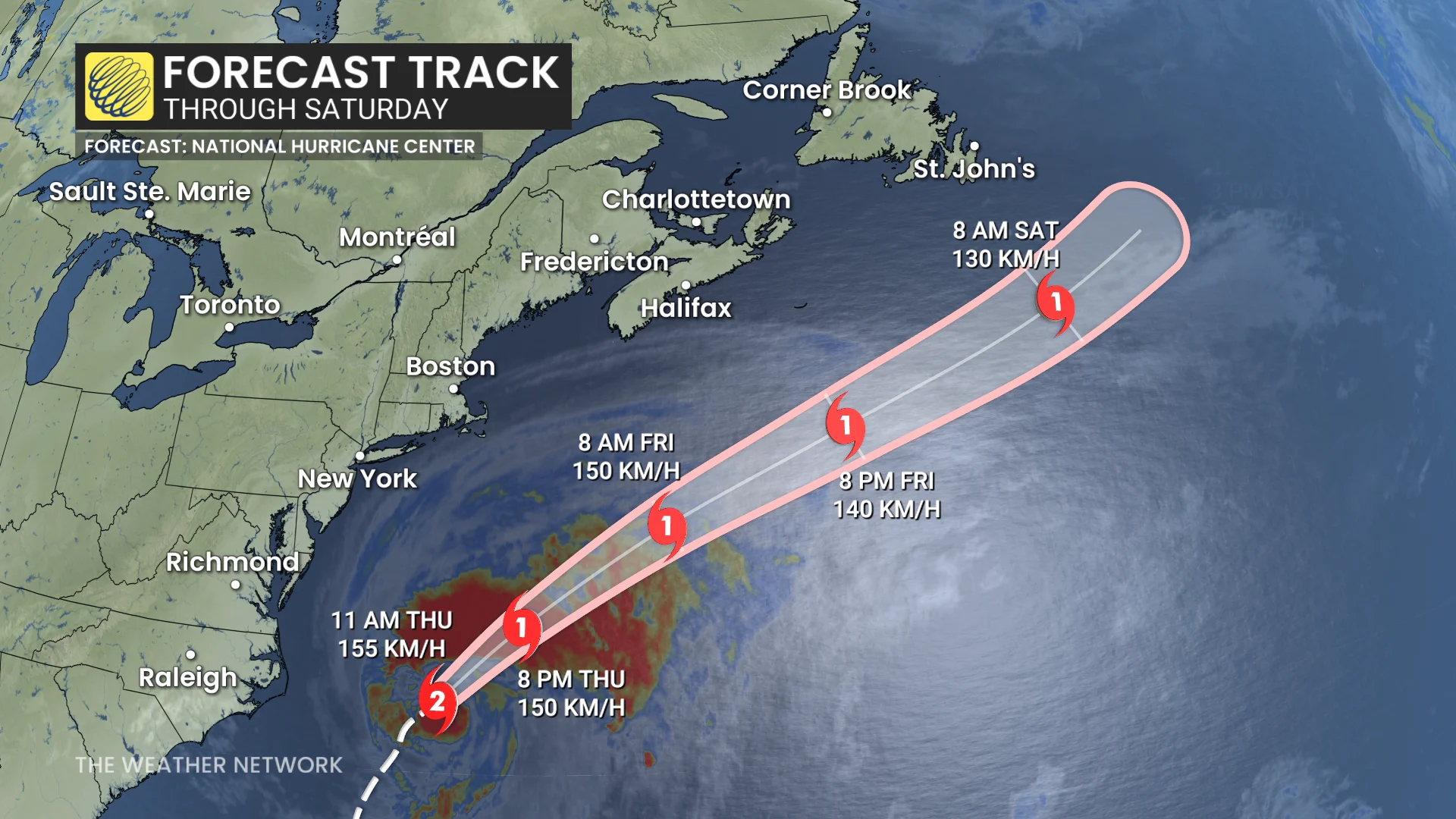
The 'cone of uncertainty' for Hurricane Erin, from August 21, 2025, showing the possible paths the storm could have taken in the days following. (The Weather Network)
The way to shrink that cone, for an asteroid, is to gather more observations. Then, its actual position is compared to where it was predicted to be at that time, based on previous observations. This narrows down its possible trajectories over time.
This is what happened with asteroid 2024 YR4.
When it was found, its cone of uncertainty for December 22, 2032 included a few possible trajectories where it directly intersected with Earth's position on that date. That indicated the possibility of an impact.
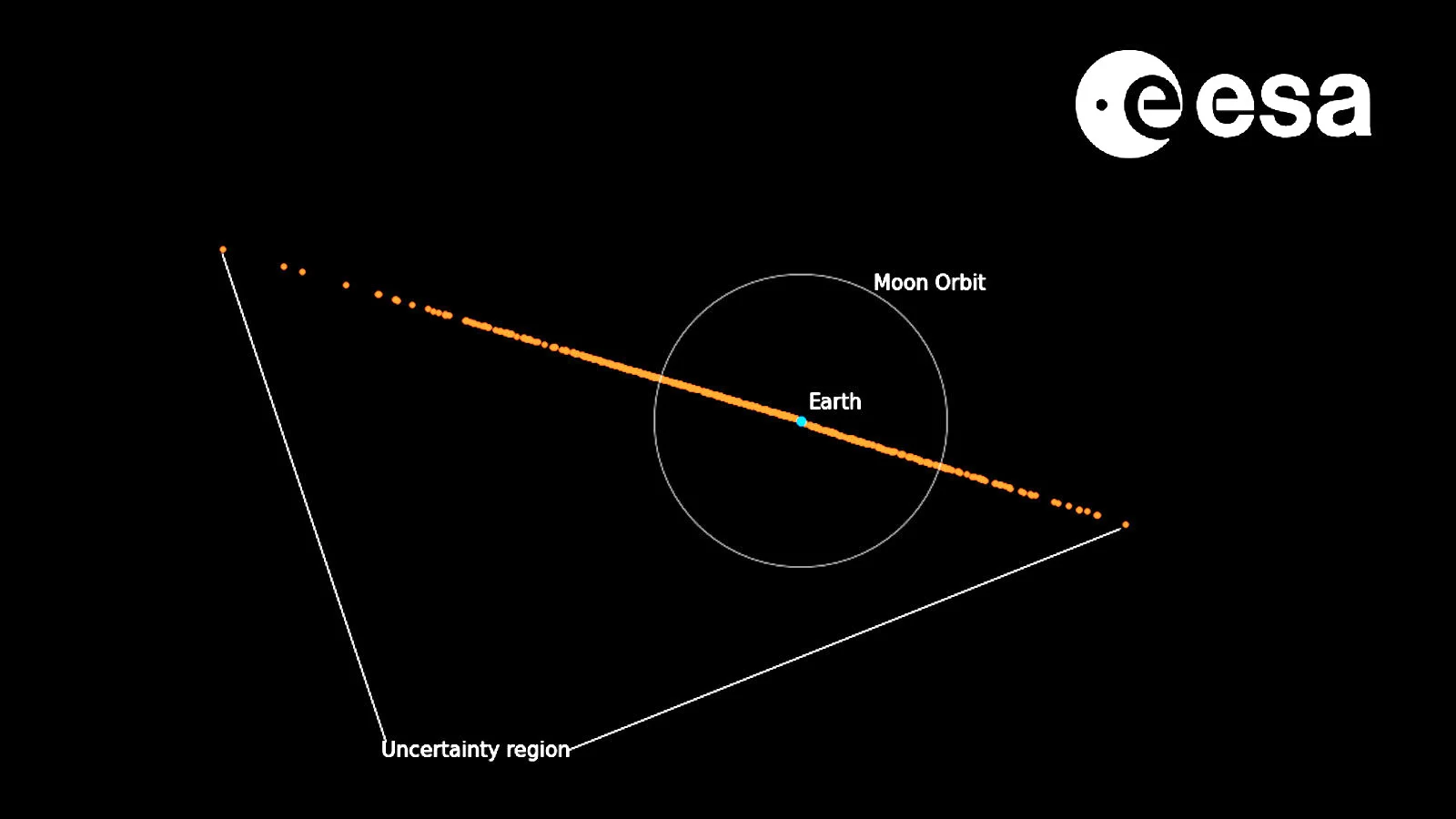
The cross-section of 2024 YR4's cone of uncertainty, as it intersected with the Earth-Moon system on December 22, 2032, included many possible misses, and a few potential hits, for both Earth and the Moon. (ESA)
It wasn't a really significant chance. However, given 2024 YR4's size and the potential damage it could cause if it did strike the planet, astronomers and space agencies labelled the asteroid as one we should continue to observe, to confirm if it was truly a threat.
Over time, new data gathered via telescope began reducing the uncertainties, until its cone eventually slipped away from Earth, removing any possibility of a direct impact here.
Unfortunately, that didn't eliminate all of our concern for this asteroid. Its new 'target' appeared to be the Moon.
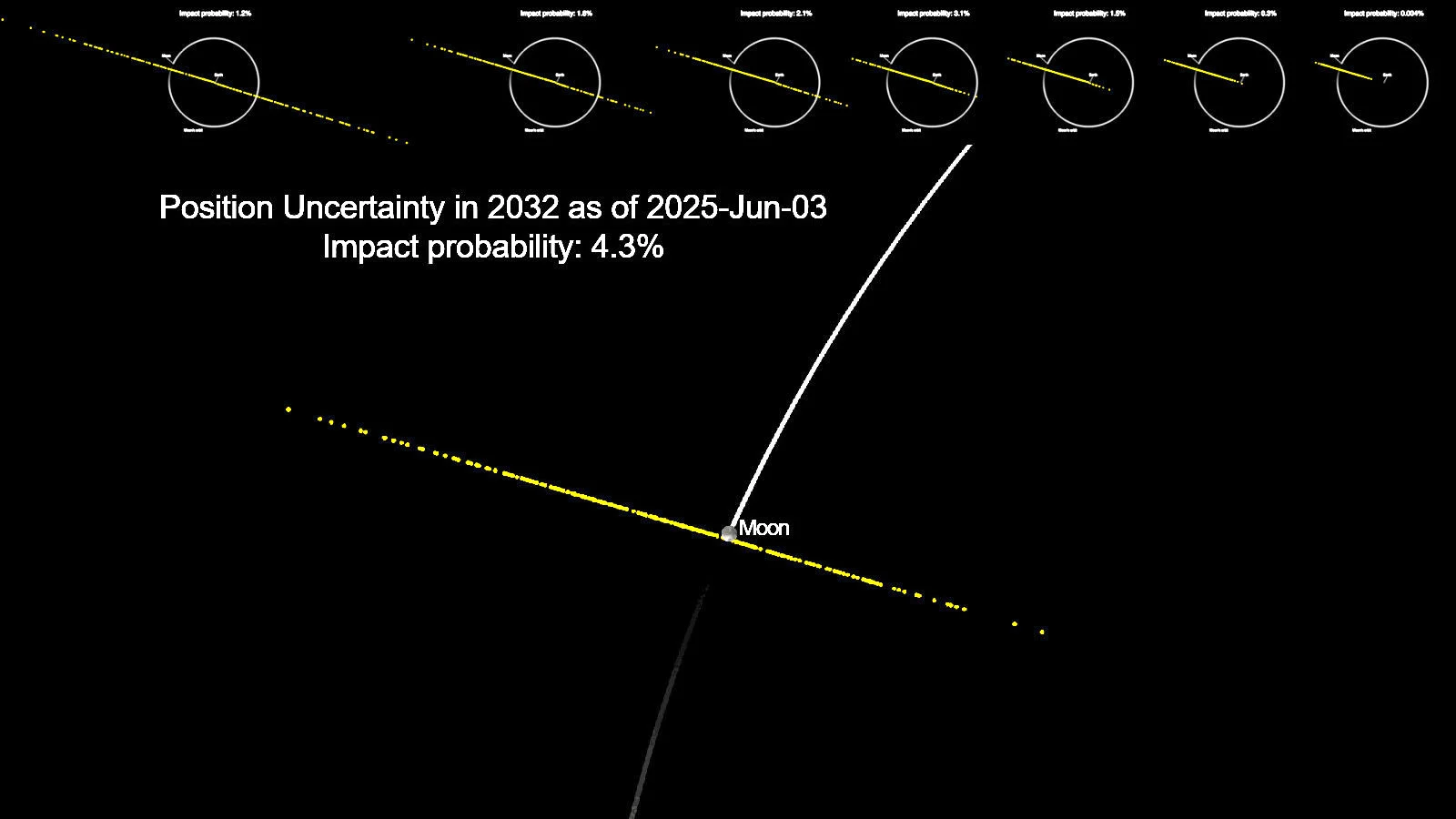
All the major updates of 2024 YR4's trajectory are shown here, along the top of this image, with the latest showing the possibility of it hitting the Moon in 2032. (NASA)
As of the last major update from 2025, there was still a 4.3 per cent chance that 2024 YR4 would strike the Moon on December 22, 2032. Again, while that means there is a 95.7 per cent chance that it would completely miss, the impact risk was still high enough to give this serious consideration.
Researchers even studied the potential consequences of such an impact. Given the speed and energy of the event, along with the Moon's low gravity, tons of lunar debris from the new crater would have been blasted into space. Not only could this debris have affected any operations on or around the Moon itself, it would also pose a threat of 'mission-ending' damage for satellites and spacecraft in low Earth orbit. Depending on exactly where it hit on the Moon, the impact may also have caused spectacular meteor storms in the weeks, months, and possibly years after.
READ MORE: Asteroid impact with Moon would produce visible flash, followed by meteor storms
As of now, though, it appears there is no reason to worry about any of those potential consequences.
New observations taken with the James Webb Space Telescope have completely ruled out any chance of 2024 YR4 striking either the Earth or the Moon.
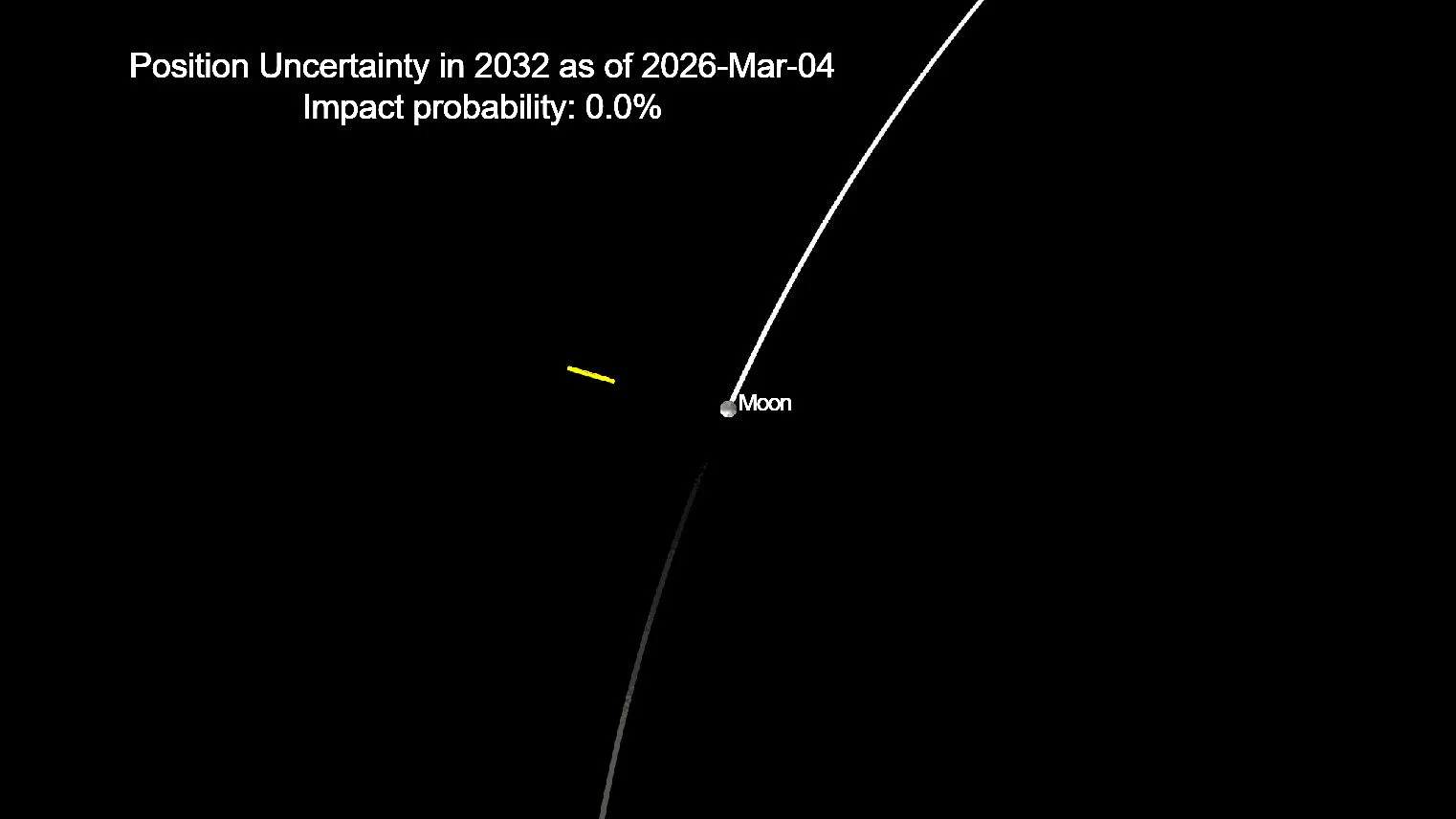
The new collection of possible positions of 2024 YR4 on December 22, 2032, after Webb observations in late February, show that there is now a zero chance of lunar impact. (NASA)
"The challenge was significant," the European Space Agency said in a press release, "to use one of the most complex machines humankind has ever built to track an almost invisible object many millions of kilometres away — and then accurately predict its position almost seven years into the future."
Observations by Webb, gathered between February 18 and February 26, 2026, used the telescope's highly sensitive Near-Infrared Camera (NIRCam). The instrument detected the faint heat signature emitted by the asteroid as it absorbed and reradiated the small amounts of sunlight it was receiving at its location near the outer edge of the asteroid belt.
These observations were then compared to highly accurate star charts produced by the ESA's Gaia mission, which allowed the team to pick out the tiny dot of 2024 YR4 from the background, and thus gather more information on its trajectory through the solar system.
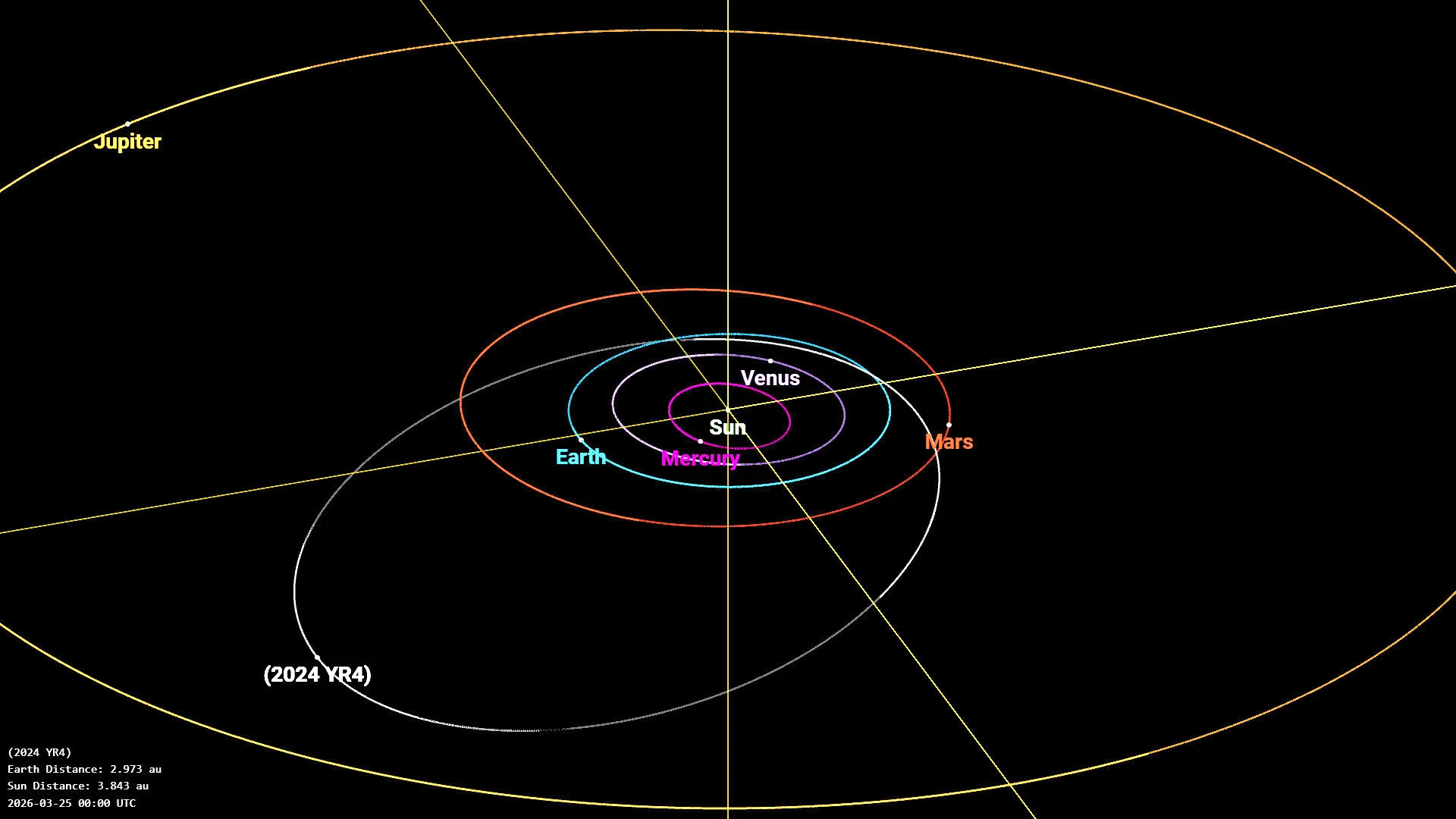
The orbits and positions of the planets of the inner solar system, along with the orbit and position of asteroid 2024 YR4, as of March 25, 2026. (NASA/JPL-Caltech)
This additional data was especially valuable, as it was gathered months after the last observations were even possible.
Thus, when the asteroid's actual position in space, as of late February, was lined up against predictions of where it should be at that time, based on the previous data, it eliminated most of the 2024 YR4's potential tracks. As a result, its cone of uncertainty was reduced down to just a handful of possible trajectories, all of which were outside the Moon's orbit and far removed from any chance of a lunar impact.
DON'T MISS: A Great Comet may shine along with meteor showers and bright planets this spring
This cooperation between telescope missions not only benefitted us in this case, this same methodology can be used in the future.
As Andy Rivkin of the Johns Hopkins University Applied Physics Laboratory and Julien de Wit of MIT told NASA: "The extreme faintness of 2024 YR4 at the time of the measurements provided a challenge because it is difficult or impossible to get good images containing both something as faint as the asteroid and something as bright as some of the stars used to precisely measure its location on the sky. The excellent quality of Webb’s NIRCam (Near-Infrared Camera) design and optics allowed us to develop techniques that worked wonders, however, and that gives us confidence that we can make such measurements again if necessary in the future, and we will not need to learn how to do it from scratch."
(Thumbnail image was produced using photo-editing software, by adding a 3D computer model of asteroid 2024 YR4 to a background image of the Moon taken during NASA's Artemis 1 mission.)