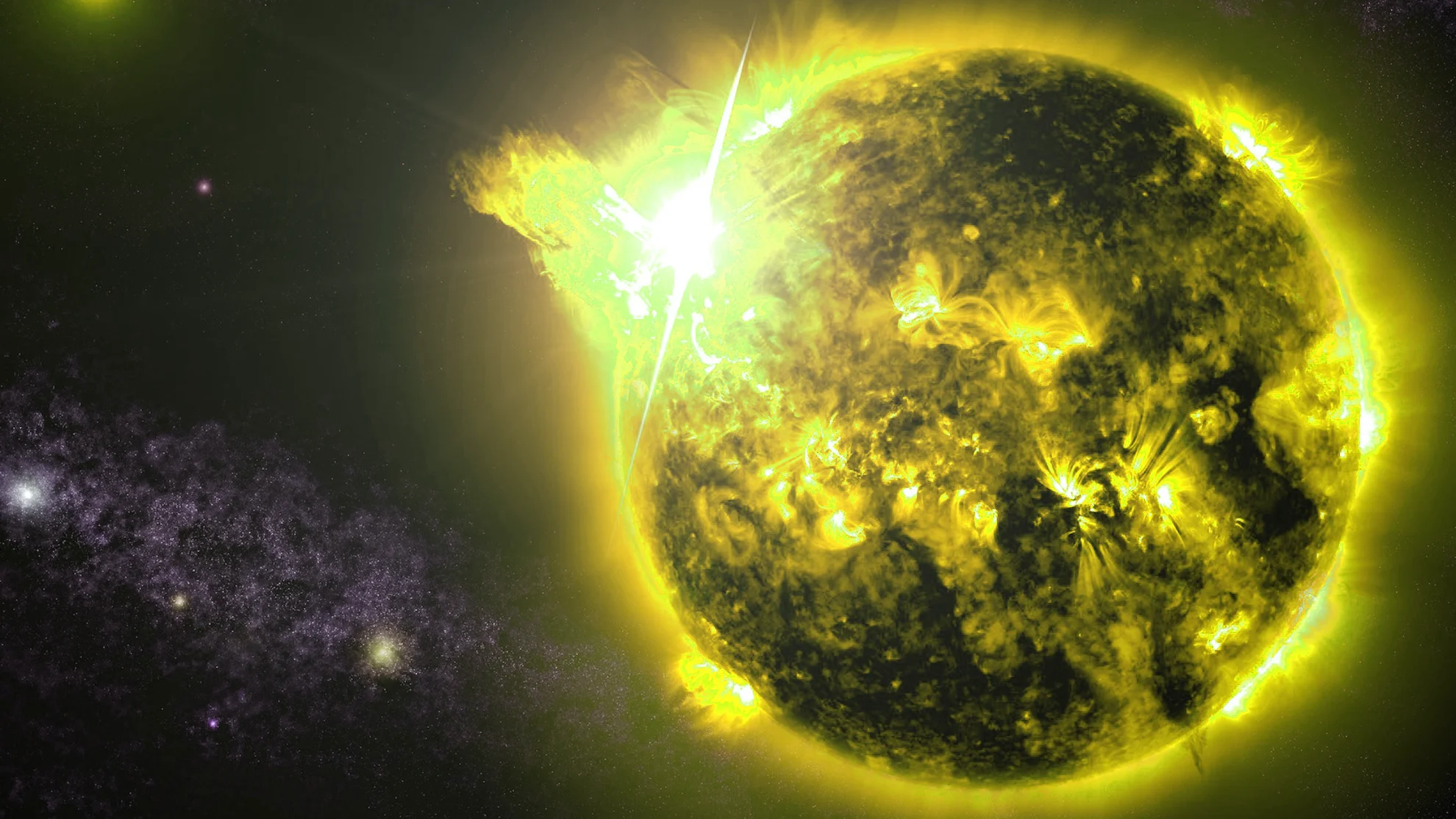
Our Sun is capable of producing devastating superflares

Although they would be exceedingly rare, there is evidence that suggests our Sun is capable of producing solar flares that far outclass anything we have ever seen in human history.
We've witnessed some truly amazing displays of solar activity over the past few years, but new research shows that our Sun is potentially capable of producing superflares, millions of times more powerful than the strongest solar flares on record.
Our Sun is an immense ball of superheated plasma, infused with powerful magnetic fields. From the activity we see on the Sun's surface and its atmosphere, the corona, the intense heat and magnetism there causes it to practically crackle with flare activity, from the tiniest sparks up to the rare and powerful X-class explosions.
What is a solar flare?
A solar flare occurs when magnetic fields permeating the Sun's surface become tangled over time, and then that tangle suddenly and violently unravels.
This begins around dark areas on the Sun's visible surface, known as sunspots. These form when the chaotic motion inside the Sun's upper layer results in a tangle of magnetic fields, and that tangle rises to the surface. There, it becomes trapped, unable to sink back into the upper layer to be recycled and reheated. As it constantly radiates energy out into space, it becomes cooler and darker compared to its surroundings.
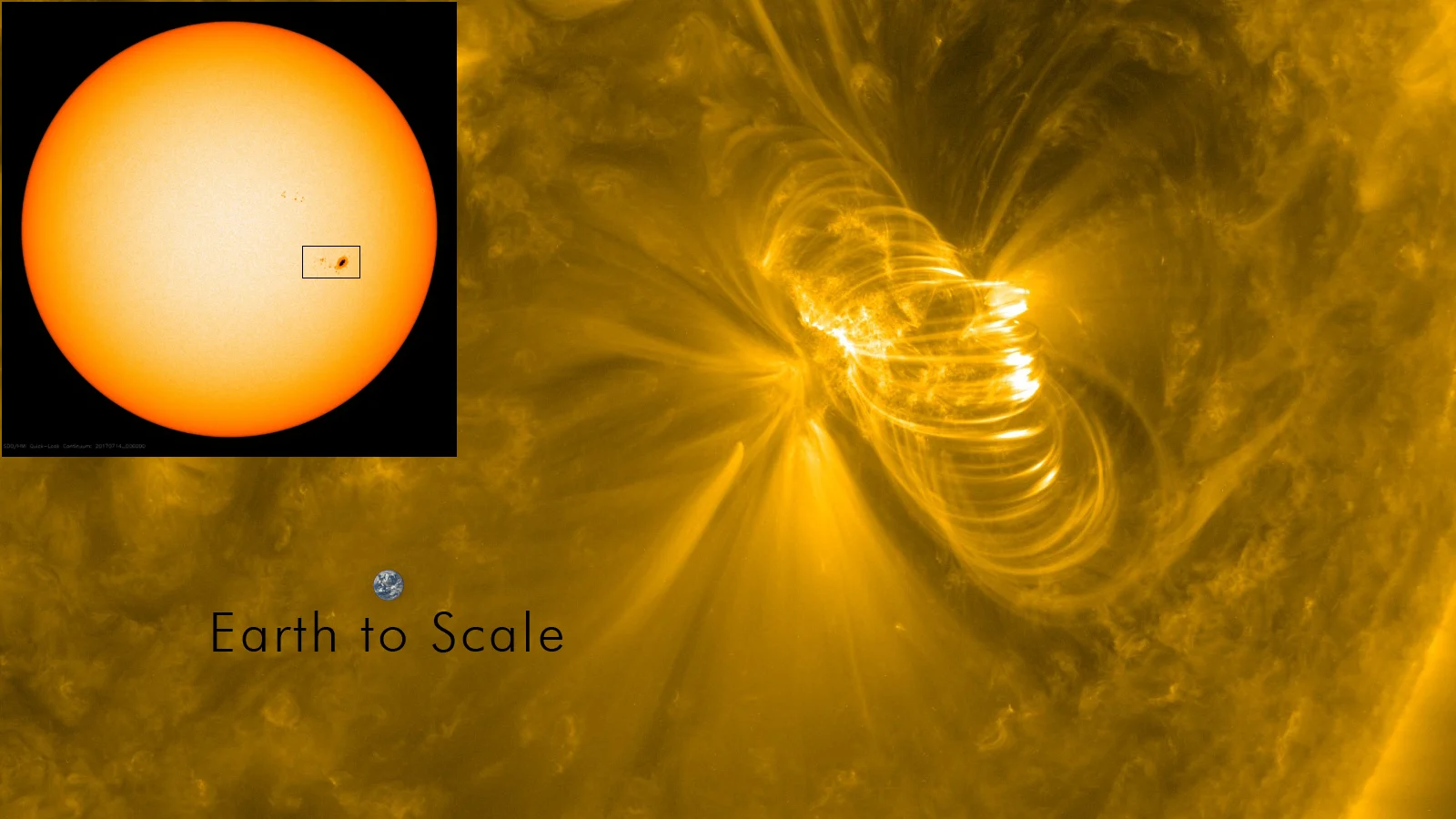
Coronal loops — immense arcs of solar plasma lofted from the surface along magnetic field lines — bridge across an active sunspot region on the Sun on July 14, 2017. Inset, top left: the Sun in visible light at the same time, showing the sunspot that produced these coronal loops. (NASA SDO/Scott Sutherland)
Switching your camera to capture only high-energy ultraviolet light, though, reveals why scientists refer to these as 'active regions'. Although magnetic fields are invisible on their own, on the Sun, superheated particles are drawn up from the surface along the field lines, forming immense arching structures known as coronal loops. Although they can appear tenuous and delicate in satellite imagery, they can reach a million kilometres above the Sun's surface, and often contain billions of tons of solar plasma.
Subjected to the chaos of all the magnetic activity going on around them, these loops constantly move and shift and twist. The longer this goes on, the more likely it is that they become tangled up among themselves, resulting in extremely unstable conditions. When one of those tangles unravels, a tremendous amount of energy gets released in the process. We call that release a solar flare.
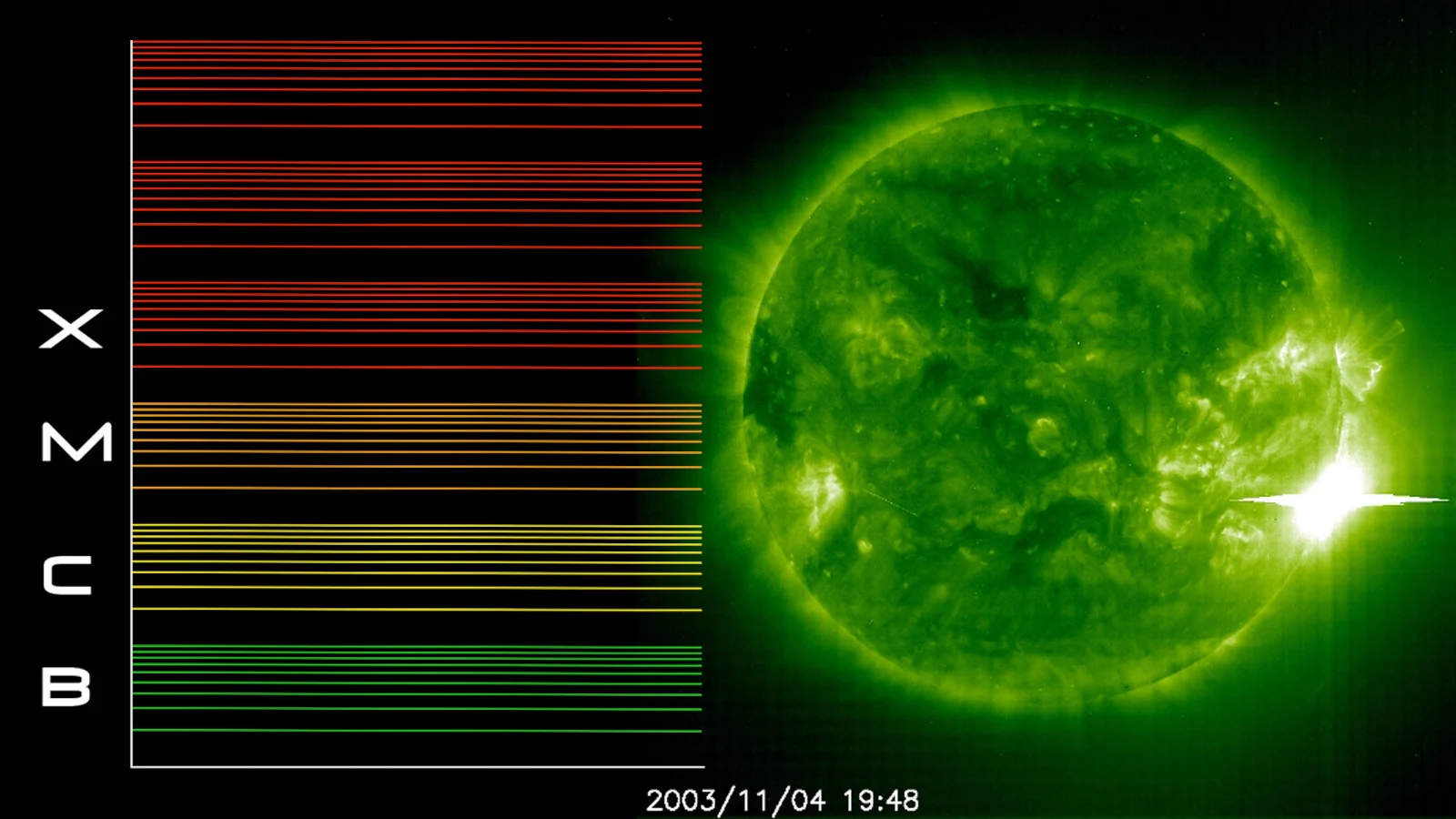
The scale of solar flares, starting with B, each with ranks 0-9, except X-class, which is open-ended at the top. The scale is accompanied by an image of one of the most powerful solar flares ever recorded, which has been estimated at somewhere between X40-X45. (NASA, NASA/ESA, Scott Sutherland)
Over decades of studying solar activity, scientists have determined that the strength of a solar flare tends to depend on the size of the sunspot and the organization of the magnetic fields surrounding it.
On the strength scale for solar flares, there are five different levels — A, B, C, M, and X. Each letter class has 10 levels, and going up one letter class is a 10x increase in power over the previous letter. Thus, an X9-class flare is 10 times stronger than an M9-class, and 100 times stronger than a C9-class. The X-class is also open-ended, with no limit to how high it can go.
A typical X1-class flare will cause radio blackouts on the daylit side of Earth, as the high-energy x-rays supercharge the planet's ionosphere, disrupting the path that radio waves take to get through this part of the atmosphere. If such a flare is accompanied by a coronal mass ejection that is aimed at Earth, when that solar storm arrives, it can spark extremely bright aurora displays in our skies.

This aurora display, seen over Collingwood, Ont, on May 10, 2024, was caused by CMEs that erupted following X1 and X2-class flares in the days beforehand. (Angie Gibson/UGC)
READ MORE: Geomagnetic storms: When should we look up and when should we worry?
How strong do flares get?
As of 2026, there are two solar flares that stand out over all others, as the strongest in recorded history.
On November 4, 2003, active region AR486 had just turned away from Earth, and was barely visible around the western limb of the Sun, when it unleashed a surprisingly strong flare. Even today, nearly 23 years later, it remains the most powerful ever recorded by satellites.
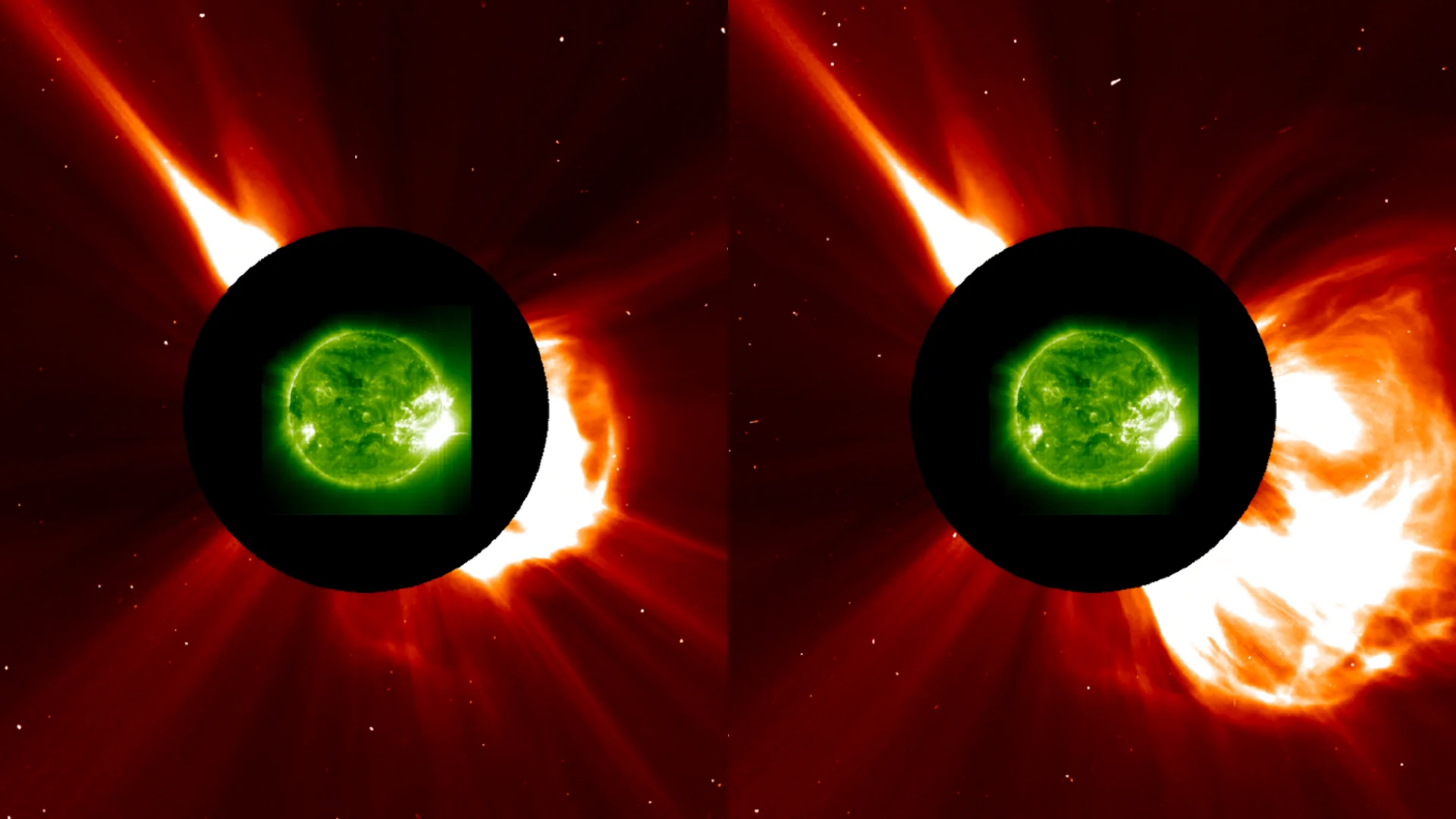
Two views of the November 4, 2003 solar flare. On the left, the flare maximum, when it saturated the sensor and the coronal mass ejection it caused just beginning to emerge from behind the coronagraph shield (the bright region to the right of the circular gap). On the right, less than 10 minutes later, the flare is subsiding, but the full extent of the CME has come into view. (NASA/ESA, Helioviewer, Scott Sutherland)
The sensor that recorded the flare couldn't capture its full strength. Initial estimates, based on what the sensor could gather before it overloaded at X17, put it as an X28-class flare. However, studies performed afterward upped that estimate to more like X40 or X45-class. That's at least ten thousand times more powerful than an X1-class flare! The only reason why we didn't see major impacts from this event is that the flare and CME were aimed away from Earth.
To find something stronger, we have to go back to September 1, 1859. At the time, two astronomers were independently observing an immense sunspot on the Sun's surface, when they noted a very distinct flash of light. What they witnessed was apparently a 'white light' flare. The next night, skies all around the world erupted in bright, colour aurora displays, and this became known as the Carrington Event.
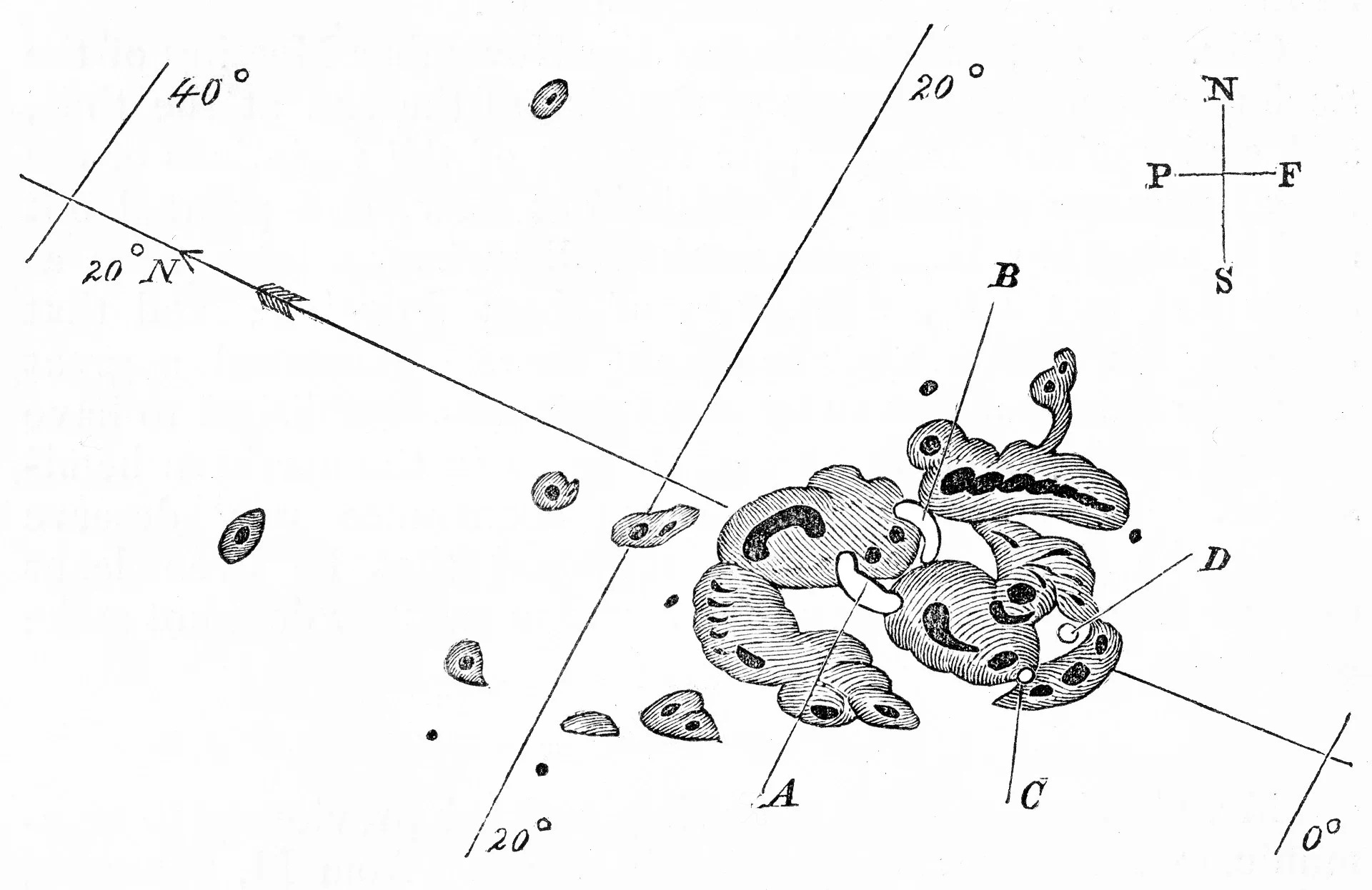
Richard Carrington's sketch of sunspots on September 1, 1859 reveals the initial bright flash (A and B), and where that migrated to (C and D) over the course of five minutes of observations.
One team of researchers, going over records from the event and applying what they know of geomagnetic storms and space weather from today, estimated that the flare that caused the Carrington Event would have been around X80-class. That puts this flare at around 100 million times more powerful than an X1-class flare!
It's no wonder why the resulting geomagnetic storm is considered to be the most powerful we've ever seen.
Out of this World: Where do the Northern Lights come from?
Superflares
Why is all of that background information important to this story?
Because as powerful as the above flares were, new research is showing us that the Sun may be capable of producing superflares — flares at least hundreds of times stronger than even the 1859 Carrington flare.
We have detected these superflares on other stars. Most were from either very young stars, or from smaller red dwarf stars, both of which have reputations in the astrophysics community of being highly volatile.
However, a few have been spotted on Sun-like stars, and research has shown that these larger, older stars have the potential to produce them at a rate of about one every 100 years or so.
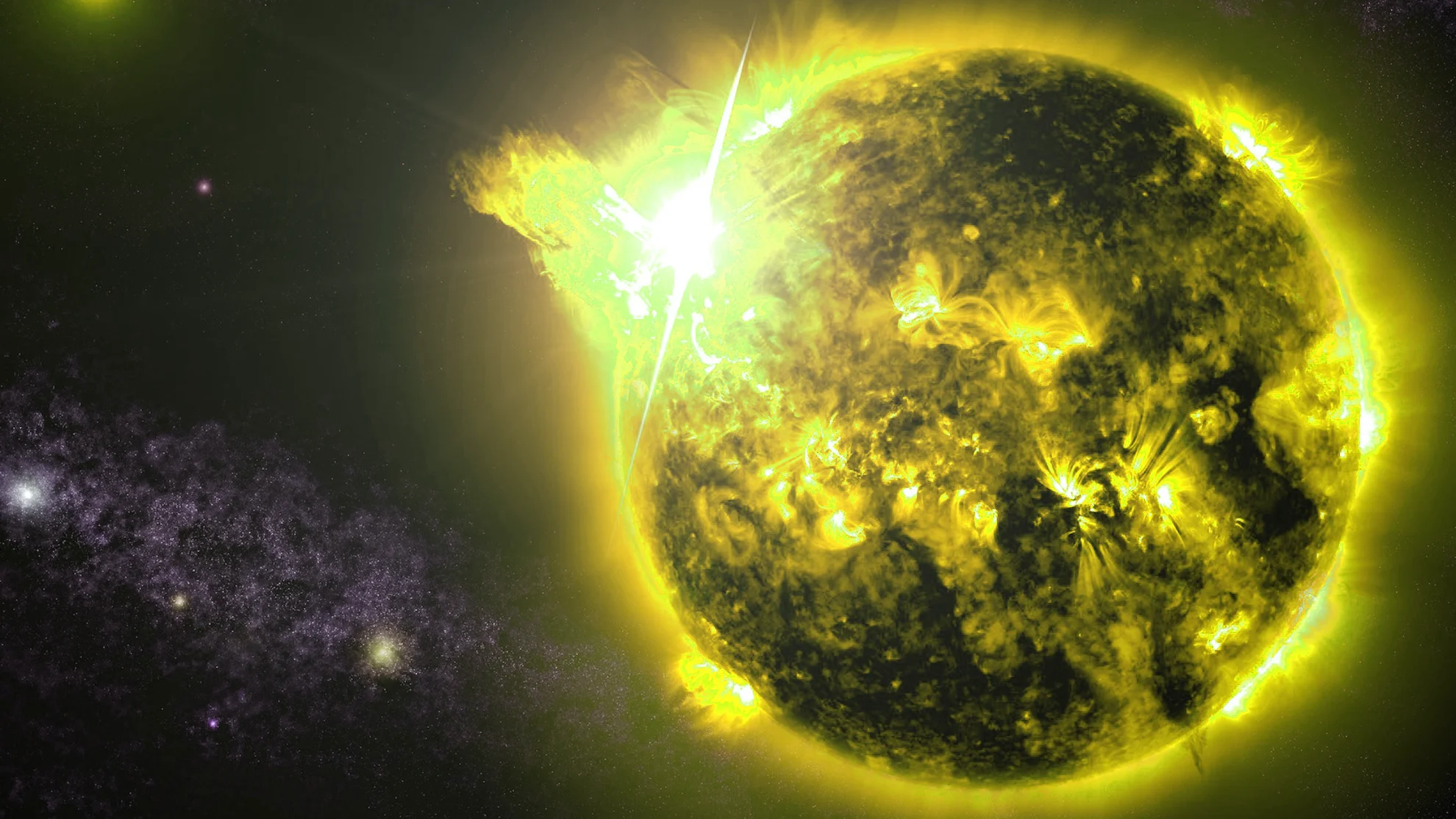
An artist's impression shows a superflare exploding from the surface of a Sun-like star. (NASA)
Looking at sunspot and flare activity from our own Sun, between 2010 and 2016, a team of researchers from the Max Planck Institute in Germany and the University of Colorado examined the relationship between sunspot size and flare strength.
Taking the 300 strongest flares that occurred within that time period, their study compared the energy those flares released with the size of the active region they were associated with.
"Of course, we knew that no superflares had occurred during the observation period," Dr. Natalie Krivova, the lead author from the Max Planck Institute, said in a press release. "But the statistical relationship we found between the released energy and the size of the active region should hold true for more powerful events as well."
Using this relationship, they then scoured through sunspot records going back four centuries. One in particular, already known for being the largest ever photographed, caught their attention.
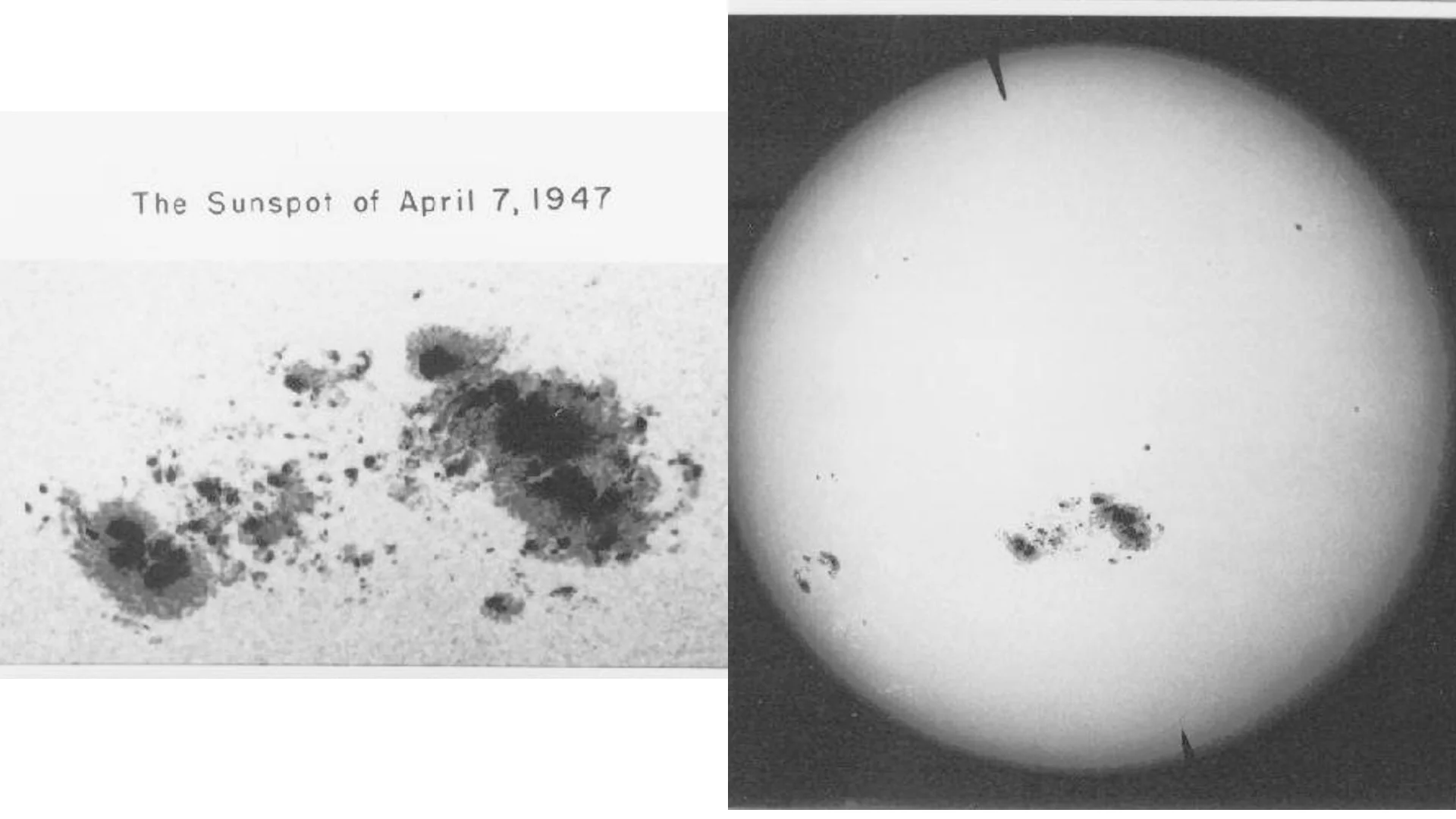
Two views of the Great Sunspot of 1947, as imaged by astronomers at the Mount Wilson Observatory. These views have been flipped vertically to orient the southern hemisphere of the Sun at the bottom of the image. (Carnegie Science)
Occurring in April 1947, this sunspot group — AR 8478 — was observed and imaged by solar astronomers as it crossed the face of the Sun. At maximum size, it covered an area of around 18 billion square kilometres. That's nearly as large as the planet Jupiter, and you could fit 40 Earths, side by side, across it!
While the Great Sunspot of 1947 did not produce a superflare, based on its size, this study reveals that the potential was there, nonetheless!
Additionally, the researchers noted that the likelihood and potential energy of extreme flares might actually be enhanced by 'nesting' or 'clustering'. This is when multiple large sunspots form in close proximity, increasing the dynamics between the magnetic fields of these active regions, as well as their potential for producing exceptionally strong flares. This activity has been noticed on the Sun in the past, and it will be something for us to keep an eye on in the future.
"Our Sun has superflare potential," Dr. Krivova concluded. "It can produce massive sunspots that, in principle, can serve as the starting point for the most extreme bursts of radiation."