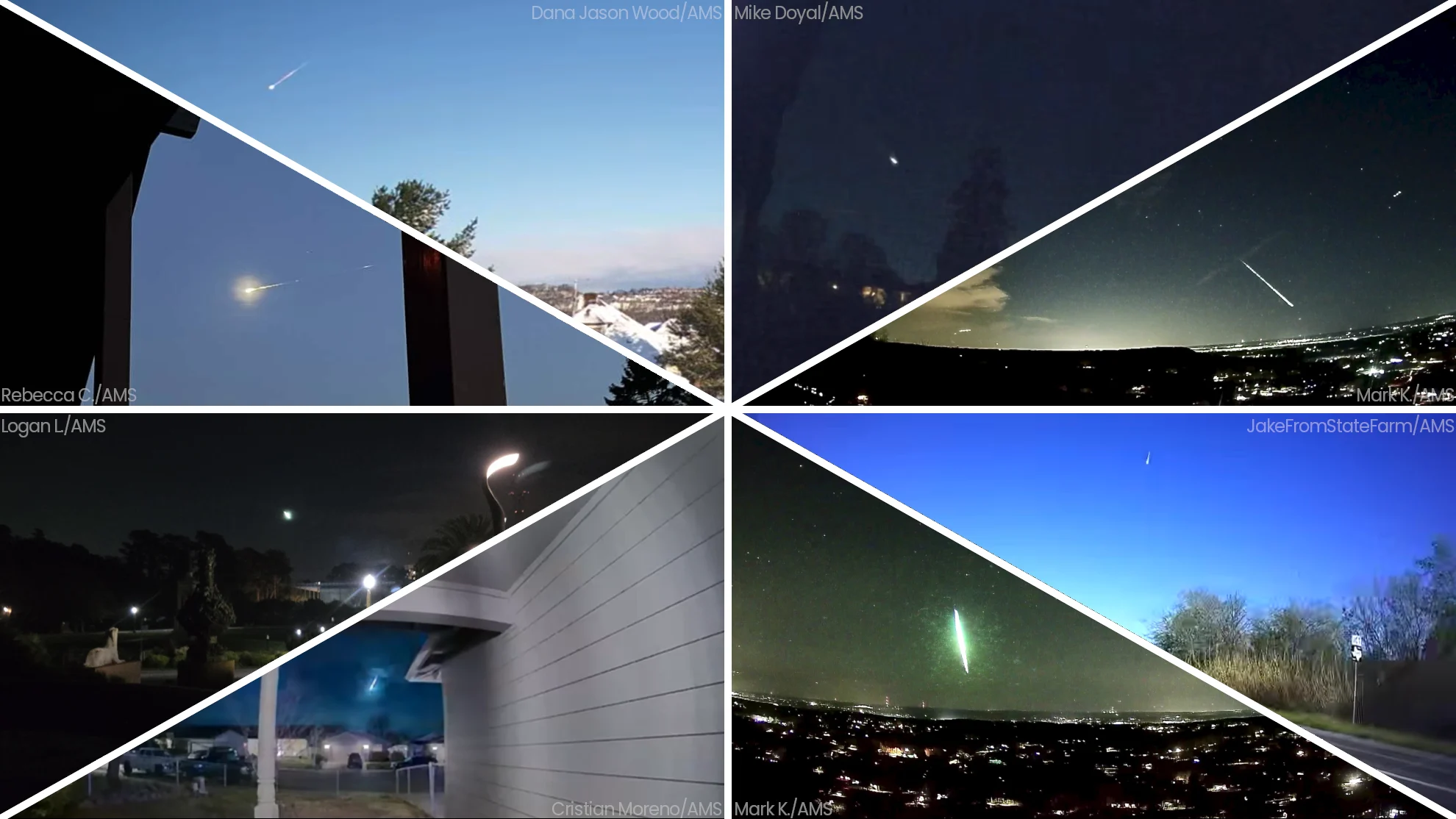
With so many bright fireball meteors lately, what's going on?

It has been March meteor madness so far this month, with an uptick in larger space rocks being swept up by our planet!
There has been a noticeable uptick in the number of bright meteor fireballs spotted throughout the month of March so far. So, what's happening?
This all apparently started on a crisp, fairly clear morning on March 17, 2026, when a roughly 2-metre wide asteroid exploded over northern Ohio. The bright meteor caused by this asteroid was spotted from as far away as northern Michigan, western Illinois, and North Carolina, and it touched off a sonic boom that was heard across the lower Great Lakes region.

This view of the bright daytime fireball over northern Ohio was captured by Jared Rackley of the National Weather Service Pittsburgh office. (NWSPittsburgh/X)
Although initial reports cast doubt on the likelihood of finding meteorites from this event, several were located in Medina County, Ohio. According to the American Meteor Society (AMS), these were rare "HED achondrite" meteorites, which may originate from the surface of 4 Vesta, the second largest object in the asteroid belt.
In the days that followed this event, additional bright fireballs were seen over different parts of the United States.
On March 21, an estimated 1-metre wide asteroid plunged into the atmosphere over southeastern Texas. According to NASA, its passage through the atmosphere produced a pressure wave that caused sonic booms heard throughout the area. Doppler weather radar in the area even caught meteorites falling to the ground from this impact, one of which apparently crashed through the roof of a house, bounced off the floor, hit the ceiling again, and then clattered to a stop. Fortunately, nobody was injured.
The day after that, on March 22, another fireball was spotted over southern California, followed by one more in central Michigan on March 23.
However, these were only the events that have occurred since the March 17 bolide caught our attention.
Going back to the beginning of March 2026, the AMS lists a total of 94 fireball events with at least 5 witness reports to back them up. Roughly one-third of these were spotted from Europe, with the rest seen over different regions of the United States, including nearly a dozen that were also spotted from parts of Canada.
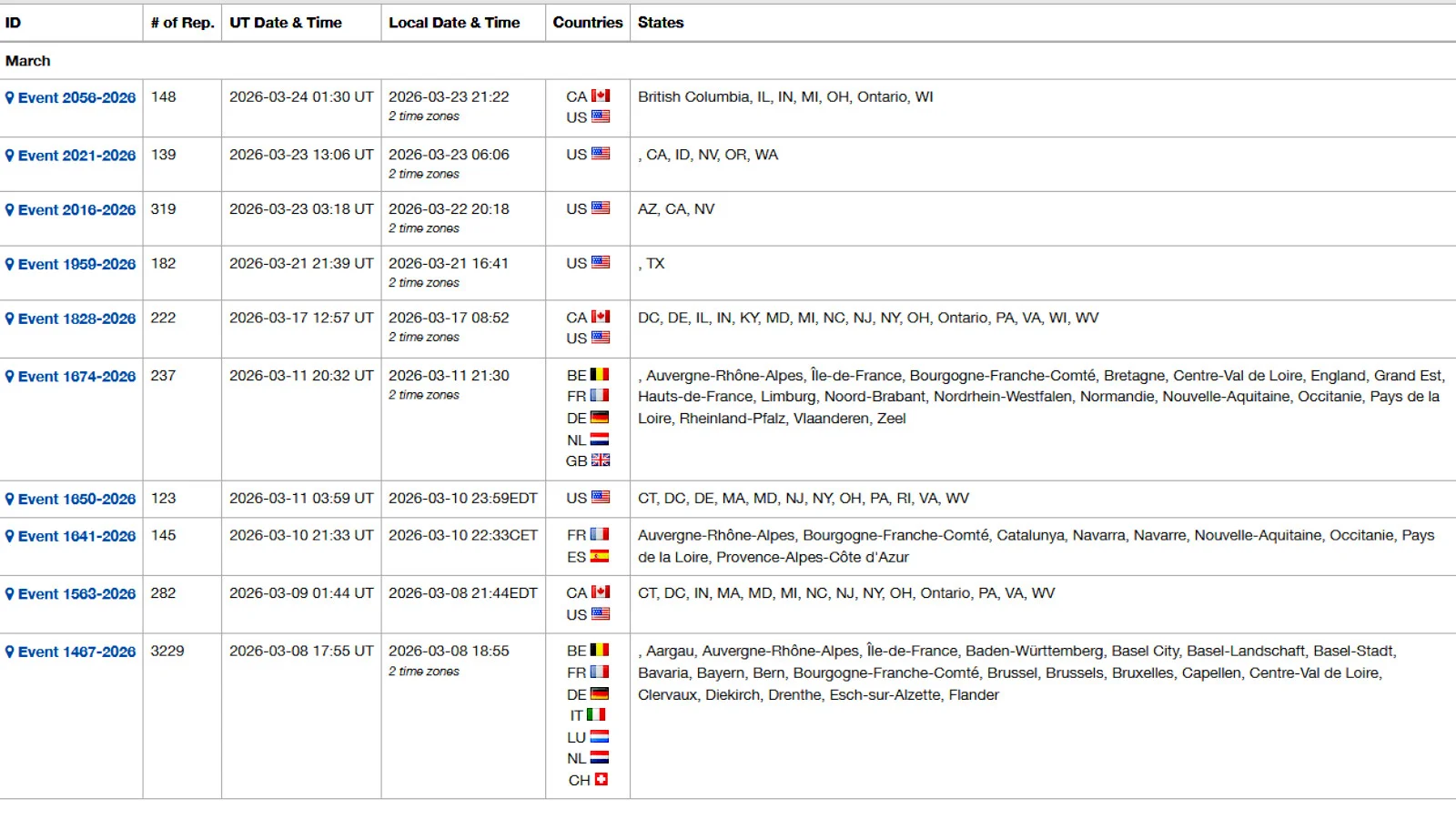
AMS fireball events from March 2026, with over 100 reports. (American Meteor Society)
Of that total, 19 events were reported by 50 people or more, 10 had over 100 reports, and one even had more than 3,000 witnesses.
That singular event, a daytime fireball on March 8, occurred over Luxembourg and western Germany, at around 7 p.m. local time. To date, the AMS has 3,229 witness reports from across France, Germany, Luxembourg, Belgium, The Netherlands, and Switzerland. Along with these reports, scores of videos and photographs were included of the bolide itself and the resulting smoke trail it left behind in the air.
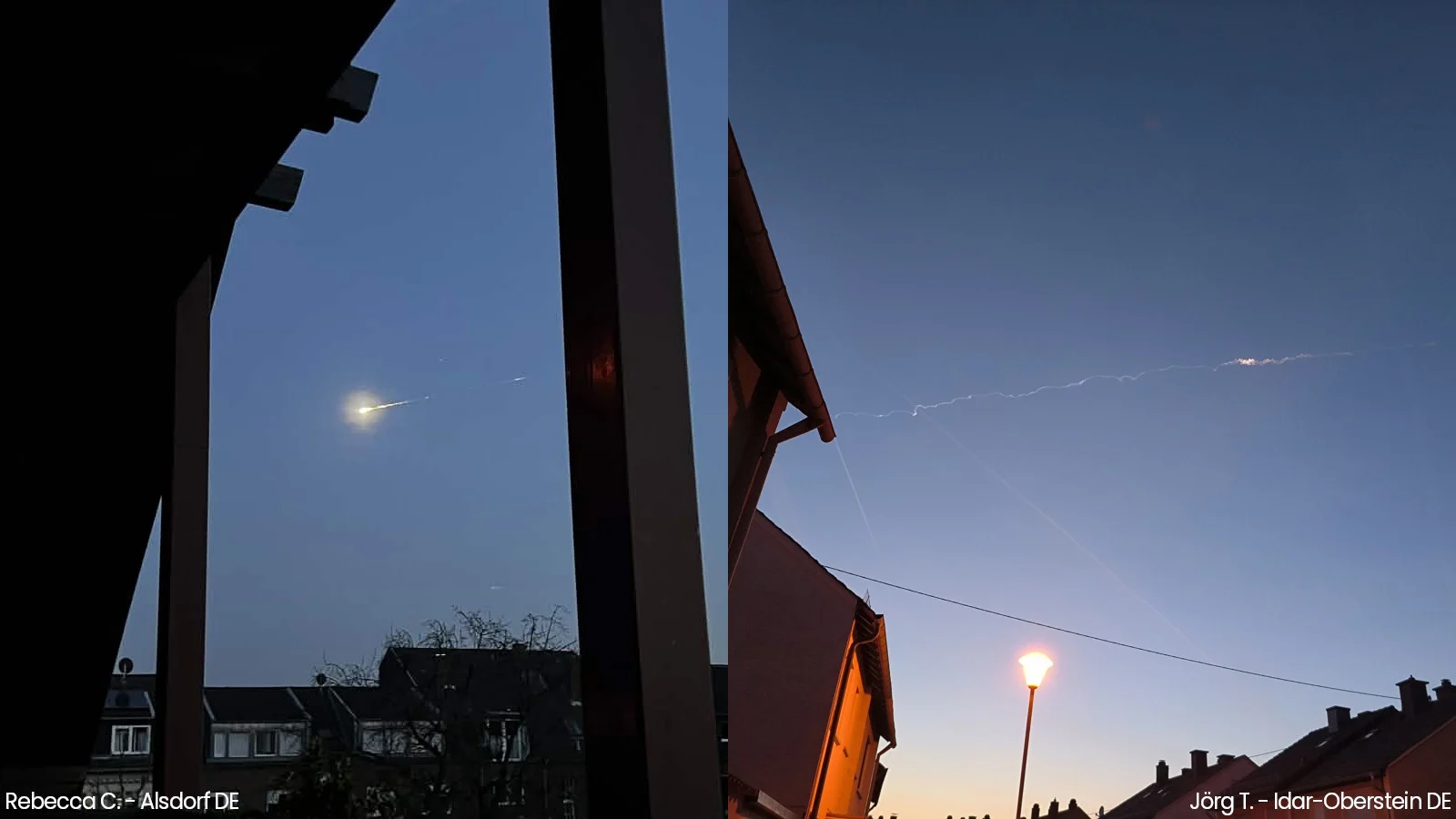
The European bolide from March 8, 2026, showing the fireball (left) and the smoke trail it left behind (right). (Rebecca C./Jörg T., courtesy the American Meteor Society)
Scientists with the European Space Agency have gone over the data and footage from this event. They determined that it was likely an object a few metres across. Thus, it was similar (at least in size) to the one that exploded over Ohio on March 17.
According to the ESA, objects of that size hit Earth at least once every few weeks, up to once every few years.
READ MORE: Possible meteor creates house-shaking boom S. of Lake Erie
So, what's going on?
Well, we can rule out meteor showers, as none are currently active in our skies. The last one, the Quadrantids, peaked on the night of January 3, and was over by the 12th. The next one, the Lyrids, hasn't started yet, as it's active from April 14-30, and peaks on the night of April 22.
Also, there are no large asteroids or comets headed towards us. While science fiction stories have used the trope of smaller impacts heralding a much larger incoming strike, we don't have to worry about that here. Telescopes can spot dangerous near-Earth objects weeks, months, or even years in advance, before they ever get close to Earth. Those that have slipped by these observations have only been smaller ones, which don't pose a serious threat, and we are getting better at detecting those, all the time.
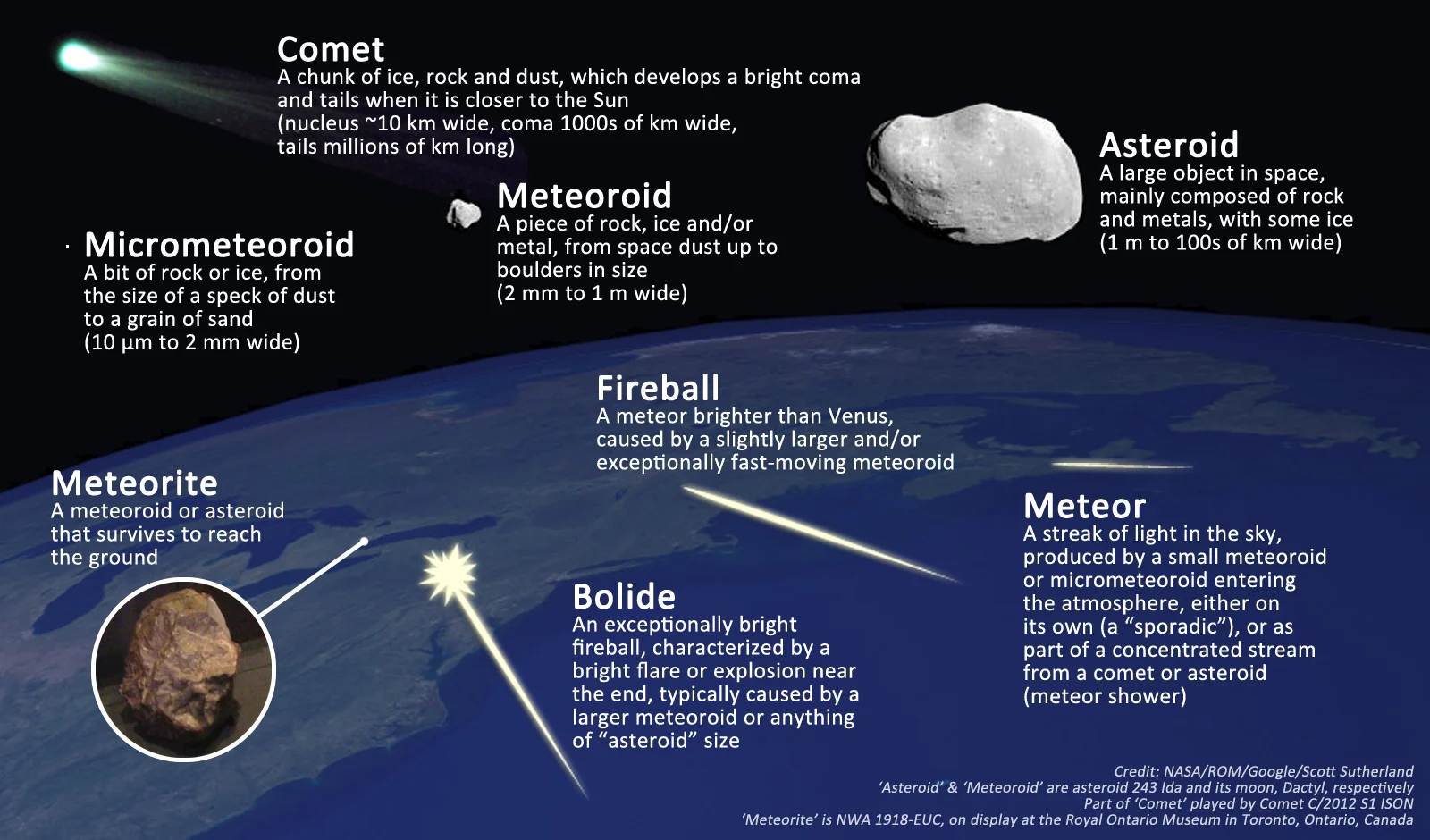
Now, on any night of the year it is possible to look up and see a random, 'sporadic' meteor flash by overhead. In fact, anywhere from 14 to 100 tonnes of meteoroids and space dust is swept up by Earth's atmosphere, each and every day. Most of the meteors from these objects are missed, because they happen over remote areas, or when it is too bright or cloudy out to notice them.
Related to this, there is a well-known phenomenon where the number of sporadic fireballs increases around this time of year.
"From February through April, the appearance rate of these very bright meteors can increase by as much as 10% to 30%, especially around the weeks of the March equinox," NASA says. "Exactly why is not known. Some astronomers think the Earth passes through more large debris at this time of year, causing an uptick in fireball sightings."
For this reason, this time of year is often called 'Fireball Season'.
RELATED: A Great Comet may shine along with meteor showers and bright planets this spring
Something unusual?
According to Mike Hankey, from the American Meteor Society, an analysis of these recent significant fireball events, as reported on their website, revealed an interesting trend.
So far in 2026, their data doesn't show any significant increase in the total number of fireballs being reported, compared to previous years. What has changed, though, is that the number of significant events — those with at least 50 witness reports each — has roughly doubled compared to the average of the past five years of reports from the same period (January-March).
"So it's not that more rocks are hitting us — it's that more of them are big enough to notice," Hankey wrote in a post on March 25.
One thing that supports this idea is the number of sonic booms reported along with these significant fireballs.
A sonic boom is caused when an object compresses the air around it, causing pressure waves to form and spread away from the source. For a meteoroid to produce one, it must reach the denser air lower down in the atmosphere. To survive that journey, the object needs to be larger and denser than most.
Based on Hankey's analysis, out of the 38 significant fireballs from January to the present day in 2026, roughly 80 percent were large enough to cause a sonic boom. This is unusual.
As he detailed in the report, both 2021 and 2023 also saw roughly 80 per cent sonic boom-producing fireballs between January and March, but that was with fewer significant fireballs (only 21 in 2021 and 16 in 2023).
This year is unique in that it has both more significant fireballs and a higher percentage of them producing sonic booms.
"Thirty large fireball events producing audible booms in a single quarter means roughly one every three days," Hankey wrote.
DON'T MISS: Asteroid 2024 YR4 will not strike either Earth or the Moon in 2032
Difficult to know, for sure
There is one limiting factor to all of this — there is no way to know, for sure, about what is happening, simply due to a lack of records for comparison.
Meteors occur all around the world, every night. However, with Earth's surface roughly 70 per cent open ocean, and its human population clustered in specific regions of the landmasses, there is a lot of area left where these events can go unobserved.

Earth at Night highlights the areas on our planet where humans are gathered and which areas are largely unoccupied. (NASA's Earth Observatory)
NASA can track fireballs, of course. They keep a running tally of these events, from April 1988 to the present, based on special sensors picking up infrasound, due to meteoroids exploding in the atmosphere, or the flash of the fireball being picked up by the Geostationary Lightning Mapper instruments on NOAA's GOES weather satellites. However, these fireballs need to be large enough to be picked up by these sensors.
The AMS site is dependent on people observing fireballs, either with their own eyes or on videos captured on their equipment, and then reporting the details of those events in an accurate way. And given the fact that fireballs happen so high in the atmosphere it is very challenging to track their exact trajectories based on these reports.
There is the Global Meteor Network, headed by Denis Vida, of the University of Western Ontario, which has the stated goal of establishing a global network of cameras pointed at the night sky. However, they still have a ways to go before they reach that goal.
So, when it comes down to it, there is really no way of knowing exactly how many fireballs fall around the world. What we're seeing now may be completely normal. Similar fireballs may have occurred in previous years, but over regions where they were missed, and the only thing different this year is that they happened where people could witness them.
Perhaps once this Fireball Season has ended, further analysis can yield more insights into what might be happening.
(Thumbnail image gathers eight different fireball events from March 2026 — in clockwise order, starting at the top left corner, Germany on March 8 by Rebecca C, Ohio on March 17 by Dana Jason Wood, Michigan on March 23 by Mike Doyal, Pennsylvania on March 8 by Mark K., Texas on March 21 by Scott Prinsen, New York on March 11 by Mark K, Oregon on March 23 by Cristian Moreno, and California on March 22 by Logan L.)