
Ontario snow squalls pack a wallop; setup to bring more this week

The final week of 2025 in southern Ontario kicked off with high winds knocking out power to thousands, and lake-effect snow squalls creating whiteout conditions.
Major impacts piled up across Ontario as another, powerful low-pressure system traversed through the province on Monday, bringing with it an entire assortment of hazardous conditions.
Warm air aloft provided plenty of freezing rain to southern and eastern Ontario through the day Sunday and early Monday, coating surfaces, trees, and power lines with a weighty crust of ice.
SEE ALSO: Freezing rain and ice pellets are dangerous winter hazards
Meanwhile, northeastern Ontario was forced to hunker down against blizzard conditions, which resulted in highways closures in and near locales such as Wawa, Sault Ste. Marie, Chapleau, and the Timmins area. The highways into and out of Wawa and Chapleau became impassable early Monday morning due to the treacherous conditions.

More than 62,000 Hydro One customers were without power across the region at one point as the powerful winds battered ice-covered power lines and trees.
Warmer temperatures over southern Ontario paired with the high, atmospheric moisture brought heavy, late-December rains to the region late Sunday. Pearson International Airport recorded 41.2 mm of rainfall on Sunday, breaking the record for its all-time, rainiest December day--a record that had previously stood for 63 years.
Localized flooding has also been reported in Toronto thanks to the heavy overnight rains.

Flooding in a Toronto park on Dec. 29, 2025. (Tyler Hamilton/The Weather Network)
High winds over Lake Erie also resulted in flooding along the lakeshore, prompting the Grand River Conservation to issue a flood warning for the watershed region.
DON'T MISS: Why snow squalls are so tough to forecast
Peak temperature swing on Monday included a 16-degree drop in Hamilton and a 20-degree plummet in Windsor from Sunday night to Monday morning.

Peak wind gusts:
Point Petre – 97 km/h
Billy Bishop Toronto City Airport – 93 km/h
St. Catharines/Niagara District Airport – 90 km/h
Chatham-Kent – 89 km/h
Cobourg – 88 km/h
Welcome Islands – 88 km/h
Windsor airport – 85 km/h
John C. Munro Hamilton International Airport – 84 km/h
Kingston airport – 84 km/h
Canadian Forces Base Trenton – 84 km/h
The Buffalo-Niagara International Airport also recorded a peak wind gust of 116 km/h on Monday morning.
Travel is not advised again on Tuesday as more lake-effect snow squalls are expected; however, if it cannot be avoided, please check Ontario 511 for current road conditions before heading out, in case of any closures.
What's to come Tuesday and beyond
Forecasters are watching for widespread, lake-effect snow squalls to continue into Tuesday, further impacting travel by creating sudden whiteout conditions, especially downwind of Lake Huron and Georgian Bay.
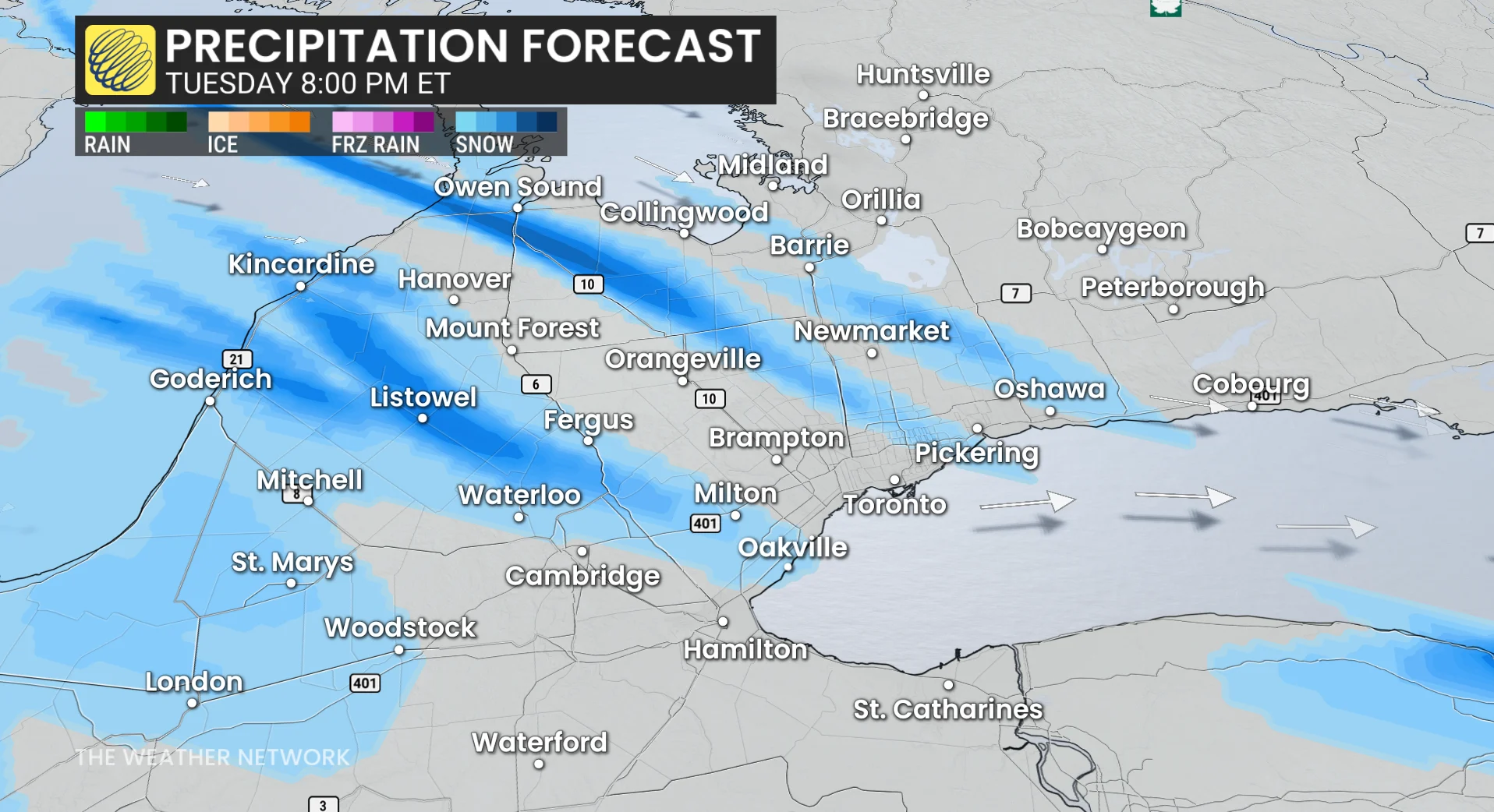
Closures and collisions were reported on portions of highways 4, 6, 8, 10, 21 and 23 on Monday evening.
Persistent snow bands are currently dumping up to 30 cm of snow through Tuesday. The primary concern, however, is not the accumulation itself, but the problematic blowing, drifting, and reduced visibility.
Collingwood, Barrie, southern Kawartha Lakes and northern York and Durham regions are dealing with the most intense squall activity off Georgian Bay.
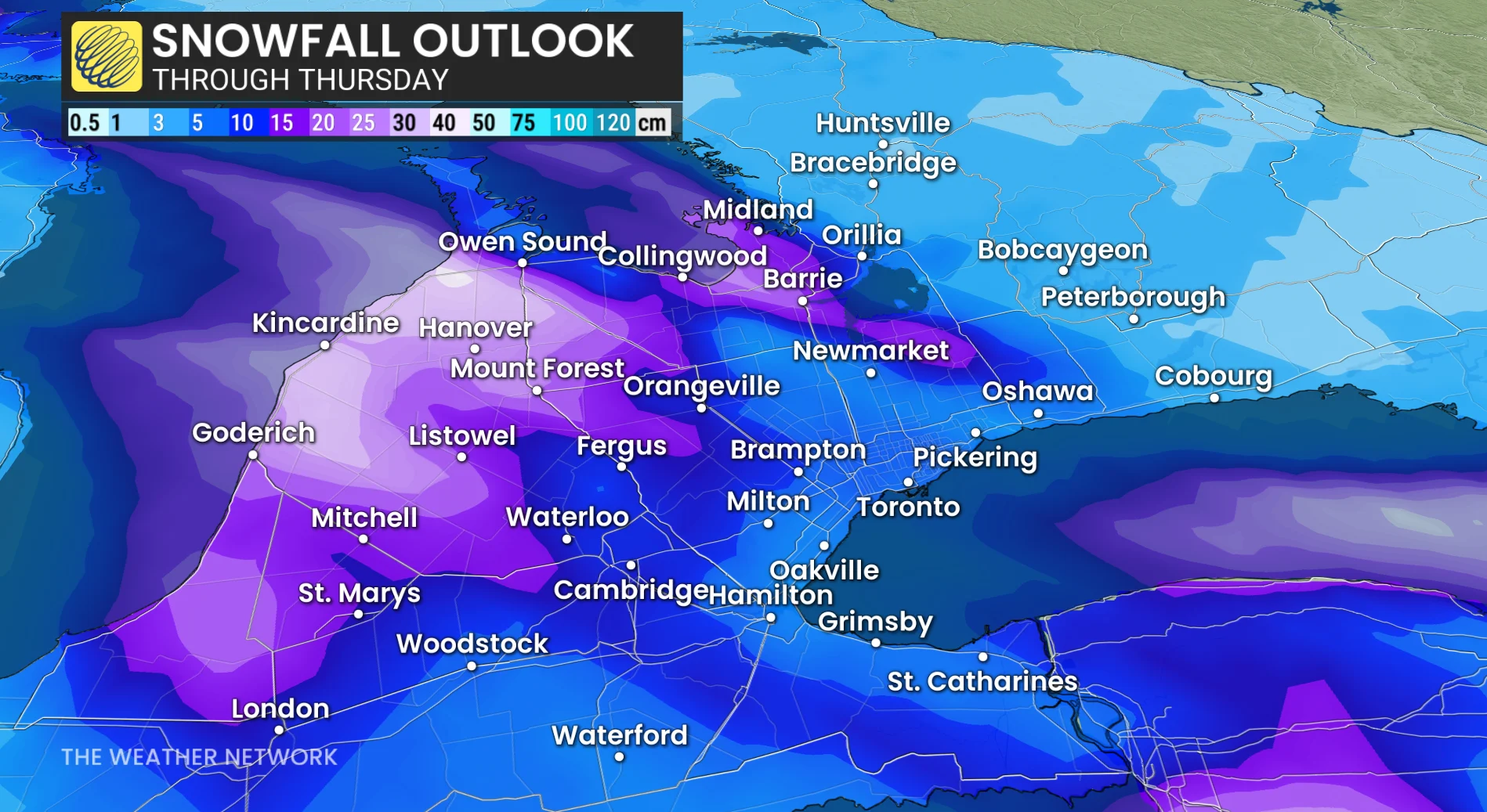
Severe squalls off Lake Huron are producing whiteout conditions. Huron, Grey, Bruce, Perth, northern Wellington, and Middlesex counties are dealing with the worst of it.
Squalls and cold air will persist into Thursday and Friday with up to 50 cm possible locally. A burst of locally heavy snowfall is threatening the Greater Toronto Area on New Year’s Eve. A potent upper trough will slide across the region, potentially enhancing snowfall.
See below for social media posts showcasing the impacts of this winter storm event across southern Ontario.

Cochrane, Ontario. Dec. 29, 2025. (Submitted)

Road closures reported in New Hamburg, Ont. Dec. 29, 2025. (Mark Robinson/The Weather Network)