Recurring water restrictions 'new reality' for Calgary after water main break

Calgary Mayor Jeromy Farkas says there's a "ticking time bomb" under the city's streets, and that means residents can expect regular water restrictions over the months to come.
"This Bearspaw feeder main served Calgarians for many years, but right now, it is at end-of-life," Farkas told CBC Radio's Calgary Eyeopener on Monday.
RELATED: No drop in Calgarians' water usage despite water main break
"No amount of short-term fixes, no amount of patchwork will be able to get this back into a reliable condition."
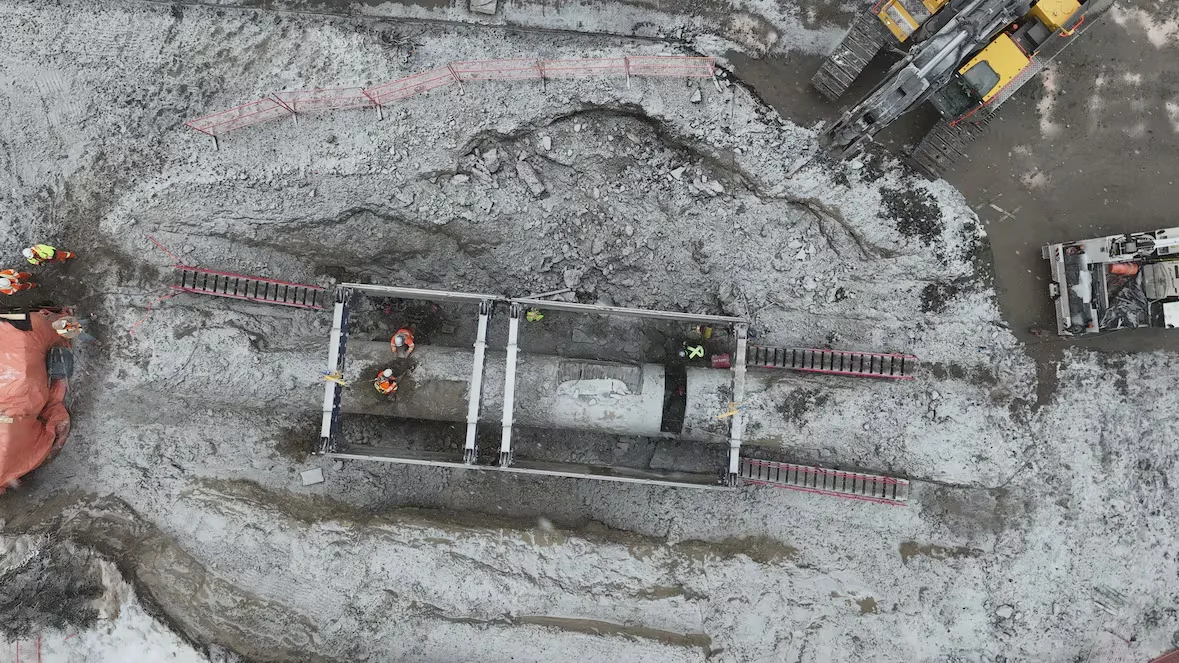
On Jan. 4, 2026, city crews continued their repairs at the break site along 16 Avenue N.W. (City of Calgary)
Last Tuesday, Calgary saw its second "catastrophic" water main break in the northwest in less than two years. That led to water restrictions and a boil-water advisory for several northwest communities, which were lifted late on Sunday.
Advisories had been in place for people in Parkdale, Montgomery and Point McKay and West Hillhurst since Dec. 30.
On Sunday, crews finished cutting the damaged section of pipe out of the feeder main, said Michael Thompson, general manager of infrastructure services, in an update Monday. It has been sent to a facility for further investigation, and crews are now inspecting the pipe in the ground using both human and robotic inspection methods, Thompson said.
Once the pipe inspection is complete, crews can begin installing the replacement section.
“If everything goes well, we are planning on having the repair complete and the pipe operational by early next week,” Thompson said.
The city would then still need time to refill the feeder system with water and test it before being in a position to ease usage restrictions.
"As we're doing the needed work changing the operations of the existing sick and failing pipe, we are living in a new reality of water usage," Farkas said.
Mayor warns of 'loss-of-life territory'
In a post on X on Monday, Farkas wrote that overnight, the city "slipped further" into the "red zone," referring to an unsustainable range of water use.
"Without changes, we'll enter loss-of-life territory, where firefighting and emergency response may be compromised. This is serious," Farkas wrote.
"Reducing use now protects lives and keeps essential services running. Please conserve."
Officials have urged residents to save water by taking shorter showers and reducing toilet flushing.
"The first Monday of 2026 is expected to mark a return to work and school for many Calgarians. We're continuing to remind everyone to adjust their water use habits and help conserve our water system," Sue Henry, Calgary Emergency Management Agency chief, wrote in statement on Sunday.
Over the past number of days, Calgary's water use has crept above the city's goal of 485 million litres. That threshold is set to ensure water is available for consumption and for emergency response and firefighting.
“A single fire can use 4.5 million litres of water and draw down a storage location by 25 per cent,” Henry told reporters on Monday. “This is the same amount that 26,000 Calgarians would use in a day.”
Speaking to the Calgary Eyeopener on Monday, Farkas said the situation had evolved rapidly.
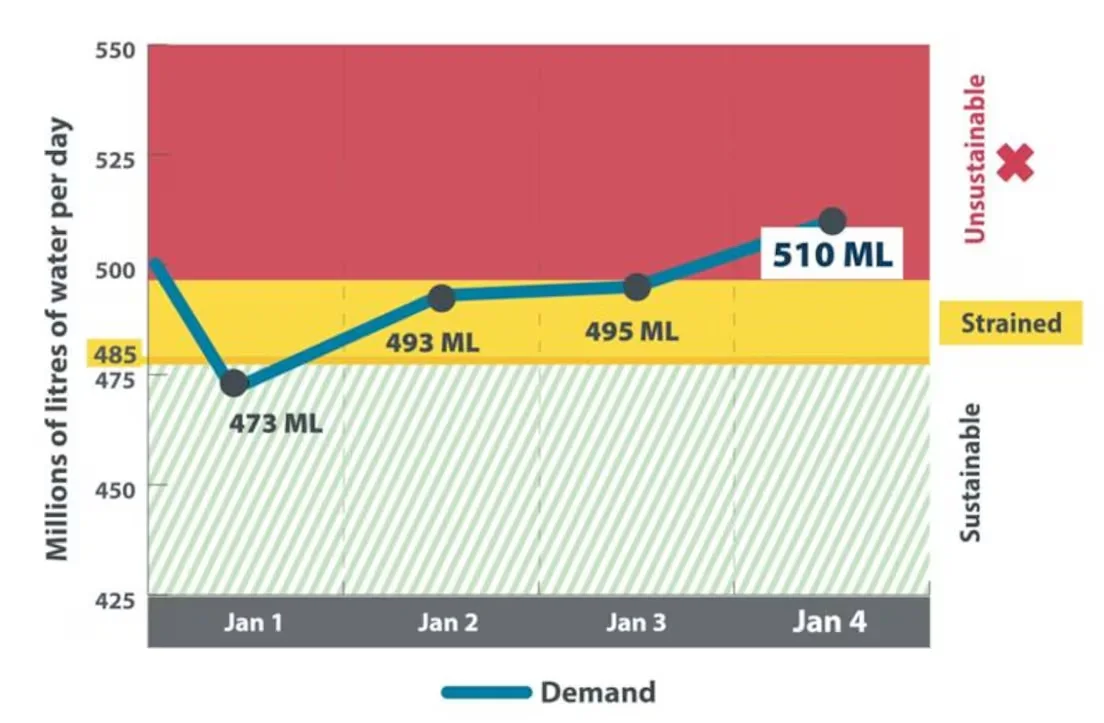
Calgarians water usage has been creeping up since the water main break. (City of Calgary)
"I think it's fair to say that we're living in a new normal," Farkas said.
"We have to do absolutely everything that we can to address the immediate needs to fix [the feeder main]. But the medium-term and the long-term fix to this is both governance as well as building out that parallel line." The replacement project is scheduled to start this spring.
"We are replacing the engine of the aircraft while in mid-flight. But until that work is done, we need to change how we think about water. Not for a few days, not only during emergencies," Farkas said.
"For a while, this is how life will be."
Future restrictions are yet to be finalized, Thompson said.
"When we have to take this pipe back out of service to do those additional urgent repairs, those measures are going to come back," he said.
"As we go through the summer, where our water usage is the highest, we're going to have to have some sort of restrictions in place."
The city is focused on bringing the Bearspaw feeder main back into service by next week, to lessen its reliance on the smaller Glenmore Water Treatment Plant, which Thompson said is a serious concern as water usage trends higher. The Glenmore plant is currently providing roughly three times its usual winter production for the city's water supply, Thompson said.
“We are working very hard to keep it running at this capacity, but if there are any mechanical or other issues, it will have a serious impact on our water supply," said Thompson. "We need to keep enough water in the Glenmore Reservoir to get us through the winter.”
The Bearspaw South Feeder Main supplies treated water to about 1.5 million people in Calgary and in surrounding communities.
Thumbnail courtesy of City of Calgary via CBC.
The story was originally written and published for CBC News. It contains files from CBC Radio's Calgary Eyeopener and The Canadian Press.