Look up! This week's Perseid meteor shower peak could be the best in years

Coinciding with this month's New Moon, the peak of the Perseids could put on the best show we've seen from this meteor shower in years!
Check your weather forecast for clear skies tonight! Even though the Perseid meteor shower has already reached its peak, there's still time to catch this amazing annual celestial light display.
Each night since mid-July, tiny meteoroids have been plunging into Earth's atmosphere from space, producing streaks of light flashing out of the northeastern sky. Furthermore, the number of these meteors has been slowly increasing, and this week — specifically on the night of August 12-13 — they have reached their maximum, as the Perseid meteor shower peaked.
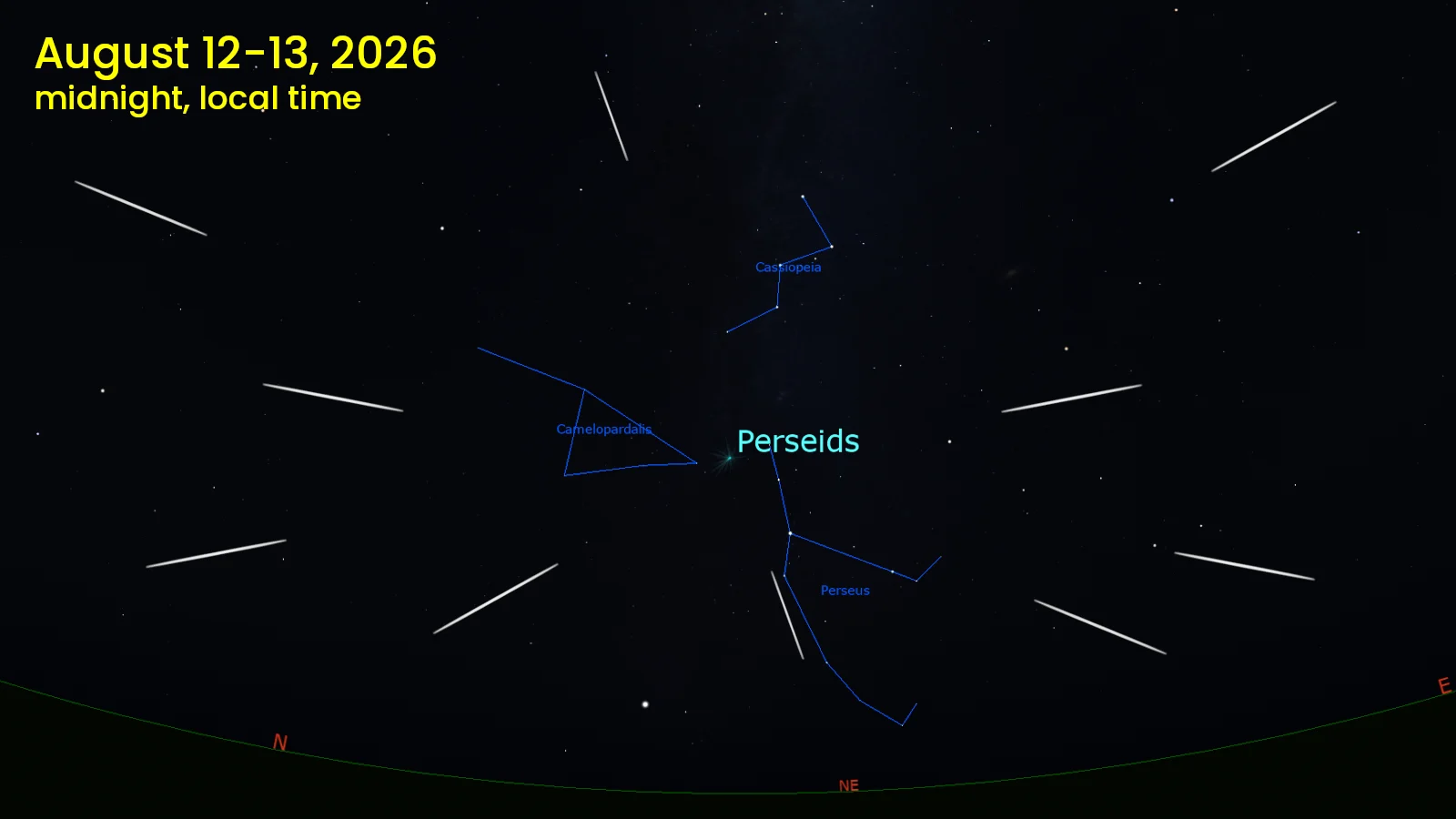
The Perseids radiant, between the constellations Perseus, Camelopardalis, and Cassiopeia, during the meteor shower's peak on the night of August 12-13, 2026. (Stellarium)
On that night, this astronomical event was perfectly timed, lining up with the lunar cycle during a New Moon.
While moonlight can sometimes spoil the show during a meteor shower peak, a New Moon gives us the perfect conditions to see the Perseids put on an amazing display in the night sky.
The last time we had such good timing for this meteor shower was back in 2007. So, this could be the best time in nearly 20 years to get out to view the Perseids!
READ MORE: Follow these tips to get the most out of meteor showers, auroras, and other night sky events
At their peak, the Perseid meteor shower can deliver between 75-100 meteors every hour. Although they originate from the northeastern sky, near the constellation Perseus, the meteors can appear at any point in the sky overhead.
Some will be dim flashes of light that disappear so quickly, you might doubt you actually saw it happen. Others will be brighter, leaving distinct momentary streaks of light against the backdrop of the stars.
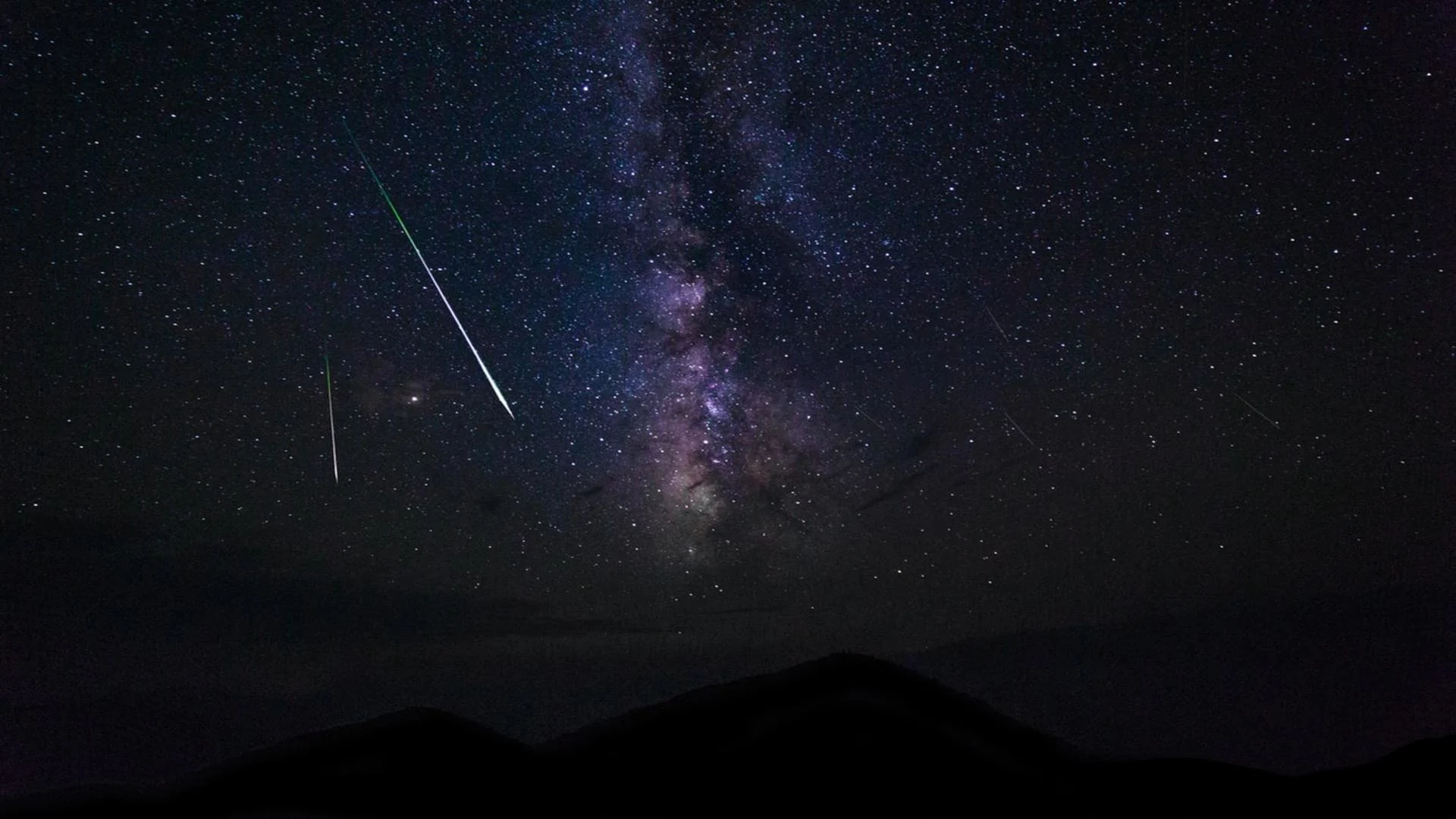
A composite photograph shows several Perseid meteors, including two fireballs, streaking across the night sky. (Austin Human, Unsplash)
Plus, if you're lucky, you may spot one of the famous Perseid fireballs blazing across the sky. These extremely bright meteors can leave long trails that are visible, even through concentrated urban light pollution, for hundreds of kilometres around.
A few of these can even grow bright enough to light up the night as if it were day, for just a brief moment!
What's going on here?
Every year, from July 17 through August 24, Earth crosses an icy stream of debris in space. This debris originates from a comet called 109P/Swift-Tuttle. The comet itself is currently far out in the solar system, between the orbits of Uranus and Neptune. However, the ice, dust, and rock that it ejects each time it passes around the Sun continues to follow it, along roughly the same orbital path.
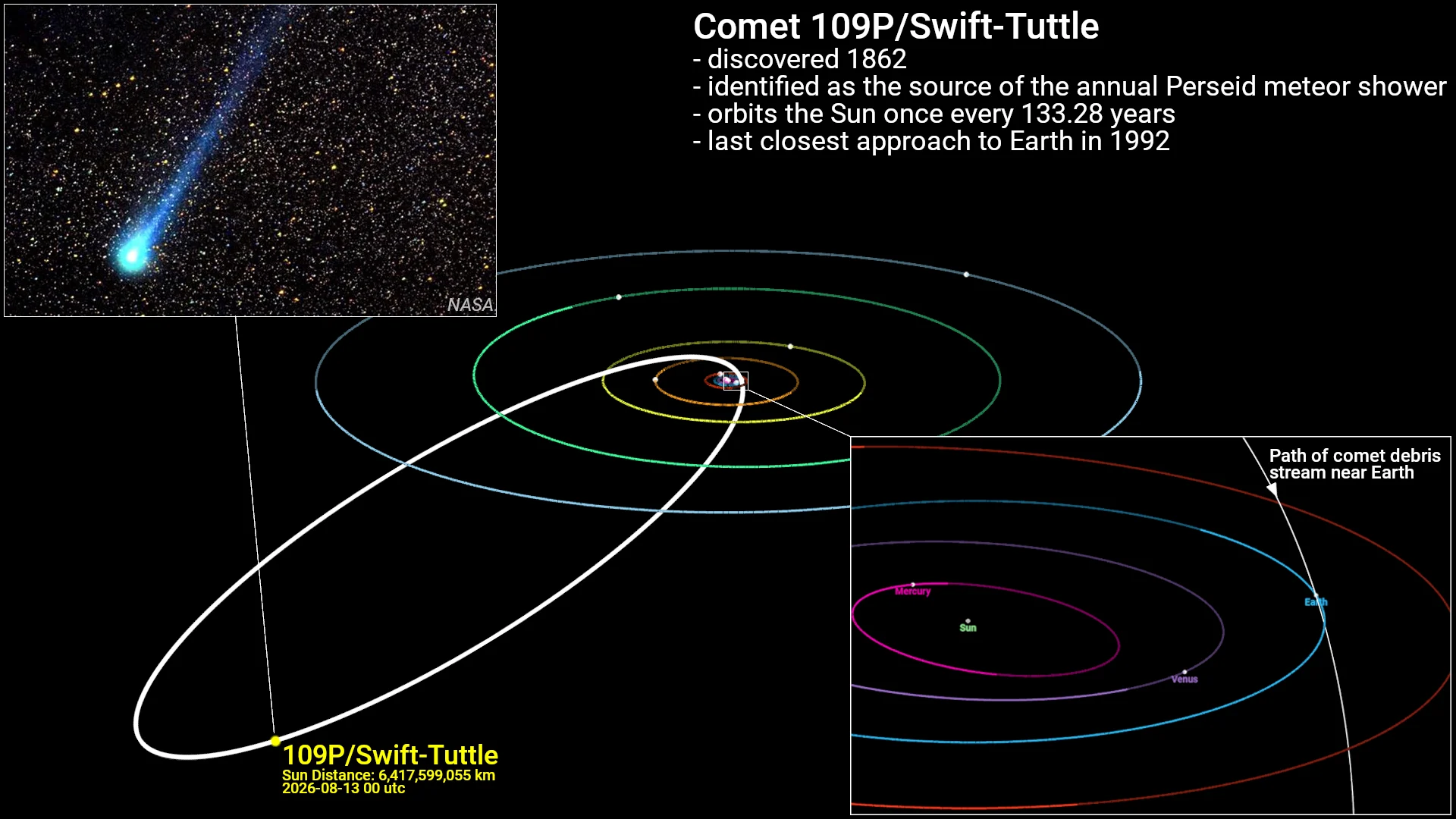
Comet Swift-Tuttle's orbit, an image of it from NASA (top left), and the path of its debris stream past Earth each August (bottom right). (NASA, NASA/JPL-Caltech, Scott Sutherland)
That debris stream intersects Earth's orbit across a roughly 100 million-kilometre-wide stretch of our path around the Sun — the same section of our orbit that we pass through from mid-July to late-August. The density of the meteoroids isn't consistent across the width of the stream, though. It is fairly diffuse at the edges, and much more concentrated near the core.
As we cross this stream, the planet's atmosphere sweeps up the bits of debris in our path. The tiny meteoroids hit the top of the atmosphere travelling at close to 60 kilometres per second, or over 210,000 km/h. At that speed, each meteoroid crushes the air in its path, squeezing the atoms and molecules in front of it together so tightly that the air glows, white hot.
This brief incandescence causes the meteor flash we see in the sky, while at the same time, the intense heat vapourizes the meteoroid. The varying brightness from meteor to meteor is the result of slight differences in the size and relative speed of the debris — smaller and slower = dimmer, while larger and faster = brighter.
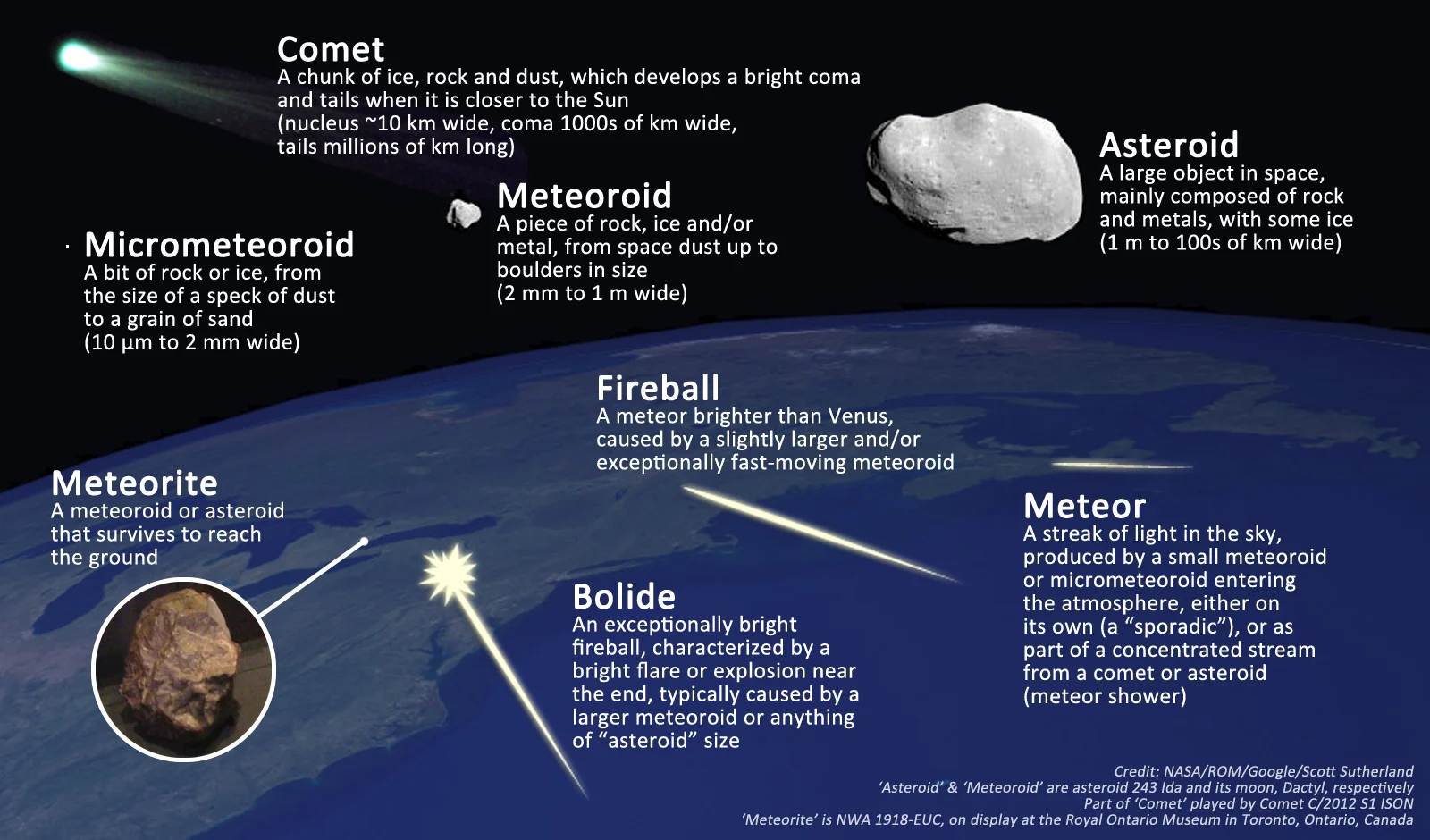
The peak of the meteor shower occurs when we reach that dense core of the debris stream. At that time, we see the maximum number of meteors from the shower. Afterwards, the meteor numbers ramp down again, until such time that we exit the stream altogether and the meteor shower ends until next year.
Although we identify one specific night (August 12-13, typically) as the peak of the Perseids, we often see a decent number of meteors during the entire week of the peak. There's the potential to see around 30-50 per hour on the night or two leading up to it, then a maximum of 75-100 per hour throughout the night of the peak, and 30-50 per hour again during the night or two after.
From then until the shower ends, the meteor rate slowly ramps down, but there's still a chance to see them on any night until the 24th.
Viewing tips
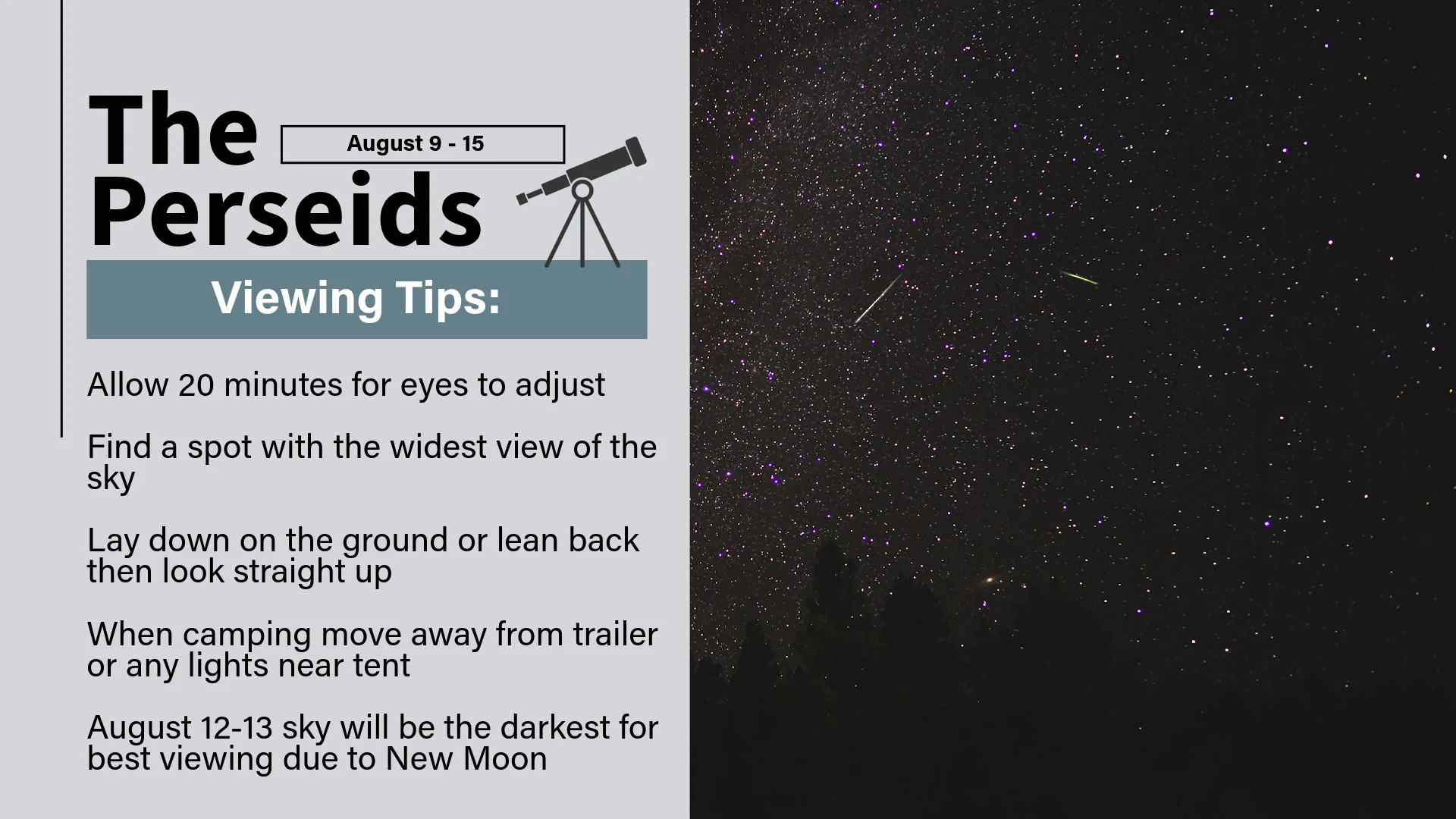
For the best results, check your weather forecast for reasonably clear skies on the nights before, during, and after the peak of the Perseids.
Since the constellation Perseus does not set at this time of year, the meteor shower's radiant remains above the horizon all day and night. Thus, given clear skies and minimal light pollution, Perseid meteors will begin to show up as soon as the sky becomes dark enough, and will remain visible until morning twilight steals them from the sky.
Ideally, find a place to watch that is far from urban lights, as that will give you the best chance at seeing the maximum number of meteors. Provincial parks are an excellent option, although be aware that the parking lot may be the only portion of the park you can access at night.
Also, check in with the centres of the Royal Astronomical Society of Canada (RASC) across the country, to see if they are planning any viewing parties in your area.
Unfortunately, besides cloudy skies, urban light pollution is the worst thing you can experience during a meteor shower. The light produced by the core of a village or town may not have that much of an effect, but light from larger urban centres can completely wash out the night sky, leaving only the brightest stars, planets, and meteors visible. Those viewing from deep inside a large city may not see any Perseids due to the light pollution inundating their sky.
However, at the very least, even for those in urban or suburban areas, find some place where bright lights from surrounding buildings, streets, or vehicles remain outside of your field of view. A local park can provide this, or a backyard sheltered by trees.
Regardless of where you watch from, once you are outside, give your eyes a minimum of about 20-30 minutes to adjust to the dark. If you wish to use your cellphone during this time, lower the screen brightness as much as you can, or see if it has a dedicated 'night mode', to limit your light exposure.
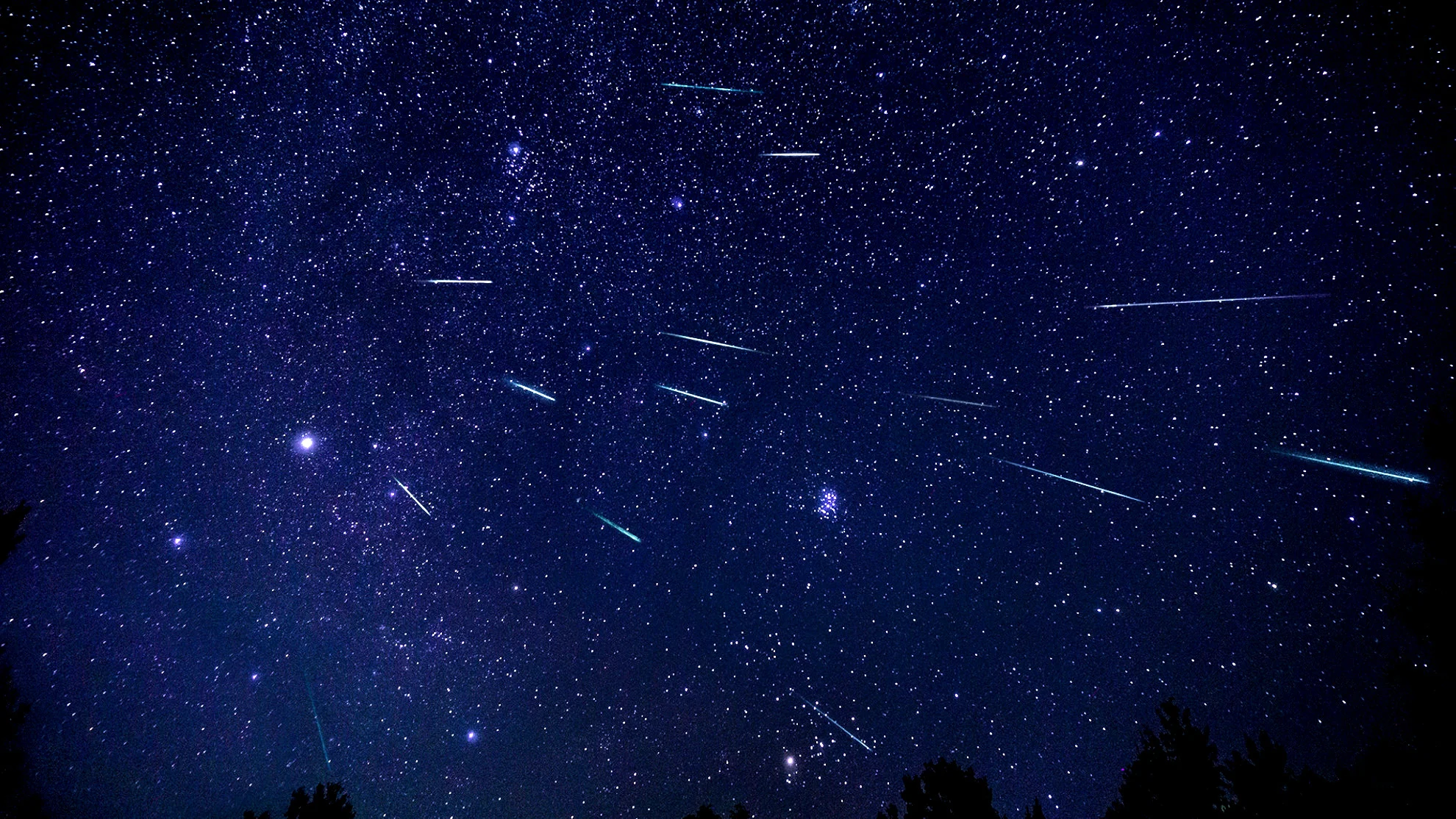
This composite image gathers together all of the Perseid meteors spotted during the shower's peak, from New Brunswick, in 2021. (Brad Perry/UGC)
You can also look up at the sky while your eyes adjust. The summer constellations will be shining in the sky, along with the core of the Milky Way, and you can find the planet Saturn after it rise in the east around 10:30 p.m., local time.
Eventually, once your eyes properly adjust to the dark, you should start to see the streaks of light in the sky above.
Watch the peak online!
Are your skies too cloudy? Is wildfire smoke blocking your view? Don't fret!
NASA provided a live stream of the Perseid meteor shower from Marshall Space Flight Center, near Huntsville, Alabama, during the peak on Wednesday night!
The stream featured views of the night sky from Marshall's Automated Lunar and Meteor Observatory (ALaMO), as well as commentary from meteor experts throughout the broadcast.
ALaMO has been observing meteors, fireballs, and lunar impact flashes for over 20 years now. The images the observatory captures provide NASA researchers with a glimpse of the meteoroid environment in space that Earth and the Moon pass through on a daily basis. ALaMO's sensitive cameras are also ideal for meteor showers, giving us a chance to watch them from anywhere.