
U.S. Army to detonate tons of toxic bomb-making materials

The planned explosion on Monday will send toxic lead dust drifting downwind from the military installation in Iowa
Officials with the U.S. Army have delayed plans to detonate thousands of kilograms of toxic explosives stored at a facility in eastern Iowa.
The blast, originally scheduled for Friday morning, is now scheduled for Monday morning.
This week’s delay arises after significant outcry from citizens, groups, and local governments over the short- and long-term health impacts of lead-filled dust falling on communities downwind from the explosion.
An expected wind shift will keep any impacts safely away from Canadian skies.
DON’T MISS: AQI, AQHI, and your health: Air quality ratings explained
This past March, crews discovered dozens of barrels of degraded lead azide at the Iowa Army Ammunition Plant (IAAAP) near the city of Burlington.
Lead azide is an explosive chemical used as a detonator. The chemical is extremely sensitive to both shock and static electricity; it can reportedly explode after a fall from a height of less than 20 cm.
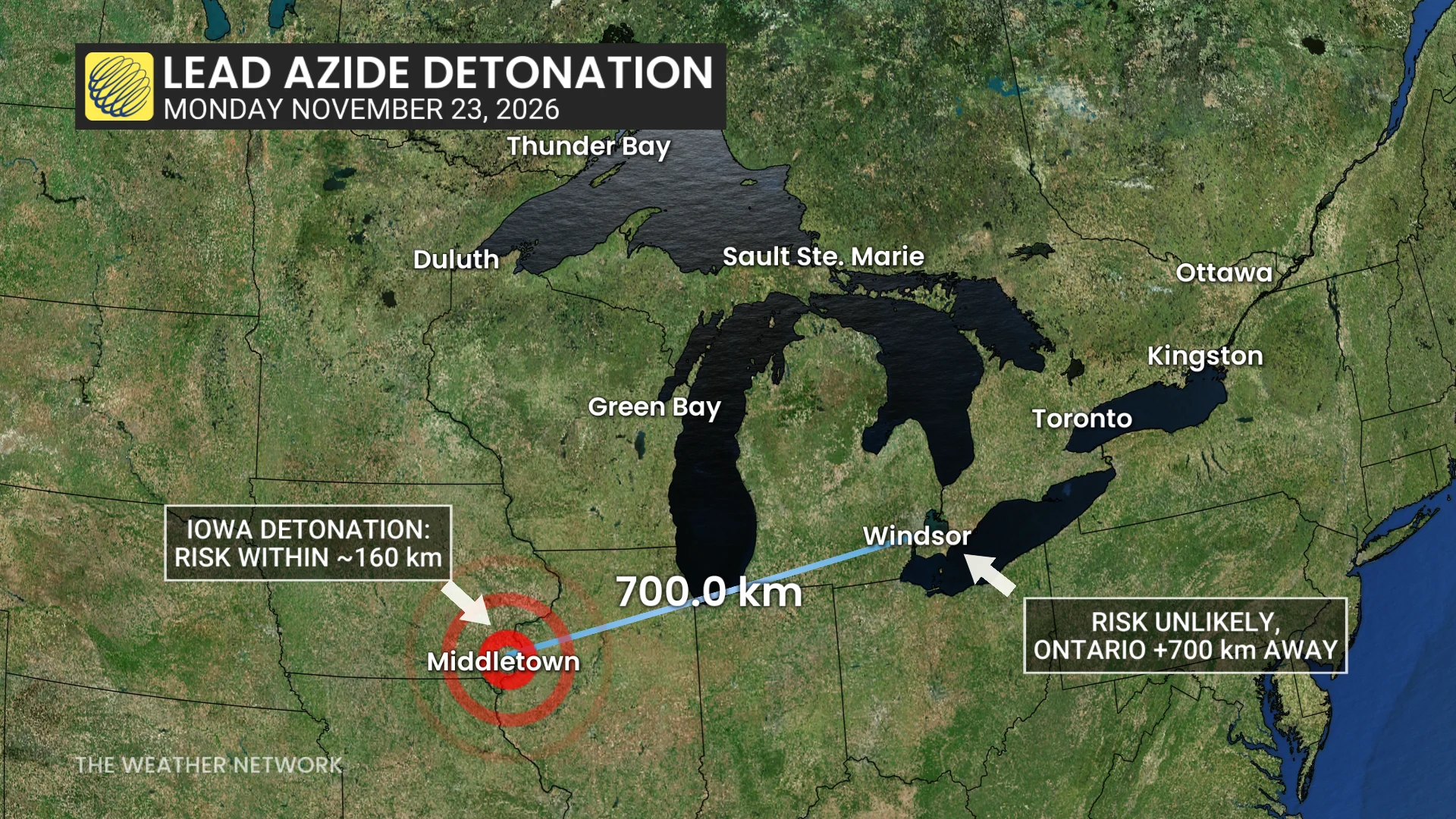
Given the chemical’s instability, the U.S. Army determined that the 68 barrels of lead azide discovered at the IAAAP cannot be relocated to a more remote site, and that they pose an uncontrolled explosion risk if they’re left untouched.
This detonation will release lead dust into the atmosphere which will blow downwind from the installation. Lead is a toxin to which any exposure is dangerous, especially for children.
Officials initially expected the toxic dust to blow north of the IAAAP over several small communities in southeastern Iowa.
However, a northwesterly wind shift expected with a cold front on Sunday may cause Monday’s anticipated fallout to blow toward more populated areas instead. This wind shift would keep any potential air quality issues away from Ontario.
“Before and during the detonation, the soil above the earth-covered magazines will be thoroughly saturated with water, and water misters will be spraying,” the Army said in a press release.
The statement added: “These measures should reduce the amount of lead that migrates from the detonation through the air off the installation.”
Residents in the affected areas have been advised to stay indoors and keep windows and doors closed during and following the blast.
The U.S. Environmental Protection Agency (EPA) said in an environmental assessment that “permanently eliminating a catastrophic threat” outweighs the potential short-term impacts of the blast and its fallout.
Header image created using imagery from Copernicus/ESA and the U.S. Army.