
Canadian astronaut Joshua Kutryk to conduct his first spacewalk Thursday

One of Canada's newest astronauts in about to venture out into the emptiness of space!
Less than a month into his first stay on board the International Space Station, Canadian astronaut Joshua Kutryk is about to venture out into the emptiness of space to install a new solar panel on the orbital lab's exterior.
Starting just after 8 a.m. EDT on Thursday, October 29, NASA astronaut Anil Menon and Joshua Kutryk from the Canadian Space Agency (CSA) are scheduled to leave the station on U.S. Spacewalk 100. Both astronauts are currently on their first missions to space. This will be Menon's fourth spacewalk, and the very first for Kutryk.

The Quest airlock is pictured here, during the first all-women spacewalk, on Jan 15, 2020, as Jessica Meir and Christina Kock exit the station. (NASA)
Exiting via the Quest airlock, Menon and Kutryk will spend six hours and 45 minutes on the station's exterior, with the primary goal to install a new International Space Station Roll-Out Solar Array (IROSA). According to NASA, the pair will be supported on this spacewalk by Jessica Watkins and Luke Delaney, who will help them in donning and removing their spacesuits, and provide assistance using the Canadarm2.
"Menon and Kutryk will first release the roll-out solar array from an external pallet," NASA said in the latest ISS blog post. "Menon then will attach himself to the robotic arm, retrieve the roll-out solar array, then ride the Canadarm2 to the installation worksite. Kutryk will remain tethered to the truss structure, translate to the port truss worksite, and join Menon to complete the installation job. Afterward, mission controllers will activate the new roll-out solar array."
Watch: U.S. Spacewalk 100 livestream begins at 6:30 a.m. EDT, October 29, 2026
READ MORE: Joshua Kutryk's launch to the ISS highlights Canada's role in space exploration
Adding power to the station
In addition to the station's primary solar arrays, there are currently six IROSA providing power, located in the 1A, 1B, 2B, 3A, 4A, and 4B positions.
The first two of these, 2B and 4B, were installed in June of 2021. The next two, 3A and 4A, were attached in December 2022. The remaining two, 1A and 1B, were added in June 2023.
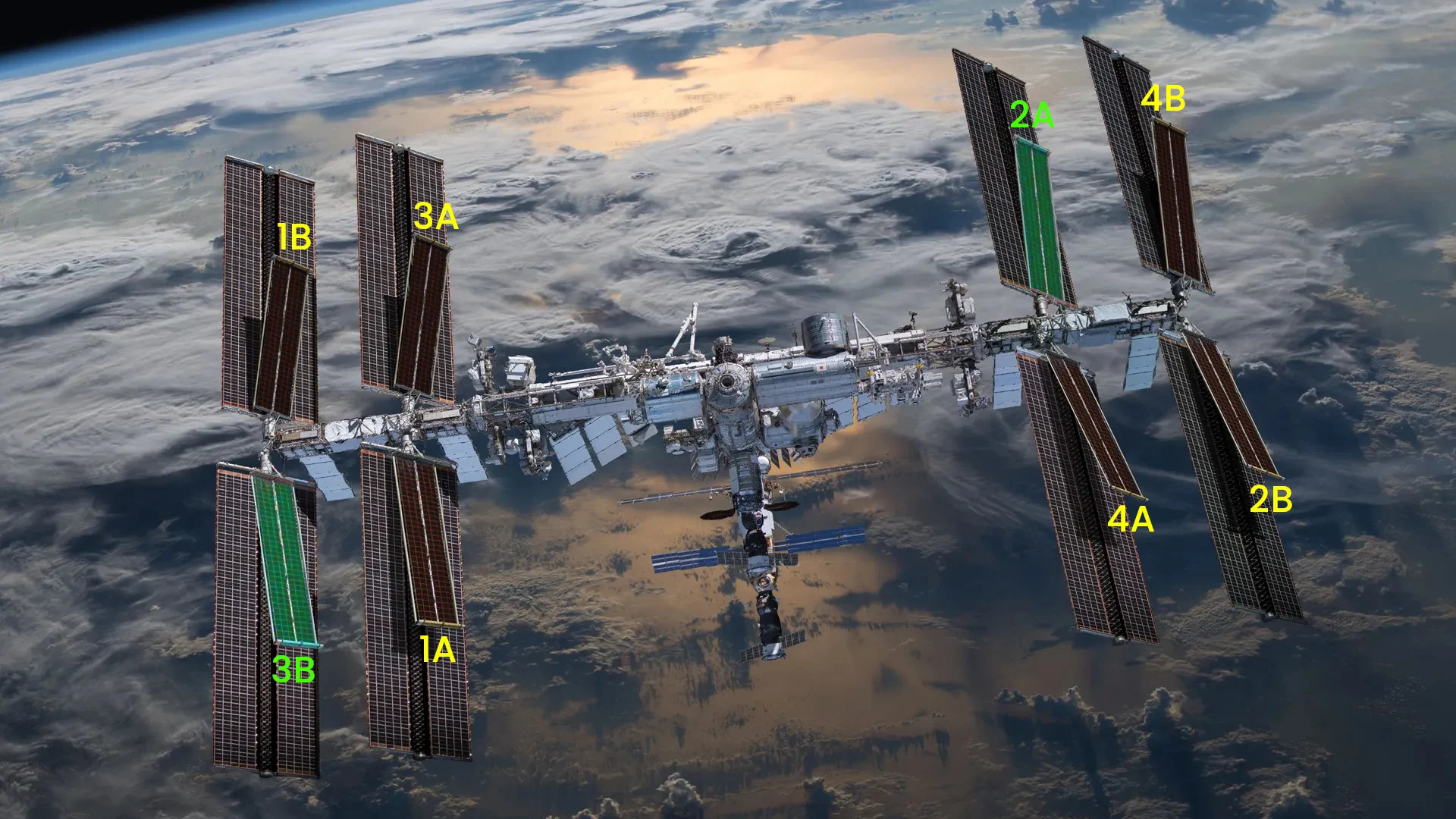
The current and future IROSA positions on the International Space Station (future shaded green). (NASA/Scott Sutherland)
During this spacewalk, Menon and Kutryk will be installing and deploying a new IROSA in the 2A position. In their next spacewalk, scheduled for November 5, these two will be adding the eighth and final IROSA, in the 3B location. These two IROSA arrived at the station with SpaceX's CRS-35 cargo resupply mission, which launched on October 13.
Roll-Out Solar Arrays, or ROSAs, are one of the newest options for spaceflight power these days.
Most past missions used rigid arrays, which are stored folded during launch, and then unfolded and extended via motors once the spacecraft has reached orbit.
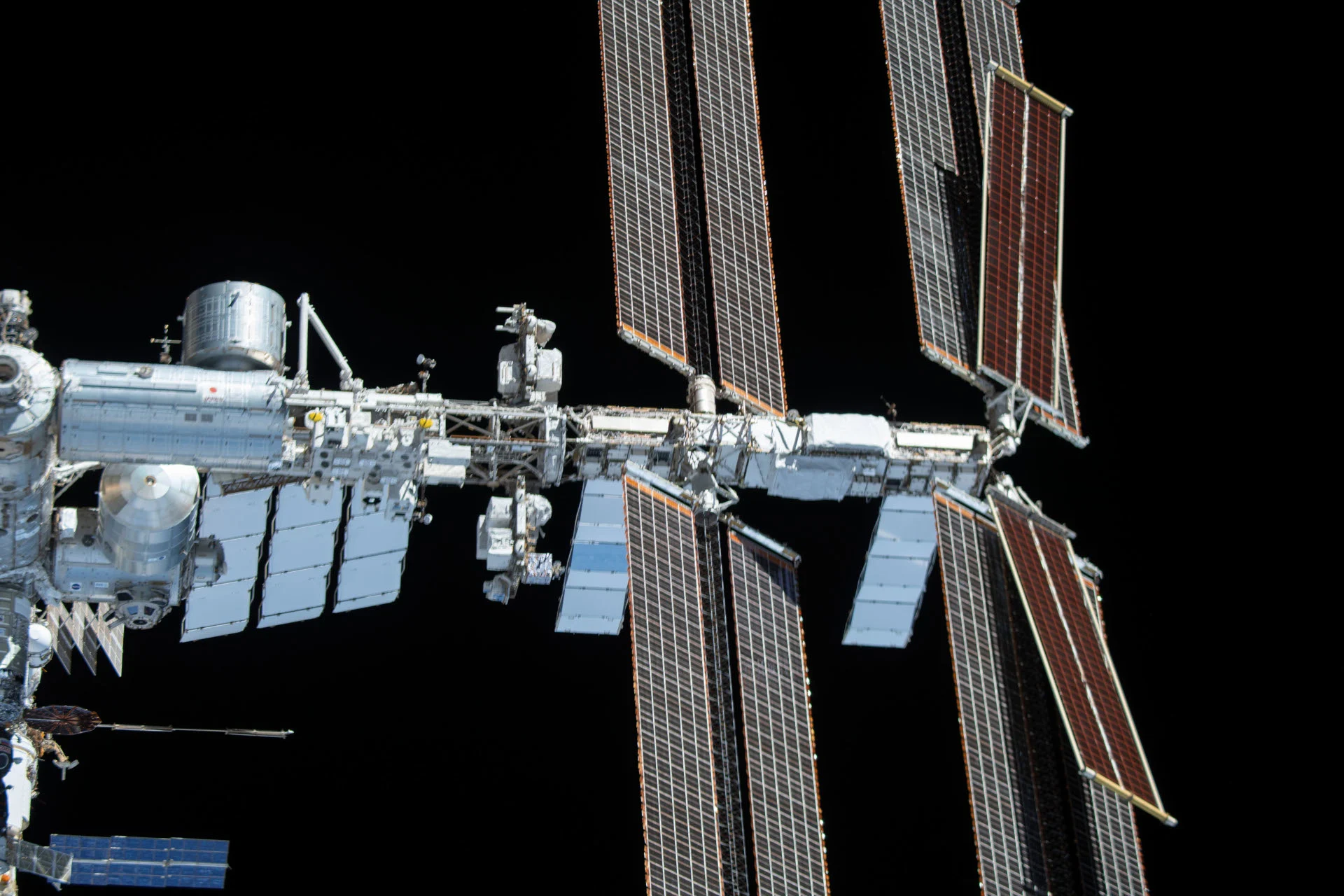
The first two IROSA, as imaged on Nov 8, 2021, from the SpaceX Crew Dragon Endeavour during a flyaround of the orbiting lab that took place following its undocking from the Harmony module’s space-facing port. (NASA)
In contrast, an IROSA is flexible, and thus launches rolled up on a spool, taking up only a quarter of the space of a rigid array. Also, once deployed, it unspools on its own, with no motor or gearbox, simply due to the potential energy stored in the array as it was initially rolled up. Due to this, it is also significantly lighter than a rigid array, making it a superior choice for missions where added weight is a concern.
In addition to their use on the ISS, NASA's Dart mission — the Double Asteroid Redirection Test — deployed ROSAs for power.

This infographic shows the DART spacecraft, with its two ROSA solar panels deployed, as it approaches impact with Dimorphos, the small companion asteroid to Didymos. (NASA/JHAPL)
This was the first deep space mission to use this new technology, which provided the power required for DART's solar electric propulsion system, while not overly taxing its ion engines with additional mass.
(Thumbnail image: Canadian astronaut Dave Williams works outside the International Space Station during shuttle mission STS-118, in August 2007.)