Aurora Alert! Bright Northern Lights possible over Canada Thursday night!

These auroras could be especially bright and far-reaching in the hours between midnight and sunrise, Friday morning!
Check your weather forecast for clear skies Thursday night into Friday morning, as there's another chance to spot the Northern Lights shining over Canada.
Early on Tuesday, October 6, 2026, two immense solar storms erupted from the Sun. This followed a moderate-strength solar flare, ranked as M1.4-class, that exploded above Active Region 4549 — a group of sunspots clustered near the centre of the Sun's Earth-facing side.
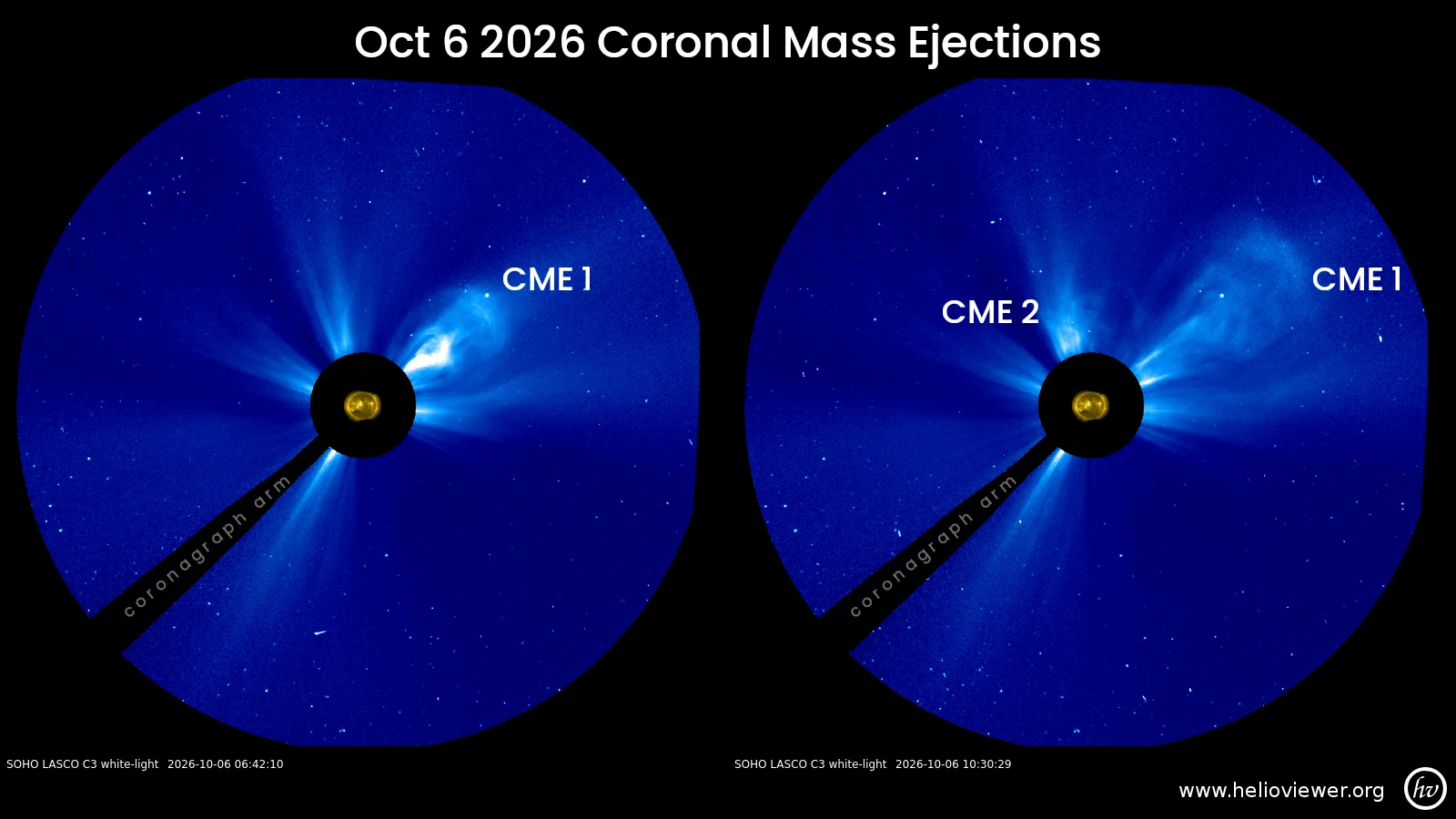
Two coronagraph views from early on October 6 shows two coronal mass ejections erupting from the Sun, roughly four hours apart. (NASA/ESA SOHO, Helioviewer)
Based on satellite observations and modelling of these two clouds by NASA and NOAA, the initial CME appears to be headed in a mostly northerly direction, and thus the bulk of it is projected to pass to the north of our planet as it sweeps by. Meanwhile, the second is what NOAA forecasters call a 'partial halo CME'.
Basically, as it expands away from the Sun in coronagraph imagery, it appears as a 'ring' shape (or in this case, a partial ring) around the instrument field of view. This occurs when a CME is expanding more or less directly towards us, with the visible ring or partial ring representing denser material at the CME's leading edge.
The forecast from NOAA's Space Weather Prediction Center has this halo CME sweeping past Earth overnight on Thursday. There's also a chance that it could be accompanied by a glancing blow from the edge of the initial CME.
READ MORE: How to get the most out of auroras, meteor showers, and other night sky events
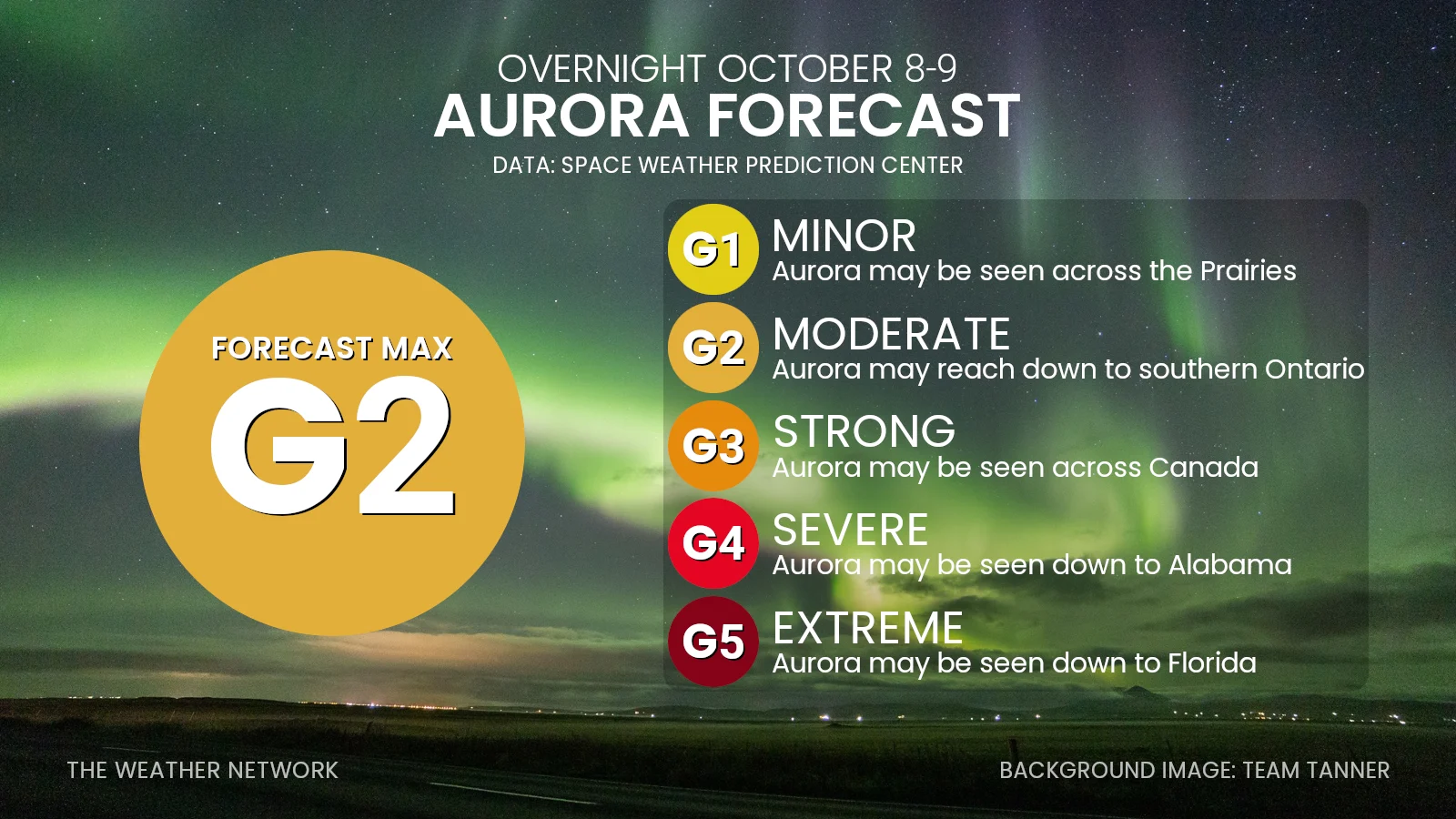
As a result, SWPC has issued a geomagnetic storm watch, with G1 (minor) storm levels expected to begin around 11 p.m. EDT, Thursday night, and G2 (moderate) levels starting around 5 a.m. EDT, Friday morning.
That timing favours the eastern half of Canada for the initial storm. However, any auroras that appear as a result will likely only reach as far south as central Quebec and the northern edge of the Great Lakes.
Given that there was heightened aurora activity earlier this week, simply due to the passage of a fast stream of the solar wind, it is possible we could also experience substorm activity. Substorms are unpredictable bursts of brighter, more extensive auroras that last only a short time. During a substorm, the Northern Lights can suddenly flare into view overhead, remain that way from just seconds to minutes, but possibly up to over an hour, and then vanish again as they retreat back to the north.
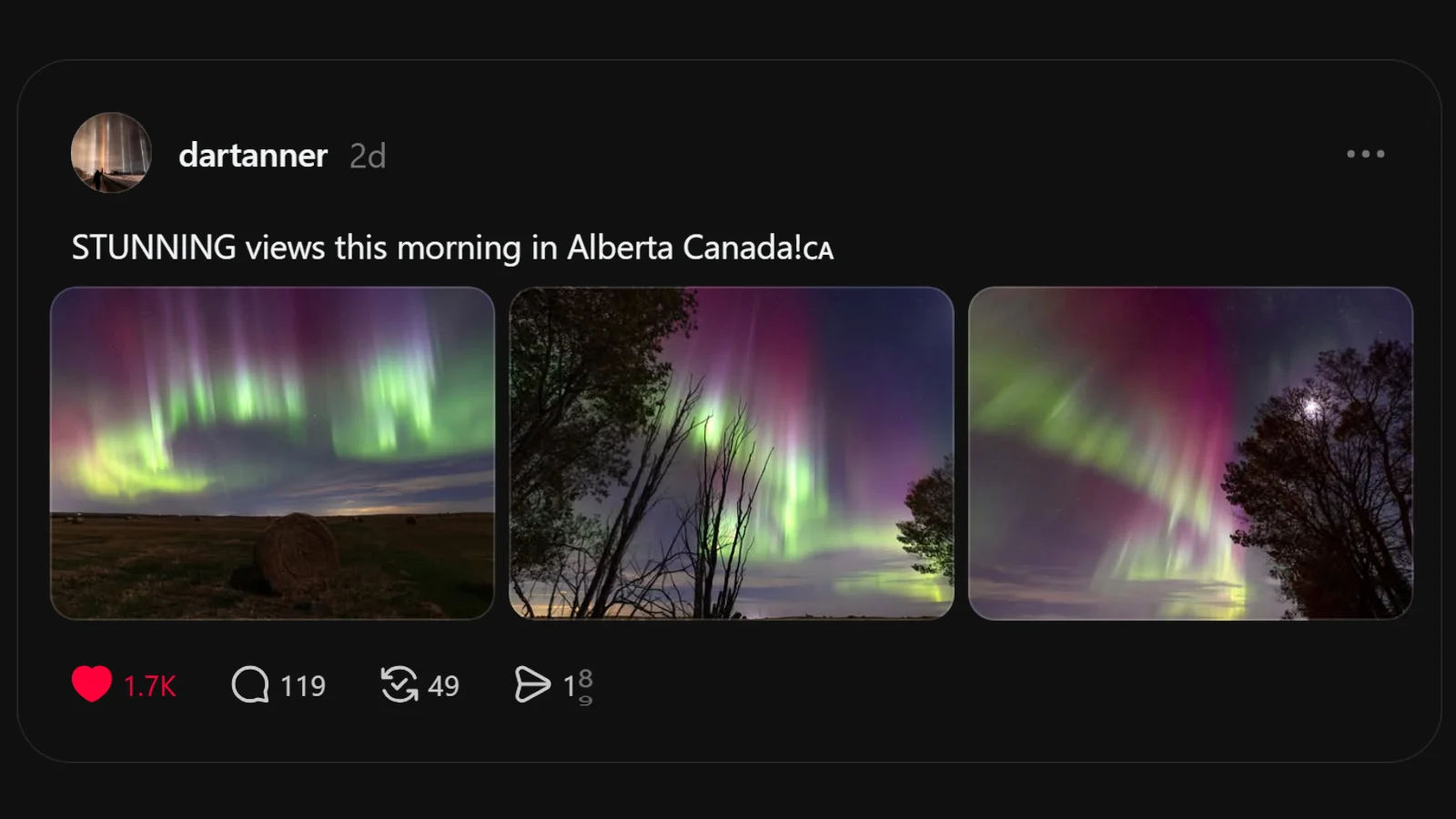
Dar Tanner, an aurora and storm chaser in central Alberta, posted photographs to Threads of the Northern Lights from the morning of Monday, October 5, 2026. (Dar Tanner/TeamTanner)
The G2 storm is timed better for observers in the western half of Canada.
Even during G1 storm levels, auroras can easily reach down into the central Prairies. At G2, the aurora 'oval' typically stretches down to south of the Canada-US border.
READ MORE: Geomagnetic storms: When should we look up and when should we worry?
Will we see it?
Although aurora colours sometimes shine bright enough to tint a thin layer of clouds, clear skies are essential for seeing the Northern Lights.
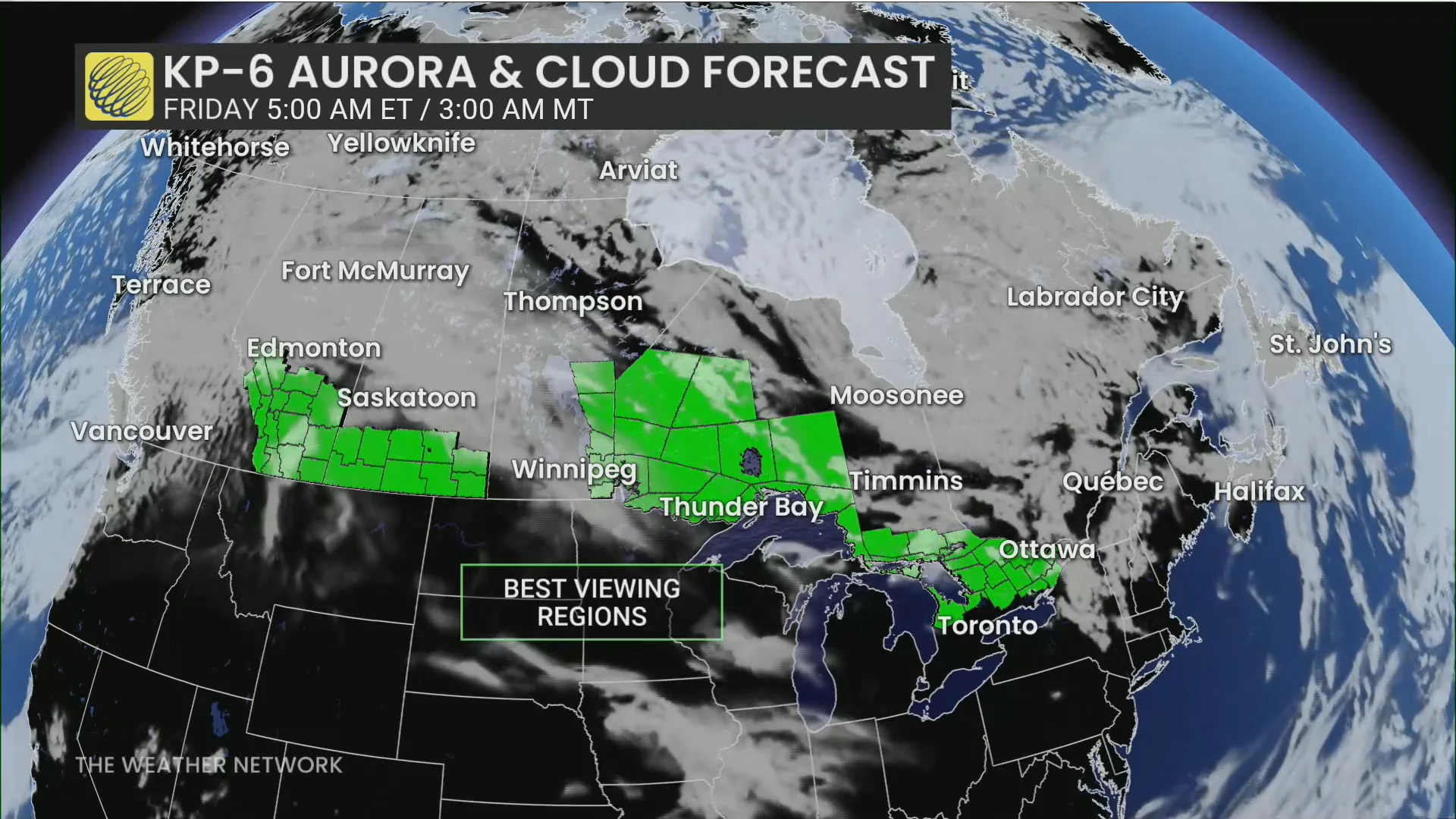
Based on the weather forecast, on Thursday night and Friday morning, the best places to spot the auroras are through southern Ontario, along the north shores of Georgian Bay, Lake Huron, and Lake Superior, through Northwestern Ontario and eastern Manitoba.
RELATED: Our Sun is capable of producing devastating superflares; should we worry?
In the west, southern Saskatchewan and southern/central Alberta appear to have the clearest skies during this space weather event.
One factor that is very favourable, based on the timing of these auroras, is the phase of the Moon!
The brighter the Moon is in the sky, the more it impacts our eyes' ability to adapt to the dark. Thus, if the Northern Lights occur during a Full Moon, the bright moonlight can make it more difficult to spot the aurora colours.
However, this particular event is timed just before the New Moon on October 10. Thus, there will only be a thin Waning Crescent Moon that rises just before sunrise on Friday morning.
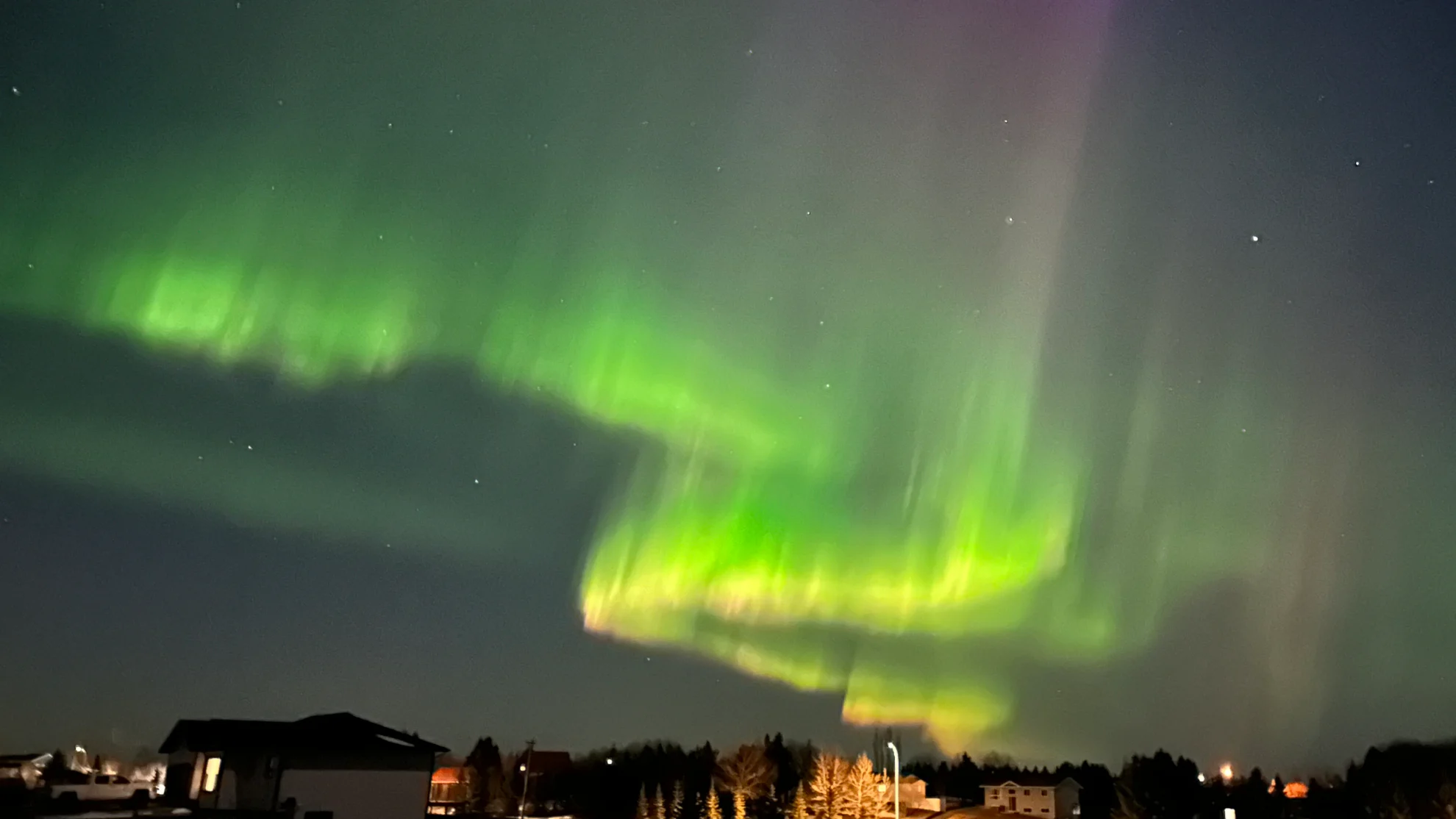
(Thumbnail image shows Northern Lights spotted over Central Alberta on April 4 2025, captured by Chris and Wina Reid, who uploaded the image to The Weather Network's UGC gallery)